You’re past “what is an agent.” You’ve shipped a few, watched them work, and now you’re staring at a real architectural decision: which code-first framework do you build the next system on. The frustrating part isn’t the choice itself — it’s that every comparison you’ve read so far treats you like a beginner. They pitch “easy,” they pitch “fast to get started,” they pitch drag-and-drop. None of them answer the question you actually have: will this give me depth and control, or is it another toy with a ceiling I’ll hit in month three?
Here’s the false choice you’re being sold. On one side, no-code tools that protect you from complexity by capping you beneath your own skill. On the other, the advice to “just build it yourself in raw code” — which ignores that you don’t want to re-implement orchestration, state, and tool-calling plumbing by hand. You want the substrate, so you can spend your time designing cognition, not rebuilding pipes.
Both AutoGen and CrewAI are code-first frameworks, so the real question isn’t “which is easier.” It’s which control model matches the architecture you’re actually designing? That’s the question the rest of this article answers on engineering terms.
TL;DR: AutoGen is a conversation-driven framework where agents coordinate through group chats and flexible message graphs; CrewAI is a role-and-process framework where agents run in a crew with an explicit sequential or hierarchical flow. Choose AutoGen when you want conversational, dynamic coordination and deep primitives; choose CrewAI when you want structured, predictable delegation with clearer data flow.
AutoGen vs CrewAI: What’s the actual difference in orchestration model?
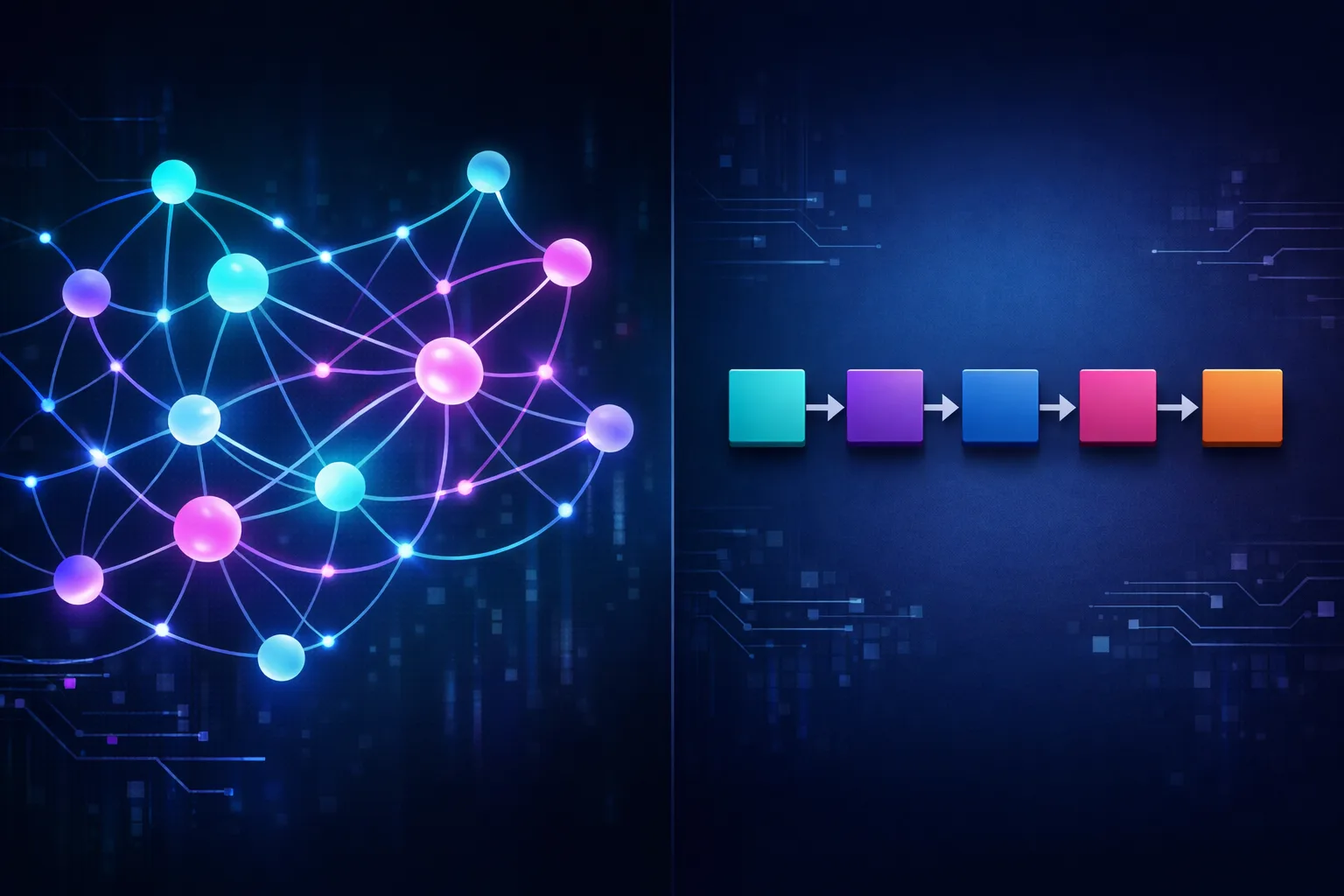
AutoGen orchestrates through conversation — agents send and receive messages in group chats, two-agent chats, and nested chats, coordinated by a group chat manager. CrewAI orchestrates through explicit process — agents are assembled into a “crew” with defined roles, goals, and a sequential or hierarchical workflow.
The architectural fork is the single decision that determines everything downstream. If you’ve been comparing this to the broader landscape — LangChain vs CrewAI vs n8n is the primer on where these tools sit relative to each other — you’ll recognize that AutoGen and CrewAI represent two genuinely different philosophies, not two skins on the same engine.
AutoGen’s model treats agents as participants in a living conversation. You define agents with system messages and tools, then let a group chat manager decide who speaks next. This is flexible — you can build nested chats, have agents hand off to sub-conversations, and create conversation patterns that no fixed workflow graph anticipated. The cost is determinism: an AutoGen conversation can wander, and token consumption scales with how chatty your agents get. In practice, uncapped AutoGen conversations can consume five to ten times the tokens you budgeted for.
CrewAI’s model treats agents as roles on an assembly line. Each agent has a role, a goal, and a backstory. You string them together in a sequential process (one pass, A → B → C) or a hierarchical process (a manager agent delegates tasks to specialists and validates their output). This is predictable — you know the shape of the flow before it runs — and it pools resources at the crew level, with a manager throttling delegation. The cost is rigidity: if your workflow needs a genuinely dynamic, back-and-forth conversation, you’ll fight the structure.
| Dimension | AutoGen | CrewAI |
|---|---|---|
| Orchestration model | Conversation / group chat | Role-and-process (sequential or hierarchical) |
| Coordination | Group chat manager, speaker selection | Explicit task delegation, manager agent |
| Determinism | Low (dynamic, can wander) | High (flow defined up front) |
| Token profile | Can overshoot (5–10× in uncapped chats) | Predictable (hierarchical ~30% more than sequential) |
| Built on | Rewritten event-driven core (0.4+) | LangChain |
How does each framework handle control and orchestration?
AutoGen gives you direct primitives — a group chat manager, speaker-selection policies, and conversation graphs you assemble yourself. CrewAI gives you a structured process you declare — sequential or hierarchical — where the framework owns delegation. One hands you control; the other imposes a shape.
“Control” is exactly where frameworks hide their ceilings, so it’s worth being precise about what each actually exposes. In AutoGen, you register tools for any agent to invoke, and you customise who speaks next by writing your own speaker-selection logic or accepting the manager’s default. That’s real power — but it’s power you assemble. The event-driven rewrite in AutoGen 0.4 split the low-level Core API (message passing, actors) from the higher-level AgentChat API, which means you can drop down to the substrate when you need to.
CrewAI takes the opposite stance. Tools are assigned to specific agents, which is more restrictive but produces a clearer data flow — you always know which role can touch which tool. The process itself is declared, not negotiated: a sequential crew runs in order, a hierarchical crew routes everything through a manager. This is less flexible, but it’s also less likely to surprise you in production.
If you’re weighing this against graph-based orchestration alternatives, the OpenAI Agents SDK vs LangGraph comparison covers the graph-vs-process fork in fuller depth. The short version for your purposes: AutoGen sits closer to the “emergent conversation” end of the spectrum, CrewAI closer to the “declared workflow” end.
Can I extend it, reach the primitives, and avoid lock-in?
Both are MIT-licensed and model-agnostic, and both expose custom tools, custom agent classes, and the underlying Python primitives. AutoGen’s lower-level Core API is more directly reachable; CrewAI’s extension surface is cleaner but sits atop LangChain, which you inherit as a dependency. Real lock-in is low in both — the bigger risk is architectural, not licensing.
This is the heart of your objection, so let’s answer it straight: why not just build it yourself in code? The honest answer is that a framework doesn’t replace your engineering — it hands you the substrate. Tool calling, message routing, state, retries, and observability are solved problems you don’t want to re-solve for every system. What a framework like AutoGen or CrewAI gives you is that plumbing already built, so your attention goes to agent design, prompt engineering, and the actual workflow logic — the part that’s genuinely yours.
The “exit” question matters too. Both are open source, so the code you write against them isn’t trapped. Where they differ: CrewAI wraps LangChain, so your stack inherits that layer (for better — ecosystem — and worse — another dependency to version). AutoGen’s 0.4 rewrite is cleaner under the hood but younger, and the older 0.2 API now lives on in the community fork AG2, which means there’s a real fork in the road if you’re reading older tutorials.
This is the natural place to contrast code-first against visual approaches. If you’re wondering whether you even want to write code at all, the Dify vs n8n comparison and the no-code vs code decision framework both make the trade-off explicit. But for you, the relevant point is this: neither AutoGen nor CrewAI caps you at a visual ceiling, and both let you reach the primitives when the abstraction gets in your way.
Which one is a better fit for production multi-agent systems?
CrewAI is the safer production bet for structured, predictable workflows — deterministic flows, clearer data flow, and a mature ecosystem. AutoGen wins when your problem is genuinely conversational or you need fine-grained control over coordination primitives. The right answer is a control-model match, not a popularity contest.
Let’s pressure-test both against production realities. On determinism and cost, CrewAI’s declared process means you can predict token spend before you deploy — hierarchical crews run about 30% more tokens than sequential, which is a number you can budget. AutoGen’s open-ended chat model is the opposite: powerful for exploration, but a compliance headache if you need auditability or a tight token ceiling.
On human-in-the-loop and autonomy, both support it, but the shape differs. AutoGen bakes human feedback into the conversation itself, which suits interactive and exploratory systems. CrewAI’s structured delegation makes it easier to pin a human approval step at a specific point in the flow. The autonomous vs assisted agents piece is the deeper dive on where that line should sit — and the AI agents vs RPA comparison frames where multi-agent systems end and deterministic automation begins.
On governance, there’s a third seat worth naming honestly — and full disclosure: we build one. EmployAIQ is a managed platform that ships the substrate you’d otherwise assemble yourself — memory, approvals, permissions, governance, and monitoring — so you design cognition instead of plumbing. It’s the wrong choice if what you want today is to own the skill of building agents in code and reach the primitives yourself. But if the outcome is a governed, production AI-workforce system and the framework plumbing is the part you’d rather not maintain, it’s a legitimate third option that a pure AutoGen-vs-CrewAI comparison can’t score. That distinction — assemble it yourself versus hire it done — is the honest fork, and it doesn’t change which framework you’d pick if you do build.
Frequently asked questions
Is CrewAI built on LangChain?
Yes. CrewAI is built on top of LangChain, which means you inherit LangChain’s ecosystem and its versioning as a dependency. AutoGen is not — it has its own event-driven core.
Do I need to know Python to use AutoGen or CrewAI?
Yes, in practice. Both are Python-first code frameworks. CrewAI has added some visual tooling, but serious use of either means writing Python. Neither is a no-code tool.
Which framework handles human-in-the-loop better?
AutoGen treats human input as part of the conversation, which suits exploratory, interactive systems. CrewAI makes it easier to pin a human approval step at a precise point in a declared flow. It depends on your architecture.
Is AutoGen still actively maintained by Microsoft?
AutoGen’s 0.2 lineage continues as the community fork AG2, while Microsoft’s newer AutoGen has converged into the Microsoft Agent Framework. Check current maintenance status before committing, since APIs diverged.
Closing / Decision
The decision isn’t AutoGen versus CrewAI in the abstract. It’s which control model matches the system you’re architecting. If you’re building a dynamic, conversational, exploratory system and you want to reach the coordination primitives directly, AutoGen is your tool. If you’re building a structured, predictable, production workflow where delegation should be declared and token spend budgeted, CrewAI is the safer bet. Both are code-first and both hand you the substrate — neither is a toy with a ceiling.
That’s the whole point, and it’s the answer to your original objection. You don’t have to choose between a no-code toy and rebuilding plumbing by hand. The right framework hands you the plumbing so you design production-grade AI employees from scratch — the depth you’d hand-roll, without rebuilding the substrate.
Build agents from scratch — join the waitlist
About the Author
Anthony Odole is a former IBM Senior Managing Consultant, where he served as Enterprise Architect on Fortune 500 engagements, and the founder of AIToken Labs. He helps business owners cut through AI hype by focusing on practical systems that solve real operational problems.
His flagship platform, EmployAIQ, is an AI Workforce platform that enables businesses to design, train, and deploy AI Employees — AI agents that function as digital workforce members — that perform real work without adding headcount.