|
Main Street Is Now Hiring AI Agents, Not People
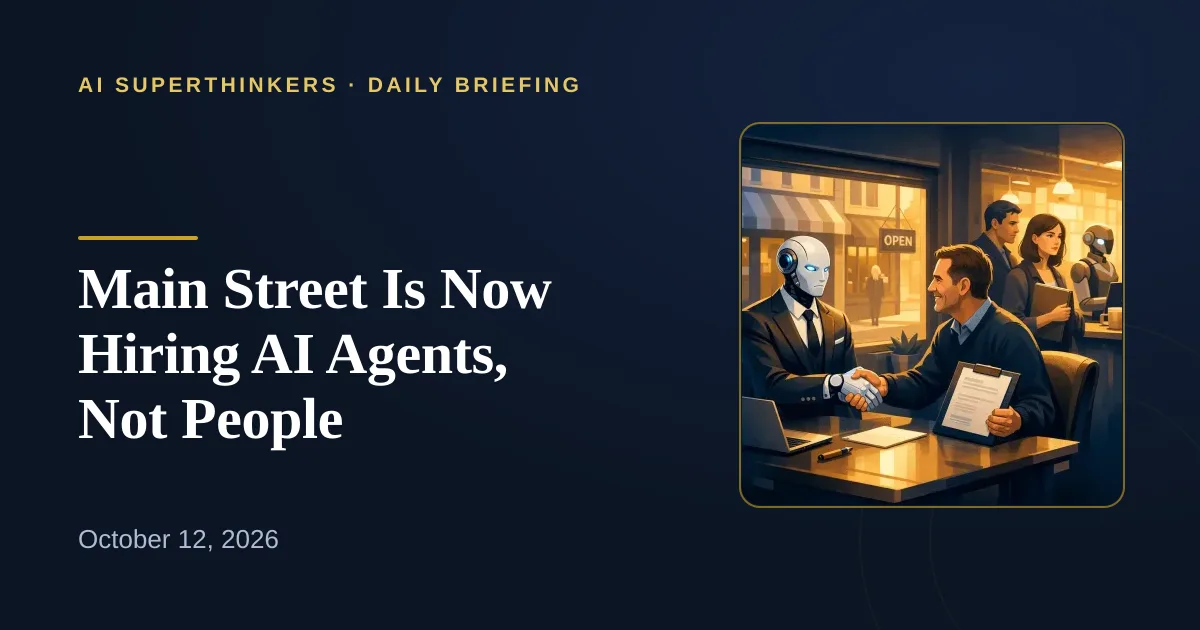
A new OECD report finds small and mid-sized businesses are redesigning their operations around agents rather than headcount — and the top three use cases are already in production, not pilots. Customer service, compliance monitoring, and supply-chain management lead the pack, with real-time regulatory flagging called out as the single most compelling early win. One profiled U.K. biotech is even running custom AI on drug discovery, which was until recently a large-enterprise-only capability.
The “so what” is blunt: the $236 billion the agents market is projected to reach by 2034 isn’t being spent by giants. The OECD names small businesses as the primary beneficiaries of the agent economy, and the World Economic Forum pegs agentic AI at $3 trillion in productivity gains over a decade. For a 5–25 person shop, that’s the difference between hiring your fourth employee and standing up a fourth AI Employee for a fraction of the cost.
The catch is governance, and the report is refreshingly specific about it. Harvard Business Review’s guidance is to treat agents like digital employees — each with a defined identity, limited authority, trusted data sources, and an audit trail — not like software you install and forget. The concrete example: a customer-service agent should never issue a refund above a threshold without a human in the loop. Klarna already runs a large share of its support this way, with escalation paths for complex cases.
What to watch: the WEF is calling for a “know-your-agent” framework built on existing know-your-customer standards. That’s a signal that agent-to-agent commerce — machines transacting with machines — is the next regulatory frontier, and it will land on small businesses first because they’re adopting fastest.
Source: PYMNTS
|