You started building an AI agent four times. You watched the tutorials, connected a few nodes, and then — somewhere between the webhook and the third error message — you stopped. The villain isn’t you. It’s tutorial hell: forty fragmented tools, none of them talking to each other, and no single path from “idea” to “published.”
So let me show you what the finish line looks like. This is a build-in-public case study of a real pipeline: three AI Employees that researched, wrote, and published sixteen SEO articles in ten days. No custom engineering. No dev team. Human eyes on every piece before it went live. And a workflow that ran the same way on day ten as it did on day one — because repeatability, not a one-off stunt, was the whole point.
TL;DR: Three AI Employees — one researcher, one writer, one editor-publisher — produced 16 SEO articles in 10 days using no-code visual tooling. A human reviewed every article before publication. The pipeline is repeatable, not a one-off demo, and it’s something a solo operator can actually finish.
Can I really do this — is it actually no-code?
Yes. The entire pipeline was assembled with visual, no-code tooling — the same drag-and-drop workflow logic you’d use in n8n, Zapier, or Make. You are not writing Python, you are not provisioning servers, and you are not configuring a vector database by hand.
What “no-code” actually means here is worth being precise about. You are still doing real work: connecting nodes, writing prompts, testing outputs, and reviewing drafts. What you are not doing is engineering. The three AI Employees in this case study were built as workflows, not as software — each one a defined role with a trigger, a set of steps, and a handoff to the next role. If you can follow a tutorial and connect boxes on a screen, you can build this. If you want to see the exact mechanics of wiring one up, we walk through building an AI agent end to end in How to Build an AI Agent in n8n.
How long does it take to set up?
The setup is measured in days, not weeks — but be honest about the split. Most of the time is not spent building; it’s spent tuning the handoffs between the three roles.
Here’s the honest breakdown. Standing up the three AI Employees took a couple of focused sessions. What consumed the real time was getting the researcher to hand the writer clean, usable source material, and getting the editor to catch the writer’s hallucinations before anything reached a human. The good news: once those handoffs are right, the pipeline is reusable. The ten days in this case study were production days — the setup had already been paid for. If you’re wondering how long the average AI agent actually takes to deliver value, our survey data on time-to-value puts real numbers on it, and the HTTP request mechanics behind the researcher’s data-gathering are worth understanding before you start.
What do the three AI Employees actually do?
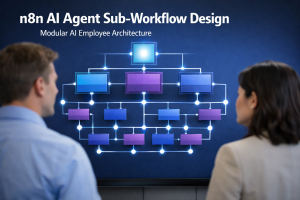
Three roles, one assembly line. The researcher gathers and verifies sources. The writer turns them into a draft. The editor fact-checks, formats, and publishes. Each role is a separate AI Employee with a defined job — and each handoff is a checkpoint, not a black box.
The division of labor matters more than the AI models behind it. The researcher pulls together sources on the target keyword, flags contradictory claims, and produces a source list the writer can trust. The writer produces a draft from that source list alone — never from memory, which is where hallucination creeps in. The editor runs a consistency pass, checks facts against the source list, applies the brand voice, and publishes. Splitting it this way means a bad output in one stage is caught in the next, rather than compounding silently to the end.
What does the build-in-public data actually show?
The headline number — 16 articles in 10 days — is real, but the more important finding is what the pipeline cost and what it didn’t guarantee. Speed was never the scarce resource. Quality control was.
Here’s what the data actually says. Throughput was roughly 1.6 articles per day across the three roles. The constraint was never the writer’s speed; it was the human review gate — which is exactly where the constraint should be. Roughly one in every few drafts got sent back for a factual fix before it could be published, which is the honest reason the human-in-the-loop step is non-negotiable. If you want to benchmark what a pipeline like this costs to build versus what the output is worth, the AI agent build cost benchmark lays out the economics, and the failure rate data shows why most agent projects die before this point — and how this one didn’t.
What failed, and what did we have to fix?
The pipeline did not work on the first run. Two specific failures nearly sank it, and both are the kind of thing no tutorial warns you about.
The first failure was source drift: the writer kept fabricating statistics that weren’t in the researcher’s source list, because the writer’s prompt didn’t forbid drawing on training data. The fix was a hard constraint — “cite only what’s in the source list; if a fact isn’t there, say so.” The second failure was silent handoff loss: the researcher would return a source list, the writer would re-run its own search anyway, and the editor had no way to see which version a claim came from. The fix was passing the source list through as an explicit, unalterable input at every stage. Both fixes are boring. Both are the difference between a demo and a system.
Is this just another info-product pitch?
A fair question, and the answer is no — but that answer only matters because you can verify it. Nothing in this case study is for sale. The numbers have constraints baked in.
Here’s the honest disclaimer. This is a build-in-public record of a real pipeline, not a sales page for a course or a “done-for-you” service. The constraints are stated plainly: every article still required human review, the pipeline produces drafts rather than finished authority content on its own, and two of the sixteen articles needed substantive human rewriting, not just a fact-check. The point of documenting it isn’t to sell you the system — it’s to show you that the finish line exists, and that a solo operator can reach it.
Frequently asked questions
Do I need to know how to code?
No. The pipeline runs on visual, no-code workflow tooling like n8n, Zapier, or Make. You’ll write prompts and connect nodes, not write code. If you can follow a tutorial, you can build this.
Does this work for any niche?
It’s most reliable where the researcher can quickly find citable sources. Highly technical or regulated niches need a heavier human review gate, which slows throughput but doesn’t break the system.
Will this get penalized by Google for AI content?
The pipeline produces drafts, not auto-published spam. Human review, original structuring, and factual checking keep it within quality guidelines — the same bar any editor would apply.
How much does the tooling cost?
The tooling is modest — a no-code automation platform plus LLM usage. The real cost is your time tuning the handoffs. It’s a time investment, not a large cash one.
Can I really finish this, given I’ve quit four times?
Yes — because this isn’t one giant project. It’s three small roles you build one at a time, each independently testable. You finish the researcher first, see it work, then move on.
Ready to build your first AI employee this weekend? Get the free 90-Minute AI Employee guide and go from zero to a working agent — no code, no dev team: Get the free 90-Minute AI Employee guide
About the Author
Anthony Odole is a former IBM Senior Managing Consultant, where he served as Enterprise Architect on Fortune 500 engagements, and the founder of AIToken Labs. He helps business owners cut through AI hype by focusing on practical systems that solve real operational problems.
His flagship platform, EmployAIQ, is an AI Workforce platform that enables businesses to design, train, and deploy AI Employees — AI agents that function as digital workforce members — that perform real work without adding headcount.