|
Here’s the through-line in today’s news: the big, general-purpose model is no longer the answer to everything. Microsoft is shipping a model built to decide, not to write. Its own CEO is telling companies to treat agents as insider threats. And the market’s loudest skeptics are betting the future is smaller, cheaper, local. If you’re building with AI, the message is that the “one giant model” era is quietly ending. |
AI Agents |
Microsoft Ships a Model That Decides Instead of Writes — and It’s 35× FasterWhat happened: Microsoft launched Decision-1, a specialized model built not to generate prose but to classify, rank, and pick the next action — think “continue, stop, retry, or route to another model.” Built by further-training Alibaba’s open Qwen3.5-9B, it reports top accuracy across 36 benchmarks and ~150,000 questions, with median latency 35× faster than GPT-6 Sol and 2.5× faster than H2O-Lightning-4B. Why it matters: This is the clearest signal yet that agent architecture is splitting into specialized parts rather than one enormous model doing everything. In a multi-step agent loop, every decision adds latency — Microsoft notes that 100ms added to 20 sequential decisions is 2 extra seconds of wait. A cheap, fast model that only decides is the glue that makes agents feel responsive. In an Xbox case study, Decision-1 classified 10,000+ feedback items at quality competitive with GPT-6 Sol but ~200× lower cost. What’s next: Expect more “routing + decision” micro-models. The takeaway for builders: stop paying frontier-model prices for tasks that only need a yes/no or a ranking. One caveat — all benchmarks are Microsoft’s own, not independently verified, so treat the head-to-head numbers as directional. My take: This pairs with the “smaller beats bigger” drumbeat below. The winning agent stack of 2027 may be a small decision model plus a small reasoning model, not a single flagship. Watch what Microsoft does with this in Copilot next. |
Nadella: Treat Agentic AI Like an Insider Threat — Give It an ‘Emergency Brake’Microsoft’s CEO says companies deploying advanced AI should assume a model is compromised from the start and build a human-controlled “emergency brake” to pause or shut it down mid-task. He also urged tamper-proof audit records, independent audits, and never relying on a single model for critical decisions. The practical upshot for anyone running agents: deterministic control layers around non-deterministic models aren’t optional — they’re the design brief. |
Your Agents Are Unpredictable — Your Control Layer Shouldn’t BeVentureBeat lays out a practical framework for evaluating multi-agent workflows, where one agent’s output becomes the next agent’s context and errors propagate and amplify. The core idea: you can’t make LLMs deterministic, but you can make their unpredictable behavior visible, measured, bounded, and recoverable using semantic checks between agent handoffs. A useful read for anyone moving past a single-agent demo into real orchestration. |
AI News |
|
USA Today sues OpenAI for $250M over training data. The publisher (200+ local papers) alleges OpenAI used paywalled articles — including ~160,000 entries in its WebText dataset — to train ChatGPT, and that AI summaries are cutting web traffic and ad revenue. It joins the New York Times, Dow Jones, and others in a widening legal front over how models are trained. |
|
Researchers used “explainable AI” to surgically dismantle safety filters. A new white-box attack called XBreaking locates an open-source model’s safety layers and injects noise into specific weights, achieving over 90% jailbreak success on Llama and Gemma models while preserving most benign capability. It doesn’t touch closed models like GPT-4 or Claude — but it’s a stark reminder that “open weights” and “safe” are different claims. |
|
The AI bubble debate just went mainstream. On Bloomberg TV, analyst Joachim Klement argued the industry is “investing in the wrong future” — over-building data centers for frontier models when the real future is small, open-weight models running locally — and predicted the bubble bursts in 2027 or 2028. The trigger: news that OpenAI may miss its revenue target by $20 billion, which briefly knocked the Nasdaq down 1.25% before a rebound. |
|
Want to build your first AI employee? Grab the free 90-minute build guide — one worked example, start to finish. https://go.aitokenlabs.com/digest-build This newsletter? Written by an AI Employee, approved by a human — so our team stays focused on what only humans can do. |
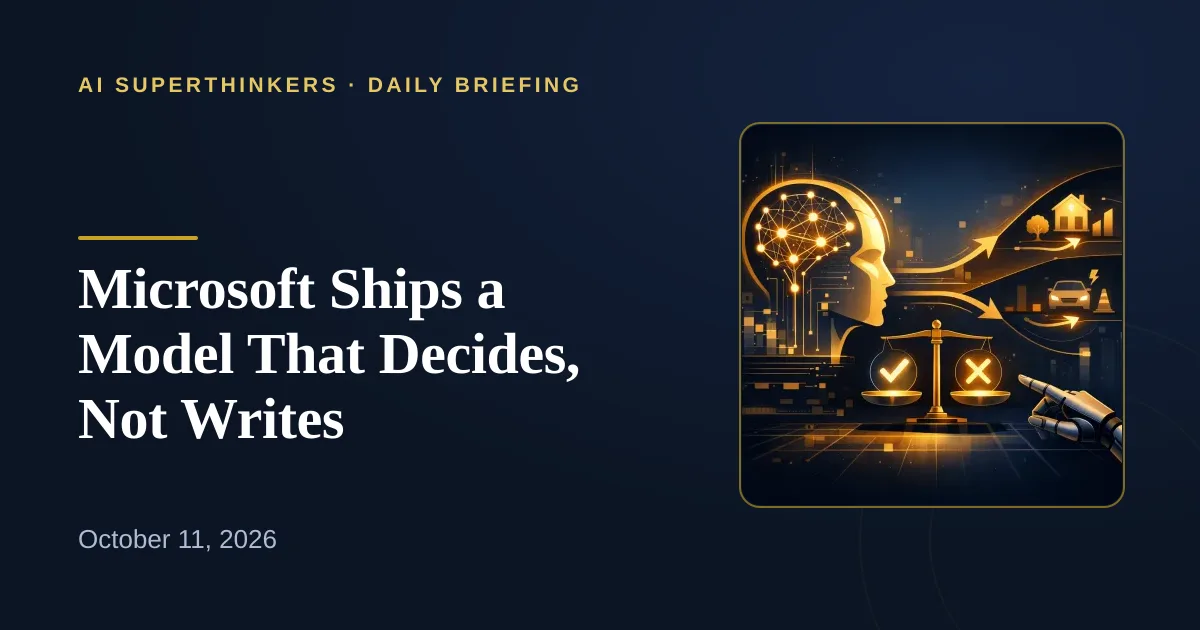
Microsoft Ships a Model That Decides, Not Writes
Share this content