|
Wednesday, April 15, 2026 | Your daily AI intelligence briefing |
|
Part 1 · AI Agents |
|
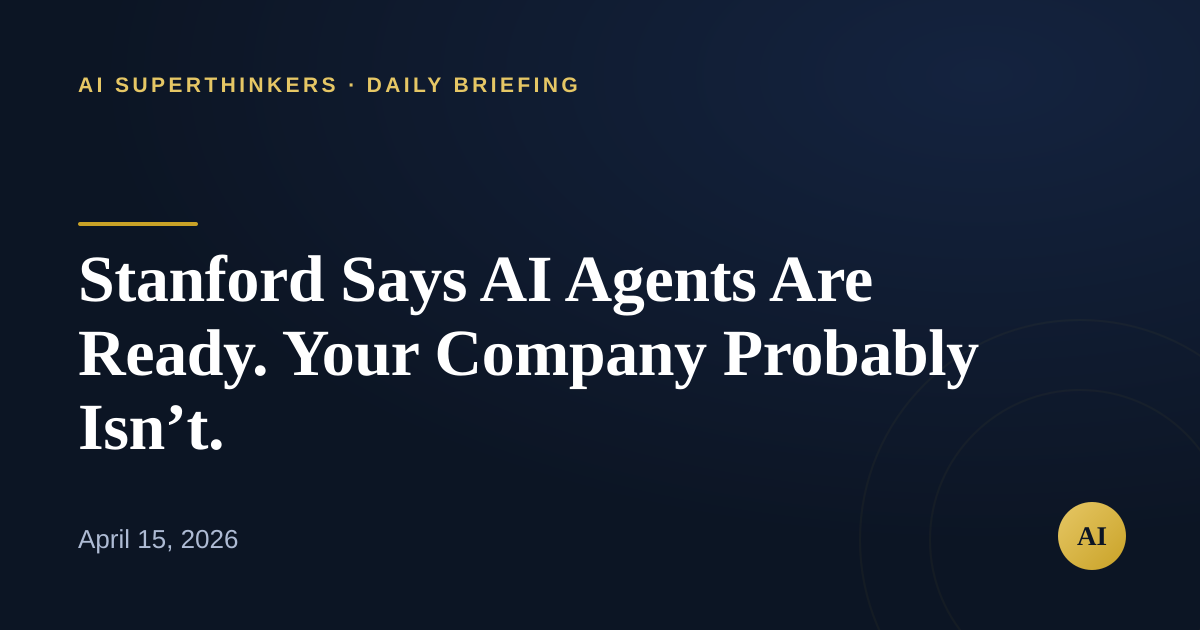
★ Featured Story Stanford’s 2026 AI Report Card: Agents Are Ready. Companies Are Not.The so what: Stanford’s HAI just dropped its annual AI Index — and the headline for business leaders isn’t about models. It’s about the organizational gap. AI is moving faster than your company’s ability to absorb it. The numbers are staggering. AI agent performance on real-world computer tasks jumped from 12% to 66% success in a single year. Coding benchmarks went from 60% to near-perfect (100%) in 12 months. Frontier AI models now match or beat humans at PhD-level science, competition math, and multimodal reasoning. Yet despite 88% of organizations reporting AI adoption, the real-world deployment is badly lagging capability. AI incidents rose 55% year-over-year (233 to 362 documented cases). Only 10% of Americans feel more excited than concerned. And there’s a 50-percentage-point trust gap between AI experts (73% expect positive job impact) and the public (23%). The business implication is direct: the companies winning right now are the ones deploying structured AI — with human oversight, defined roles, and measurable outcomes. The ones losing are running AI pilots that never leave the lab. Stanford’s data confirms what we see every day: the technology is not the bottleneck. The operating model is. |
|
Quick Hits |
Gupshup Launches “Superagent” — Autonomous AI for Customer Conversations at ScaleConversational AI platform Gupshup just shipped Superagent, a cloud-based autonomous AI agent that handles customer conversations across every major messaging and voice channel — start to finish, without human handoff. A self-hosted version called Superclaw targets SMEs and privacy-sensitive organizations. The significance: enterprise-grade autonomous customer engagement is no longer a custom build. It’s a product you can deploy this week. For any business still routing customer queries through a human queue, the clock is ticking. |
Uber Bets $10 Billion on Autonomous Vehicles — 28 Cities by 2028Uber is making the largest autonomous vehicle commitment in its history — $10+ billion split between equity stakes in EV makers (Rivian, Lucid, Baidu) and a robotaxi fleet targeting 28 metro areas by 2028. This is a dramatic break from Uber’s asset-light, gig-economy model. The strategic bet: be the platform that aggregates all robotaxi providers, just as it aggregated human drivers. For business owners, this signals that AI-driven autonomous logistics and delivery are moving from sci-fi to supply chain within 24 months. |
|
Part 2 · AI News |
Anthropic Is Now Worth More Than Ford, GM, and Boeing — CombinedInvestors are reportedly approaching Anthropic with valuations exceeding $800 billion — more than double its February 2026 valuation of $350B. The catalyst: Anthropic’s annualized revenue has exploded from $9B at end of 2025 to $30B today. Meanwhile, its new frontier model, Claude Mythos, is so capable at finding software vulnerabilities that Anthropic called a broad release “reckless” — prompting a surprise closed-door meeting between Treasury Secretary Bessent, Fed Chair Powell, and major bank CEOs to warn of cybersecurity risks. Anthropic has reportedly declined the $800B offers for now, with a potential IPO as early as October 2026. The takeaway: the AI value creation curve is not flattening — it’s going vertical. |
Four AI Companies Just Absorbed 80% of All Global Startup Money in Q1Global startup investment hit a record $300 billion in Q1 2026 — up 153% year-over-year. AI captured $242B of that, or 80% of all venture capital on Earth. And four US companies took the lion’s share: OpenAI ($122B), Anthropic ($30B), xAI ($20B), and Waymo ($16B). Late-stage funding rounds surged 281%. In one quarter, investors deployed nearly 70% of their entire 2025 VC budget. What this means for you: the AI infrastructure being funded today becomes the tools you’ll use in 18–24 months. The concentration is staggering — and so is the pace of what’s coming. |
Warning: Almost Half of AI-Generated Code Is Failing in ProductionLightrun’s 2026 State of AI-Powered Engineering Report — surveying 200 senior DevOps and SRE leaders at US enterprises — found that nearly 50% of AI-generated code fails in production. A separate VentureBeat survey puts the debugging rate at 43% of all AI-generated changes. Translation: the productivity gains from AI coding tools are real, but so is the quality tax. Engineers are spending more time debugging AI output than they saved writing it. If your business is using AI to build software faster, this is your reminder that “faster” without oversight isn’t better — it’s just faster failure. Human review of AI code output is not optional; it’s the ROI multiplier. |
|
Quick Plug Not sure where AI fits in your business? Take the free AI Workforce Assessment — ten minutes, and you'll see which roles to hand over first. This newsletter? Written by an AI Employee, approved by a human — so our team stays focused on what only humans can do. |