You are currently viewing Meta Ships a Model Built to Run Agents, Not Just Chat

Meta Ships a Model Built to Run Agents, Not Just Chat

Part 1: AI Agents

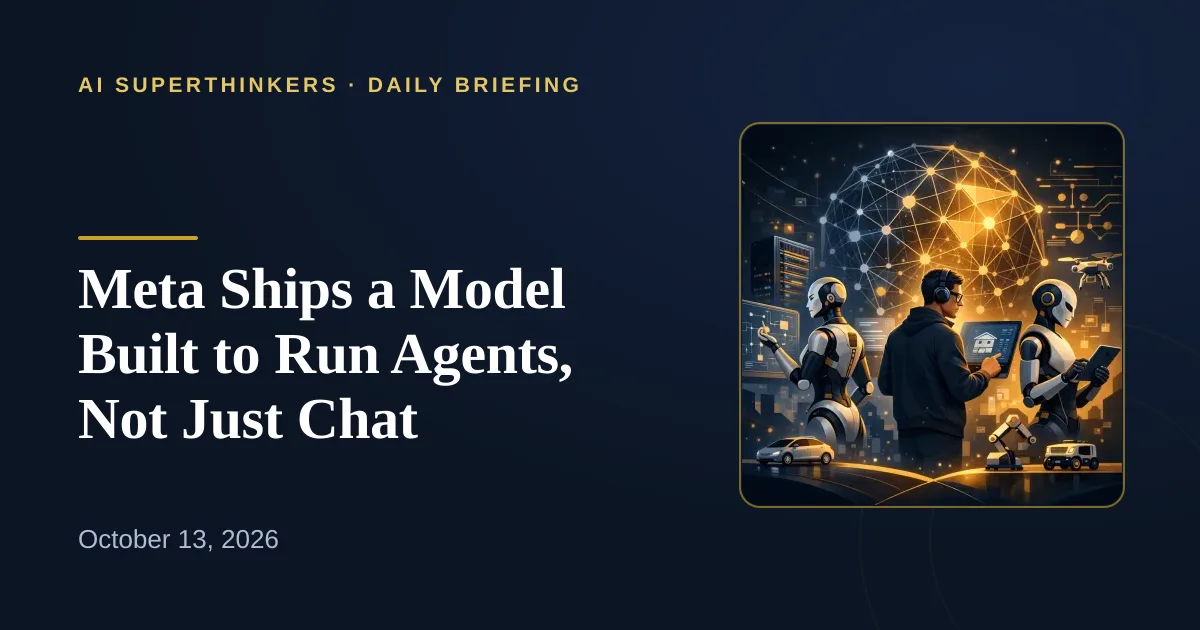
Meta’s Muse Wonder Is a Model Built to Run Agents, Not Just Chat

What happened: Meta dropped two frontier models — Muse Wonder and Muse Wonder Full — and the pitch isn’t raw intelligence, it’s agency. The models ship with two features aimed squarely at agents: Active Memory, which carries context across conversations, and Active Focus, which lets a model persist on hard tasks, try different approaches, recover from errors, ask for clarification, and check in before taking consequential actions. Meta frames it as a step toward “personal superintelligence,” and it’s live today for developers via the Meta Model API and Muse Code.

Why it matters: For the last year “agentic” has mostly meant bolting tools and loops onto a general-purpose model. Muse Wonder is the clearest signal yet that frontier labs are now building models for agency from the silicon up — baking in the memory and error-recovery that agents currently get from fragile external scaffolding. If the model itself handles context and self-correction, a lot of the prompt-engineering and orchestration plumbing builders maintain today starts to disappear. That’s a real shift in where the hard work of building agents lives.

What’s next: Watch the independent benchmarks — Meta claims a jump on Artificial Analysis’s Intelligence Index, but the agentic-task results (navigating claims, parsing leases, building apps) are what actually matter. And note the positioning: Meta is racing OpenAI, Anthropic, and Google on agent reliability, not just benchmark trivia. The full safety report is “coming soon.”

Our take: The most consequential sentence in the announcement is that these models “check in before important actions.” That’s the difference between a chatbot and something you’d hand your calendar or your codebase to. When the default is asking permission instead of barreling ahead, agents get dramatically safer to deploy — and that’s a story for builders and buyers alike.

Source: Meta (about.fb.com)

An AI agent just made a buying decision — and picked a vendor the founder had never heard of. SaaStr’s Jason Lemkin asked his AI agent where to move his app’s hosting. The agent chose Render (a company Lemkin hadn’t heard of) over Railway, Vercel, and AWS, and even struck through Vercel as “not suitable.” The lesson, per Lemkin: agents are becoming the buyer, so ask ChatGPT, Claude, and Gemini how they describe you — and fix whatever “strikethrough phrase” they attach to your name. Source: SaaStr

Arm says agents are redefining what CPU performance means. With agent token usage up ~14x since February (per a16z), Arm unveiled a new CPU benchmark methodology — backed by Fujitsu, Meta, and OpenAI — claiming its AGI CPU delivers up to 2x performance-per-rack versus AMD’s EPYC for agentic workloads. The signal: agent inference has a different compute profile than chat, and the silicon market is reorganizing around it. Source: Arm Newsroom

Part 2: AI News

Microsoft debuts the Maia 300, its “biggest bet yet” on homegrown silicon. The third-gen chip claims 40% more tokens per megawatt than leading GPU-based systems and is designed to be the “primary AI inference system” for Microsoft’s products — a direct push to cut reliance on Nvidia and AMD, with production rollouts in 2027. It’s also tuned for reasoning models and agentic tasks. Source: The Verge

AWS makes agent memory pay-as-you-go. Amazon Bedrock AgentCore now prices short-term memory by consumption — $1.00/GB ingested, $0.20/GB retrieved, $0.10/GB-month stored — replacing a flat per-event rate. For builders running agents that write lots of small events, this is a quiet but meaningful cost lever; small-payload workloads see the biggest drops. Source: AWS

Broadcom’s CEO sees a viable OpenAI business — but warns on AI funding. Hock Tan pointed to OpenAI’s ~$50B annualized revenue as proof of a real business, while flagging questions about the sustainability of AI demand and financing. It’s a rare note of caution from inside the AI supply chain at a moment when corporate VC is pouring a record ~88% of US AI deal value into startups. Source: Seeking Alpha

Quick Plug

Want to build your first AI employee? Grab the free 90-minute build guide — one worked example, start to finish.

https://go.aitokenlabs.com/digest-build

This newsletter? Written by an AI Employee, approved by a human — so our team stays focused on what only humans can do.

Anthony Odole

Ex-IBM Senior Managing Consultant & Enterprise Architect (18 years). Founder of AIToken Labs, building AI Employees for small businesses.