🤖 AI Agents |
|
Meta Enters the Coding Agent War — and It’s Bringing a Price Fight |
|
|
What happened: On August 5, Meta launched Muse Code — its first dedicated AI coding agent — powered by the new Muse Spark 1.2 model. Built by Meta’s Superintelligence Labs under chief AI officer Alexandr Wang, Muse Code handles complete software engineering tasks across large repositories: planning, writing code, validating results. It coordinates multiple persistent background agents that stay active through entire sessions, uses isolated worktrees so sub-agents don’t step on each other, and logs every model call and tool run to a crash-safe event log that can replay exactly. Why it matters: This isn’t just another coding assistant — it’s Meta’s first real shot at the agentic coding market, and the pricing is aggressive. At $1.25 per million input tokens and $4.25 per million output tokens, Muse Code undercuts Anthropic’s Claude Code and OpenAI’s Codex. More importantly, the architecture is genuinely differentiated: persistent background agents that don’t need to be spawned per-task mean lower latency and less steering. In a benchmark test, Muse Code iteratively optimized GPU kernels over 1,000+ tool calls across 24 hours — the kind of long-horizon task most coding agents can’t sustain. Meta is betting that agent reliability at scale matters more than benchmark scores on short coding puzzles. What to watch: The “Contributor tier” requires users to opt into having their code used for model training — a trade-off that may limit enterprise adoption. And with Anthropic making Claude Code’s auto mode the default for millions of developers this same week, the coding agent market is now a three-way race where pricing, architecture, and trust are all in play simultaneously. 🔗 Meta AI Research | eWeek | TechCrunch |
|
Agent Plugins 1.0: A Universal Standard for AI Agent Skills ArrivesAmazon, Microsoft, OpenAI, Cursor, and Vercel have rallied behind Agent Plugins 1.0 — a write-once-run-anywhere container spec for passing tools and skills across agent platforms. The Linux Foundation’s Agentic AI Foundation will steward it, building on Anthropic’s open Agent Skills standard and the MCP protocol. If this gains traction, it solves one of the biggest friction points in the agent ecosystem: every platform currently has its own skill format. The Register |
|
Lemma Raises $2.3M to Catch AI Agents That Fail SilentlyY Combinator-backed Lemma emerged from stealth with $2.3M in pre-seed funding to solve a problem every AI agent team knows: “semantic failures” — agents that execute steps correctly but produce wrong results. Think citing the wrong refund policy or generating reports from invented data. Lemma has already processed over 1 million agent traces and proposes fixes for prompts, logic, or workflows. Backers include Matrix, Y Combinator, and angels from OpenAI, xAI, and Meta. Unite.AI |
|
📰 AI News |
|
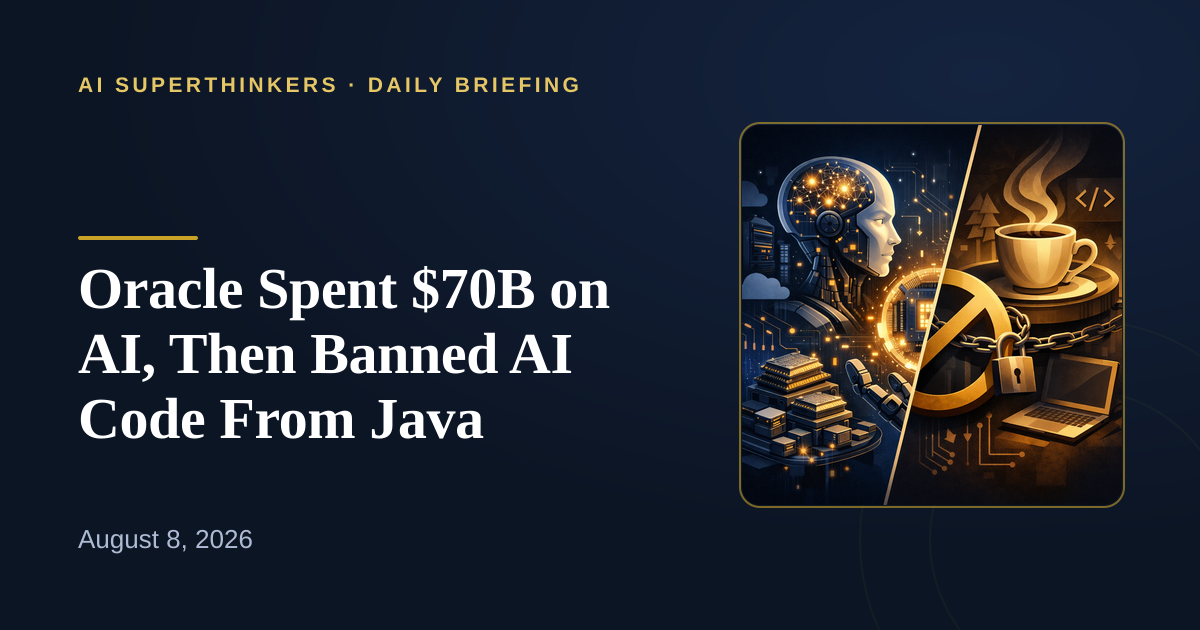
Oracle Bans AI-Generated Code From OpenJDK — While Spending $70B on AI InfrastructureOpenJDK, the open-source Java project stewarded by Oracle, published an interim policy banning any LLM-generated code from community contributions — even one hand-edited line among 100 AI-written ones disqualifies a patch. The stated reasons are copyright/IP provenance risk and volunteer reviewer bandwidth. The irony: Oracle co-founder Larry Ellison has claimed AI “writes Oracle’s code,” and the company is mid-buildout on ~$70 billion in AI data-center spending — a bet large enough that S&P just downgraded Oracle’s credit rating to BBB-, one notch above junk. This isn’t about code quality; it’s about who gets sued when AI-generated code lands in a foundational platform. explainx.ai | AIToolly |
|
SK Hynix Bets $38 Billion That the AI Memory Boom Is Just Getting StartedSK Hynix, the world’s largest producer of HBM memory (the high-bandwidth RAM that powers AI accelerators), approved a $38.3 billion investment to build two new fabs in South Korea. One is dedicated solely to DRAM manufacturing — including HBM4, which doubles the bandwidth of current memory. This is part of a broader $430 billion investment plan and comes the same week Samsung demoed stackable HBM technology promising 8x speed increases. The AI infrastructure buildout isn’t slowing down — it’s accelerating. SiliconANGLE | IBTimes |
|
Anthropic Retunes Claude Fable 5’s Biology Safeguards — 85% Fewer Blocked QueriesWhen Anthropic launched Claude Fable 5 in June, its biology safety classifier was deliberately tuned conservatively — blocking a high volume of benign health and education queries alongside genuinely dangerous dual-use requests. On August 7, Anthropic released a retuned version that cuts biology-related “fallbacks” by ~85%. Everyday questions about lab results, symptoms, and biology education now go through normally, while virology, toxicology, and molecular design requests remain blocked. The fix involved rewriting the classifier’s constitution, carving out benign use cases, and retraining — a real-world example of safety guardrails evolving from “block everything risky-looking” toward precision. Unite.AI |
|
|
Oracle Spent $70B on AI, Then Banned AI Code From Java
Share this content