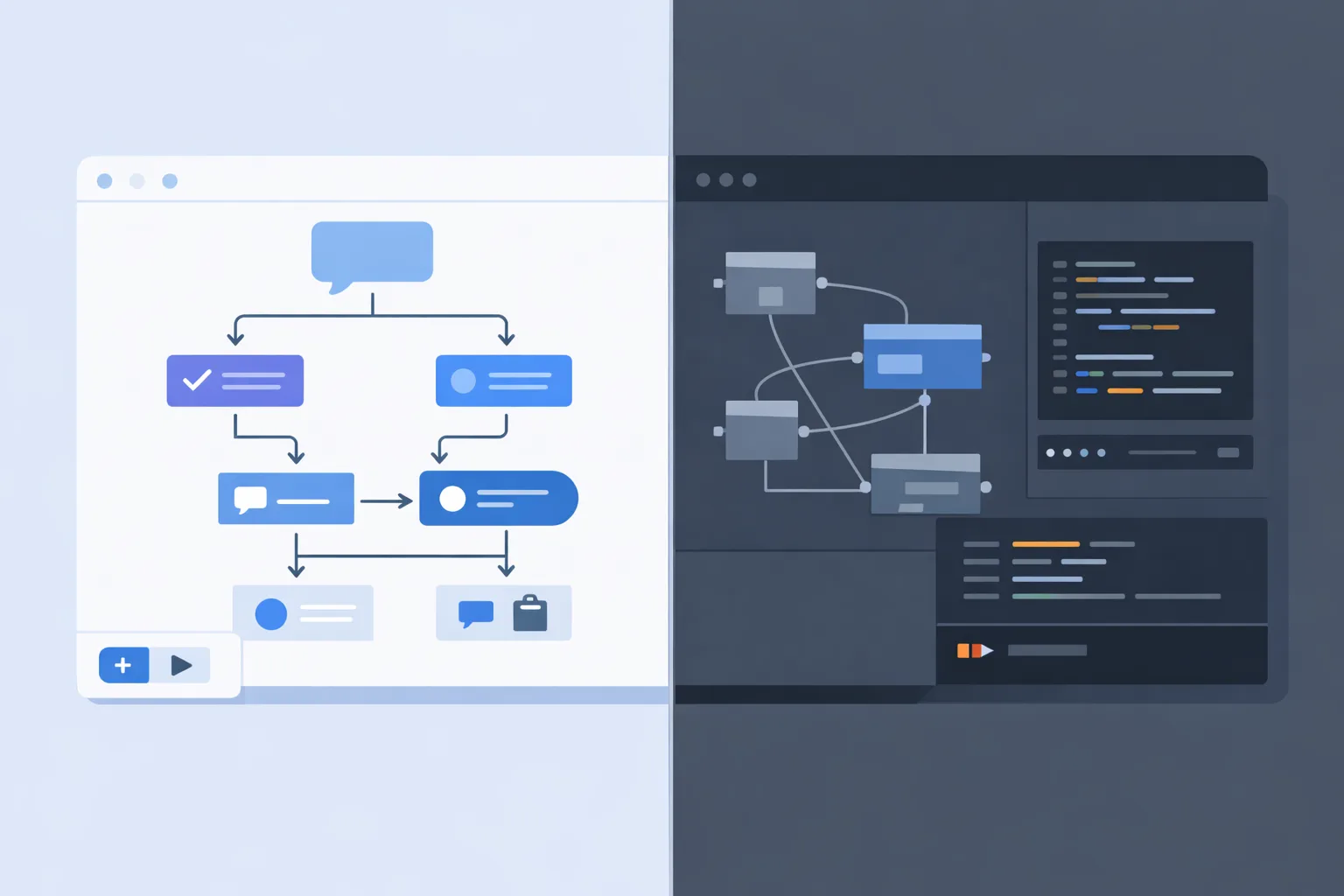
Two platforms, two very different answers to the same question: how do you build a conversational AI agent that can actually hold production conversations? Voiceflow and Botpress both sit under the broad “visual builder” umbrella, but the moment you look past the drag-and-drop demo, they diverge hard — in primitives, in extensibility, in deployment, and in where each one stops you.
This is a comparison written for people who can hand-roll the plumbing if they have to. If you’re deciding between these two, you’re not asking “which is easier.” You’re asking which one gives you enough depth and control before it becomes a ceiling. That’s the question this article answers.
TL;DR: Voiceflow is a polished visual canvas for conversation design that starts to pinch when you need code-level control, while Botpress gives developers deeper primitives, extensibility and self-hosting — but both become a ceiling if you want maintained, governed AI Employees rather than a toolkit you assemble. Neither is a toy; the real question is where each one stops you.
What are Voiceflow and Botpress, at the primitive level?
Voiceflow is a San Francisco–based collaborative canvas for designing conversational agents. Its center of gravity is conversation design: playbooks, functions, knowledge bases, variables, and a visual flow that non-engineers and engineers can both read. It has raised $15M and is built around a deliberately opinionated architecture — fully managed LLM APIs on one end, self-hosted custom NLU models on the other, with a consistent interface layer decoupling the application from any single model provider.
Botpress is a Montreal-based platform with deep open-source roots, founded in 2017 as one of the first open-source chatbot frameworks. Its center of gravity is the developer: a visual Studio sitting on top of modular primitives — nodes, cards, hooks, variables at four scopes, an Autonomous Node where an LLM picks the next step, and a full SDK. It raised a $25M Series B in June 2025 and has repositioned itself as agent infrastructure rather than a chat widget.
The key distinction up front: Voiceflow is a conversation-design tool that exposes code where you need it. Botpress is a developer platform that happens to render a visual editor. That ordering explains almost every difference that follows.
Before you commit to either, it’s worth being clear on what these tools are not: they’re not automation frameworks for structured business processes. If your workloads look more like invoice processing or data entry than conversation, the distinction we cover in AI Agents vs RPA: Understanding the Real Difference in 2026 will save you from picking the wrong category entirely.
Where does each platform stop you?
Voiceflow stops you at the edge of its canvas. It gives you custom JavaScript functions, modular blocks, API tools, MCP servers, and multi-LLM routing — real extensibility, not a toy. But the design primitives are conversation-first: flows, playbooks, and states are the first-class citizens, and code lives inside them. If your agent needs behavior that doesn’t map cleanly onto a conversational flow, you’re bending the canvas to fit.
Botpress stops you further out. The Execute Code card, the SDK, hooks, and the Autonomous Node mean you can reach down into the runtime and write the logic yourself. But that reach now ends where the platform ends: the self-hosted, MIT-licensed v12 distribution that drew most engineers to Botpress has been sunset, and Botpress Cloud is the only supported path for new development. What remains open source is the tooling — CLI, SDK, API client, public integrations — not the platform that runs your agent.
Quotable takeaway: Voiceflow’s ceiling is the shape of the canvas; Botpress’s ceiling is the shape of its cloud.
Voiceflow vs Botpress: which gives a developer more control?
For code-level control in the current product, Botpress wins on breadth — the SDK, hooks, and Execute Code cards give you runtime access that Voiceflow doesn’t match. Voiceflow wins on a different axis: the control is cleaner and more coherent because it’s all one workspace. You write a JavaScript function, test it, inspect execution logs, and split-test versions without leaving the canvas.
There’s a nuance people miss. Voiceflow’s custom code is genuinely capable — you can call external APIs, write reusable functions, and route across multiple LLMs. What it does not give you is ownership of the runtime. You’re renting a very well-built engine. Botpress gives you more of the engine’s internals, but since the open-source platform was sunset, you’re renting the cloud too — just with more dials exposed.
The honest summary: if “control” means touching the runtime and extending behavior with code, Botpress offers more of it. If “control” means a coherent, testable build environment where code and conversation live in one place, Voiceflow is the tighter tool.
Which platform is better for self-hosting?
Neither, in the way most engineers mean it — and that’s the single most important correction in this comparison.
Botpress’s reputation as “the open-source, self-hostable option” is a legacy story. The self-hosted v12 platform still exists in a separate repository, but it’s no longer the main product and isn’t the path for new development. What’s MIT-licensed today is the CLI, SDK, and integrations around Botpress Cloud — not a self-hostable distribution of the full platform.
Voiceflow was never self-hostable in that sense. It publishes useful open components — voiceflow-cli, react-chat, API examples — but the platform itself is a managed cloud.
Quotable takeaway: If data sovereignty or running the stack on your own infrastructure is a hard requirement, neither platform’s current product satisfies it the way the old Botpress v12 did. For that, you’d look at a code-first framework like Rasa or LangGraph — which are out of scope here but worth naming honestly. The full trade-off between running your own stack and renting one is its own question, and we go deep on it in Self-Hosted vs Managed AI Agent Platforms: Security, Cost, and Control.
Voiceflow vs Botpress for enterprise and governance
Enterprise fit comes down to what “governance” means to you. Voiceflow’s strength is the collaborative layer: versioning, environments, split testing, transcripts, and QA tooling that lets a team ship changes with review and rollback. That’s governance of the conversation — and it’s excellent.
Botpress’s strength is governance of the integration surface: a large integration hub, multi-LLM support with bring-your-own API keys, and a Desk product that pulls the human-support side into the same platform. Its enterprise story is about scale and reach across channels.
Neither fully answers the governance questions a regulated team asks — audit trails, memory supervision, per-agent access control, and a maintained runtime you don’t have to babysit. That’s not a dig at either tool; it’s a category observation. Both are toolkits you assemble, and governance is something you build on top of them.
Quotable takeaway: Voiceflow governs the conversation; Botpress governs the integration. Neither ships governance of the employee out of the box.
How do their pricing models actually compare?
Both use subscription models, but shaped differently. Botpress historically offered a pay-as-you-go tier and a Plus tier around $89/mo, with Team and Enterprise above that — though pricing shifted in 2026, so treat any specific figure you find online as stale until you check the live page. The pattern is a low entry point that scales with usage and seats.
Voiceflow’s model is oriented around building and publishing conversational agents at scale, with usage-based components for tokens and calls. The real cost driver in both cases is not the seat fee — it’s model tokens at production volume, which you budget for separately regardless of platform.
Quotable takeaway: The subscription is the least interesting number. The costs that actually decide this comparison are model tokens at scale and the engineering time you spend maintaining what you built. If you want the full ledger before you choose, our AI Agent Platform Total Cost of Ownership guide catalogues the hidden costs builders routinely miss.
Which platform should you actually choose?
Choose Voiceflow if your team’s bottleneck is conversation design — you have designers, PMs, and engineers collaborating on flows, and you want clean versioning, testing, and split-testing in one coherent workspace. Choose Botpress if you need deeper runtime extensibility, a large integration hub, and a bigger developer community — and you accept that the self-hosted open-source story is largely historical.
Choose neither if what you actually want is the outcome — a governed, maintained AI Employee with memory, supervision, and an audit trail — rather than a toolkit you assemble and operate yourself.
Full disclosure: we build one of those — EmployAIQ, an AI-workforce platform where you hire AI Employees rather than assembling them. It’s the wrong choice if you want to own the skill of building agents yourself. If your goal is to hand-roll the plumbing, this article’s whole point is that Voiceflow and Botpress are both legitimate places to do it.
And if your instinct after all this is to reach for raw code anyway, the same depth-and-control question plays out one layer down in the agent-orchestration frameworks — we compare the two big ones in AutoGen vs CrewAI for Multi-Agent Systems: Complete Technical Comparison.
Voiceflow vs Botpress: comparison table
| Dimension | Voiceflow | Botpress |
|---|---|---|
| Core primitive | Conversation design (playbooks, flows, states) | Developer platform (nodes, cards, hooks, SDK) |
| Extensibility | Custom JS functions, API tools, MCP, multi-LLM routing | Execute Code, full SDK, hooks, Autonomous Node |
| Open source / self-hosting | Managed cloud; some open components (CLI, react-chat) | Open-source roots; v12 platform sunset, cloud-only for new builds |
| Best fit | Collaborative design teams shipping conversations | Developer-leaning teams needing runtime control |
| Governance | Conversation-level: versioning, testing, split-testing | Integration-level: hub, multi-LLM, Desk |
| Deployment | Cloud | Cloud (self-hosted legacy only) |
Frequently Asked Questions
Is Botpress still open source?
The CLI, SDK, and public integrations remain MIT-licensed, but the self-hosted v12 platform was sunset. Botpress Cloud is the only supported path for new development — the full platform is no longer self-hostable open source.
Does Voiceflow support custom code?
Yes. Voiceflow supports custom JavaScript functions, API tools, MCP servers, and multi-LLM routing. The limit is that code lives inside the canvas — you control behavior, not the runtime.
Can I self-host Voiceflow or Botpress?
Not in the way most engineers mean. Voiceflow is cloud-only. Botpress’s self-hosted v12 is legacy and unsupported for new builds; the current product is Cloud. For true self-hosting, code-first frameworks are the better fit.
Which is cheaper, Voiceflow or Botpress?
Neither is categorically cheaper. Both use subscription plus usage-based components, and the dominant cost at scale is model tokens — which you budget for separately on either platform.
Want to design AI employee roles from scratch rather than deploy templates? The AI Agent Architects runs as a small five-week cohort, and the waitlist hears every enrolment date first: Join the AI Agent Architects waitlist
About the Author
Anthony Kayode Odole is a former IBM Senior Managing Consultant, where he served as Enterprise Architect on Fortune 500 engagements, and the founder of AIToken Labs. He helps business owners cut through AI hype by focusing on practical systems that solve real operational problems.
His flagship platform, EmployAIQ, is an AI Workforce platform that enables businesses to design, train, and deploy AI Employees — AI agents that function as digital workforce members — that perform real work without adding headcount.