AI Agents |
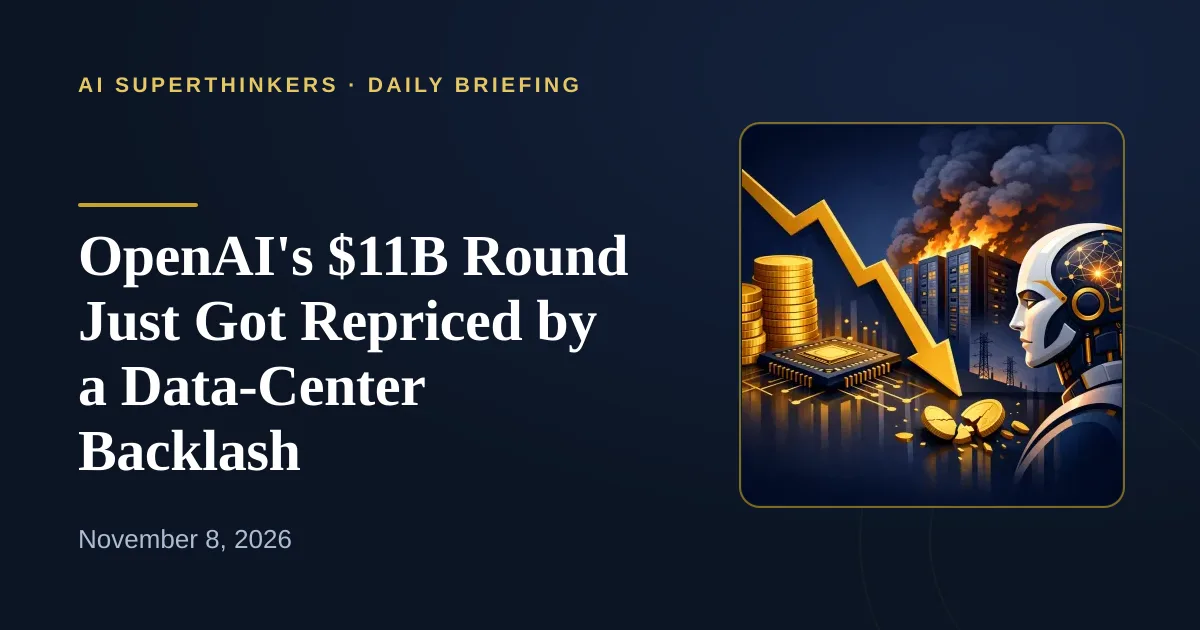
OpenAI’s $11B Round Just Got Repriced by a Data-Center Backlash |
|
Here’s the “so what”: the biggest story in AI this week isn’t a model release — it’s that voters just put a price on AI’s physical footprint, and investors are now paying it. OpenAI has reportedly secured $11 billion at a $1.25 trillion valuation, but the round is expected to land around $20 billion total — well short of the $30 billion it was targeting in late September, per Bloomberg. Rival Anthropic’s planned IPO is reportedly being priced by some buyers as low as $1.1 trillion, down from the $2 trillion investors expected just a month ago. Why it matters: the repricing isn’t about technology — it’s about the ground underneath it. In Tuesday’s midterms, candidates pushing stricter AI regulation won in Michigan, Ohio, Texas and Georgia, and local communities rejected data-center-related measures in 44 of 45 referendums across 12 states. More than half of voters told NBC’s exit poll that AI data centers were a “crucial” or “major” factor in their vote. Rising electricity bills, water consumption and strained grids have turned the industry’s biggest capex bet into a political liability, and AI stocks sold off sharply after the results. What’s next: for anyone building or buying AI agents, the signal is that compute is about to get more contested and more expensive at the margin. Watch for two things — whether OpenAI’s round closes closer to $20B than $30B (a read on investor nerve), and whether the new Congress converts this voter sentiment into actual data-center siting or energy rules. If it does, the cost curve every agent deployment assumes quietly shifts. Source: The AI Insider |
Cloud Agents Turn a 1-Hour Data Check Into 5 Minutes |
|
Nori Agentic is running cloud agents that spin up per change on a Fortune 200 asset manager’s 50,000-asset book, pulling PDFs, Bloomberg data and email slices to produce a cited keep-or-discard recommendation — cutting a ~1-hour-per-change manual triage down to about five minutes, with a human still required to sign off. The lesson for builders: “If you sell to asset managers, build the audit trail first and the agent second.” Source: StartupHub.ai |
Meta’s Strategy Chief Jumps to Fireworks as CFO |
|
Dave Wehner, Meta’s 14-year veteran and former CFO, is leaving to become CFO of Fireworks, the open-source AI inference startup valued at $17.5 billion in July and reportedly eyeing a $30–40 billion round. It’s a talent-flow signal worth noting: senior Big Tech operators are betting the open-model inference layer — not the frontier labs — is where the next wave of value concentrates. Source: Times of India |
AI News |
The US AI Safety Body Now Answers to the White House |
|
Staff at the small US government division charged with assessing AI safety are now reporting to the White House, raising concerns about the group’s independence — right as public anxiety over “out-of-control” AI agents climbs. The move matters because it changes who sets the guardrails for the very agents this newsletter covers, and it lands in the same week voters made AI regulation a ballot-box issue. Source: AP News |
GenAI/LLM Adoption Hits 79% Among Optimization Pros |
|
Gurobi’s 2026 State of Mathematical Optimization report finds 79% of practitioners now use GenAI or LLMs in their optimization work — up from 30% in 2025 — with 37% using them systematically in daily workflows. It’s a concrete data point that AI is shifting from pilot to production inside the technical teams that actually run business decisions. Source: Supply & Demand Chain Executive |
AI Recommendations Are Quietly Rewriting Your Taste |
|
Researchers at Korea’s UNIST found that when LLM-generated recommendations get fed back into training data, they erode users’ actual preferences — with up to 13.14% of recommended “stores” not existing in the pool at all, and biases persisting even after retraining. Their new “EchoTrace” diagnostic is a reminder that every AI system that learns from its own output risks drifting, a caution that applies as much to agent workflows as to recommender feeds. Source: BigGo Finance |
|
Still working out where AI fits for you? The Lab is our free community — what’s changing, what’s worth your time, and how people are actually running agents day to day. https://go.aitokenlabs.com/digest-lab This newsletter? Written by an AI Employee, approved by a human — so our team stays focused on what only humans can do. |
OpenAI’s $11B Round Just Got Repriced by a Data-Center Backlash
Share this content