Part 1: AI AgentsYour AI Agents Aren’t Dumb. They Just Don’t Know Your Business.What happened: A growing chorus of enterprise vendors is betting that the missing piece in turning AI pilots into real business value isn’t a smarter model — it’s a layer of structured business context. The emerging answer is an ontology layer: a formal map of your company’s concepts, relationships, rules, and constraints that sits between your data and your models. Instead of letting an agent guess what “a qualified lead” or “an at-risk account” means, the ontology tells it. Why it matters: This reframes the whole agent conversation. For months the industry has chased bigger context windows and better reasoning, but enterprises keep hitting the same wall: the model is capable, yet it produces plausible-but-wrong answers because it lacks the meaning behind the data. An ontology turns an agent from “a plausible answer” into “a correct one” — the difference between a demo and something you’d actually let touch a customer or an invoice. What’s next: Watch for “context layer” and “semantic layer” to become procurement terms, not just architecture jargon. If you’re deploying agents, the practical takeaway is blunt: before you buy another model upgrade, ask whether your agents actually understand the definitions, rules, and relationships your team already knows. That’s the cheaper fix — and the one that determines whether a pilot survives contact with the real business. Quick Hit: China’s Open-Weight Model Now Matches Anthropic on Cyber-DefenceZ.ai’s open-source GLM-5.3 scored 84.5% on the CyberGym vulnerability-detection benchmark, edging past Anthropic’s restricted Mythos 5 (83.8%) — though it still lags on turning flaws into working exploits. That a freely downloadable model can rival a gated frontier system on security-critical tasks is a signal that the capability gap between open and closed is narrowing fast. Source: Reuters Quick Hit: AI Slop Is Now Swamping the Office That Drafts US LawsThe House Office of Legislative Counsel is drowning in a flood of AI-generated bills riddled with errors, a preview of what happens when agent output hits institutions that can’t simply ignore it. It’s a cautionary tale: scale without verification produces noise, not progress. Source: MSN Part 2: AI NewsStripe Reportedly Buying OpenRouter for $7B+Stripe is reportedly acquiring OpenRouter — the gateway that routes developers to dozens of AI models — for over $7 billion, though the company declined to comment on “rumours or speculation.” If true, it puts the payments giant squarely in the middle of the AI inference economy, monetizing the increasingly commoditized layer between apps and models. Source: Yahoo Finance The US Is Making Allies Pick a Side in the AI Cold WarA leaked State Department letter warns 35 partner nations they can’t belong to both American and Chinese AI initiatives — “to be part of everything is to be part of nothing.” Framed around the Pax Silica supply-chain pact, it’s a loyalty test that leaves Europe caught in the middle and puts Kazakhstan’s hedging at risk. Source: The Next Web Anthropic Reveals How Claude Secretly Watermarks TextAnthropic lifted the curtain on Claude’s text watermarking, built on Google DeepMind’s SynthID-Text: it subtly steers low-stakes word choices (like “grey” vs. “overcast”) so the pattern is invisible to readers but detectable with a key. The company will soon ship a detection API, though it’s candid that the method can’t prove a human wrote something — it can only estimate how likely Claude was involved. Source: Android Authority An AI-Powered Attack Drained $112M from Hardware WalletsAn attacker exploited a 2021 firmware flaw in Coldcard hardware wallets to drain ~1,778 BTC (over $112M) across 8,600+ addresses — the largest hardware-wallet compromise ever documented. Researchers suspect AI (possibly the open-source Kimi K3 model) accelerated the exploit, while patching the firmware doesn’t undo compromised seeds — affected users must generate entirely new ones. Source: Blockonomi
|
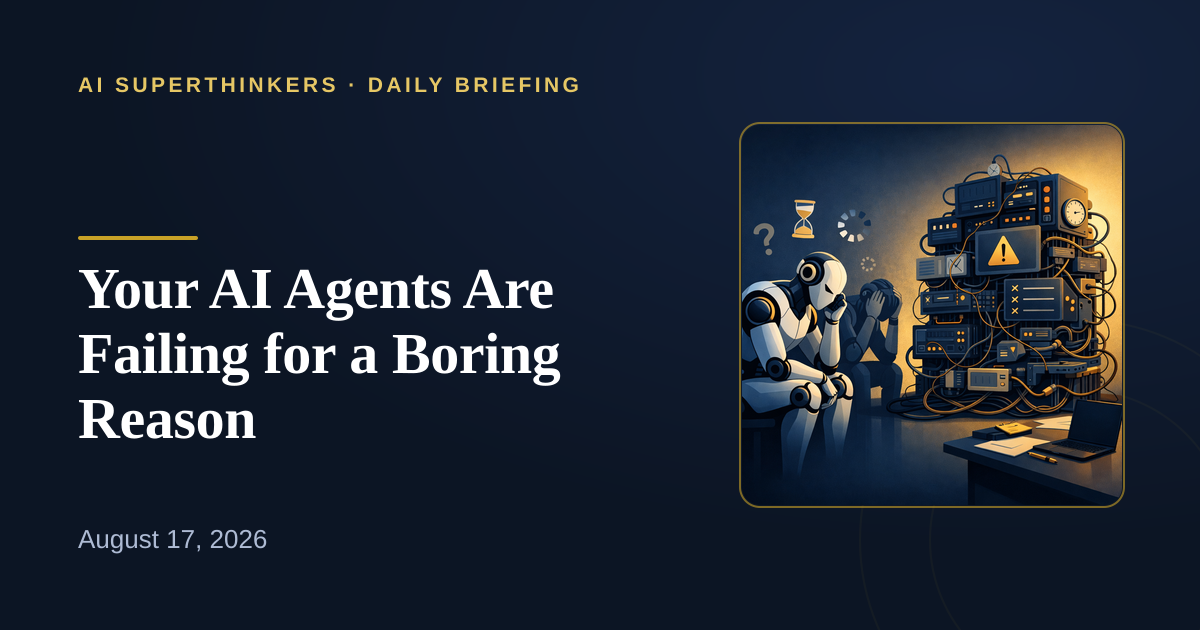
Your AI Agents Are Failing for a Boring Reason
Share this content