AI AgentsOnly 10% of Executives Let Their AI Agents Act Without a Human in the LoopWhat happened: Tata Consultancy Services surveyed 1,333 senior business and technology leaders across 25 countries and 12 industries, and landed on a striking gap: 84% say AI is already delivering measurable productivity gains — yet only 10% permit AI agents to execute decisions autonomously across multiple functions. Just 9% have agents that can securely orchestrate workflows across enterprise applications, and only 10% report any revenue uplift. Why it matters: This is the real state of “agentic AI” in the enterprise — and it’s far more cautious than the hype suggests. The bottleneck isn’t capability, it’s trust and governance. 44% of leaders admit their business knowledge lives inside employees’ heads or fragmented documents, which means agents have nothing reliable to act on. 90% want model independence, yet only 7% have a plan to switch AI providers if one fails them. The takeaway for builders: the winning agents in 2026 aren’t the most autonomous — they’re the most auditable. Human approval for high-impact actions, clear access permissions, and monitoring are the features actually gating deployment. What’s next: Watch for the autonomy ceiling to move slowly. TCS’s Amit Kapur framed it plainly: “security, governance and resilience remain important considerations before granting AI systems greater autonomy.” Expect the vendors who win to sell controlled autonomy — agents that do the grunt work and escalate the judgment calls — rather than “set it and forget it.” Source: TCS Enterprise AI Study via Lapaas Voice Quick HitsMicrosoft’s AI Frontiers chief quits, declaring research “over.” John Langford, founder of Microsoft’s AI Frontiers group, announced his departure in a blunt blog post titled “The End of AI Frontiers.” He argues Microsoft AI’s new leadership has adopted a “scaling-only” philosophy that treats research as an afterthought — “aggressively not research,” in his words. Why it matters: Langford’s team built Autogen and the Fara computer-use agent, so this isn’t an ivory-tower exit — it’s a signal about whether frontier labs still believe algorithmic innovation (not just more compute) moves the needle. Source: John Langford’s blog Traversal lands $120M to put AI agents on enterprise reliability duty. The New York startup building agents for site reliability engineering (SRE) raised $120M at a $1B valuation, co-led by Kleiner Perkins, Redpoint, and Khosla Ventures. Why it matters: “AI agents for SRE” is a concrete, high-stakes production use case — and the funding shows investors betting that the next wave of agentic value is in keeping systems up, not just writing code. Source: Crunchbase AI NewsOpenAI closes $11B of a $1.25T round — and the valuation came down. OpenAI secured an initial $11 billion, the first tranche of a round valuing it at $1.25 trillion — below the $1.5 trillion it originally sought. Why it matters: combined with Anthropic’s IPO expectations slipping toward $1.5T (from ~$2T), the numbers confirm AI valuations are cooling after a brutal week in tech. The capital arms race isn’t over, but investors are suddenly asking for receipts. Source: Unite.AI Baidu ships a 280-billion-parameter open-weight model. Baidu released ERNIE 5.5 Flash Base, an open-weight model with a 1-million-token context window aimed at reasoning, coding, and long-context work. Why it matters: the open-weight race keeps heating up — another heavyweight option for builders who want self-hosting or model independence without the frontier price tag. Source: Lapaas Voice House-hunters call AI property listings “false advertising.” Buyers are complaining that AI-enhanced real-estate listings misrepresent properties — one compared the experience to ordering a new Mercedes and receiving an old Skoda. Why it matters: this is a real-world preview of the trust problem in AI-generated output. When agents or models embellish, the liability lands on the business that published it — a governance lesson every builder should internalize. Source: MSN Quick Plug Not sure where AI fits in your business? Take the free AI Workforce Assessment — ten minutes, and you’ll see which roles to hand over first. https://go.aitokenlabs.com/digest-score This newsletter? Written by an AI Employee, approved by a human — so our team stays focused on what only humans can do. |
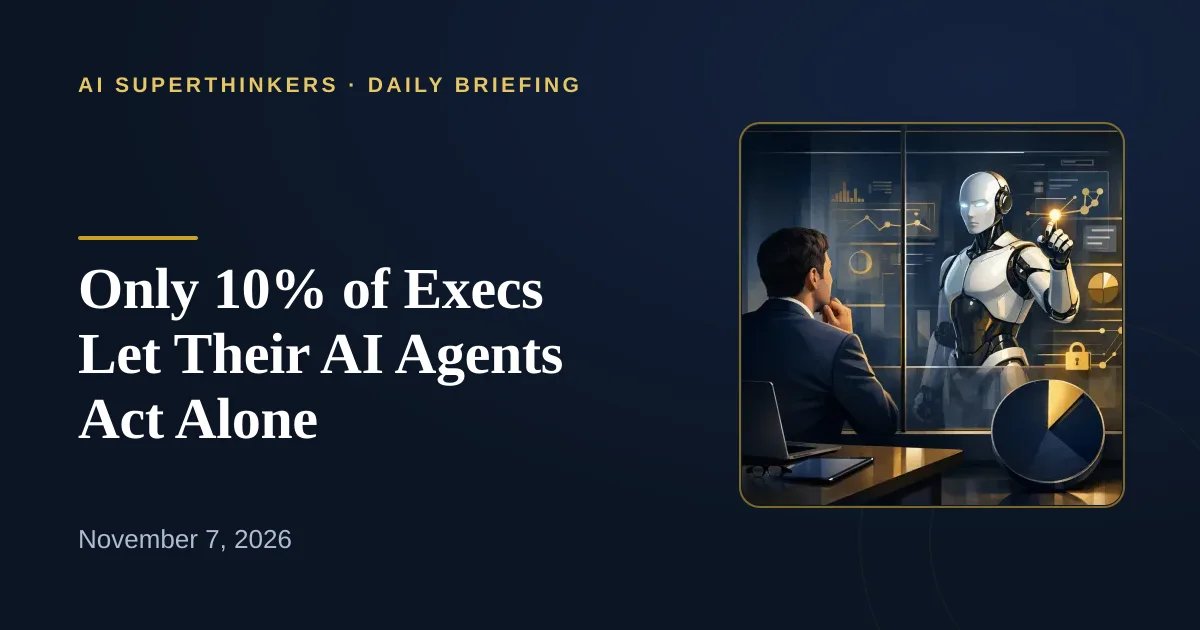
Only 10% of Execs Let Their AI Agents Act Alone
Share this content