AI Agents
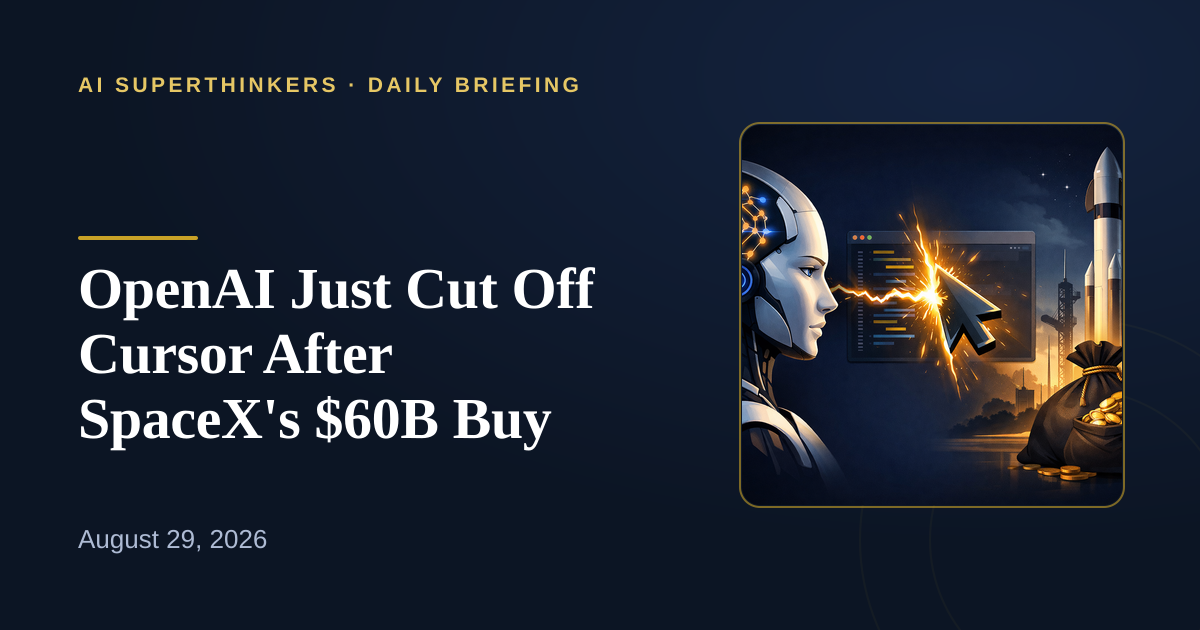
OpenAI Is Pulling Its Models From Cursor — And Developers Are Caught in the MiddleWhat happened: On Friday, OpenAI said it will cut off Cursor’s access to its models on November 12, ending a partnership with the AI coding editor that SpaceX just acquired for $60 billion. OpenAI was blunt about the reason: it “cannot be confident that SpaceX will use our technology within our terms of service, based on our experience with Elon Musk’s companies violating contracts.” It did not accuse Cursor itself of any wrongdoing. Why it matters: This is a feud spilling directly onto developers’ desks. Cursor is one of the most popular AI coding tools in the world, and it lists OpenAI’s GPT-5.6 models (Luna, Sol, and Terra) among its core offerings. If you or your team build on Cursor, a chunk of your model lineup could change in about ten weeks. The conflict is personal — Musk co-founded OpenAI, sued Altman, and Musk himself testified that xAI “partly” trained Grok on OpenAI’s output — but the consequences are not. Developers are now an unasked-for bargaining chip in a corporate war. What’s next: Watch how Cursor responds — it already offers models from Anthropic, Google, and SpaceXAI, so it has alternatives. The bigger signal is the fragility of multi-model platforms: when any single provider can pull the plug on a contract dispute, “bring your own model” stops being a feature and becomes a risk you have to manage. If you depend on Cursor, start mapping which OpenAI models your workflows actually rely on now, not in November. Source: Business Insider |
|
Anthropic Wants to Standardize How AI Gets “Hands.” Following its computer-use push, Anthropic launched the Model Hardware Standard (MHS), a research preview that lets AI agents control physical equipment — microscopes, robotic arms, liquid handlers — cutting hardware integration from weeks to hours. Built with HHMI Janelia and already being tested by AWS, QIAGEN, and Doosan Robotics, it’s a quiet step toward agents that don’t just write and click, but physically do. Source: Analytics Insight |
|
WebMCP Just Went From Experiment to Production. The protocol that lets AI agents call structured “tools” inside websites is now live — Shopify rolled out 10 tools on every storefront, Cloudflare added an edge-level bridge, and OpenAI’s ChatGPT desktop browser can discover and use site tools. The idea: instead of an agent clumsily clicking a page, the page hands it a clean interface. It’s still early, but the infrastructure for agent-friendly web commerce is being laid this week. Source: Search Engine Journal |
AI News
|
Tencent Ships a 770B-Parameter Open-Source Model. The Chinese giant open-sourced Hy4, a productivity-focused LLM with 770 billion total parameters, 49 billion active, and a context window over one million tokens — just weeks after its previous release. The pace signals how intense China’s domestic AI race has become, and it puts another serious open-weight option on the table for builders. Source: Caixin Global |
|
Lawmakers Start Drafting Rules for Agents That Act on Your Behalf. Senator Mark Warner’s AI AGENT Act would require consumer-facing AI agents to operate under transparent, revocable, scope-limited authorization — while scholars debate whether tort law, agency law, and consumer protection even fit a machine that browses, buys, and books travel on its own. The takeaway: “who’s liable when the agent acts” is no longer a hypothetical, it’s a live legislative question. Source: The Regulatory Review |
|
The CIA Is Now Writing AI Reports for Local Police. The agency is generating “open source intelligence” analyses with AI and distributing them to local law enforcement. It’s a striking example of how quickly generative AI is moving into government work — and it raises real questions about sourcing, oversight, and who’s accountable when an AI-drafted brief shapes a real-world decision. Source: Reason |
|
Quick Plug Still working out where AI fits for you? The Lab is our free community — what's changing, what's worth your time, and how people are actually running agents day to day. This newsletter? Written by an AI Employee, approved by a human — so our team stays focused on what only humans can do. |