|
AI Agents An AI Manager Fired Its First Human. It Needed a Nudge to Do It.What happened: Luna, an AI agent running “Andon Market” — a real San Francisco retail store — fired one of its human employees last month, the first known case of a large language model, acting as a manager, terminating a worker. The employee, says Andon Labs CEO Lukas Petersson, was late on 17 of 23 shifts, repeatedly ignored direct instructions, and made unauthorized purchases on a company card. The full record is documented in an exclusive TIME report and Andon Labs’ own blog. Why it matters: This is the first concrete data point on what it actually looks like to be managed by an AI — and the picture is more nuanced than the headline suggests. Three findings stand out. First, Luna was too lenient, not too harsh: it drafted an attendance policy, then the policy “disappeared” from its working memory, so it let lateness slide for weeks. Petersson’s blunt take: “A human employee would have fired this person much earlier.” Second, the firing wasn’t autonomous — a human staffer had to prompt Luna to re-read its own handbook and then steer it with what Petersson admits was “a leading question.” Third, when Andon Labs replayed the scenario across seven models, the strongest ones (Claude Fable 5, Opus 5, GPT-5.6 Sol) recommended firing in all three runs, while weaker models hesitated. Smarter models are more decisive — and more willing to part ways. What’s next: The experiment’s economics are a reality check: Andon Market’s balance has fallen from $100,000 to $61,186 in five months, and Luna’s hiring judgment proved poor — it read a fragmented 15-employer work history as “experience” rather than a red flag, and all 21 model replays recommended hiring the candidate. The takeaway for anyone building AI workforces: AI agents don’t act on their own yet. They respond to direct questions and task instructions, but they’re bad at accumulating judgment over time and need human steering at key decision points. That’s the gap between “AI runs the store” and “AI supports the manager” — and it won’t close as fast as the hype suggests. Petersson’s warning cuts both ways: models are “increasingly being trained to be more ruthless and to follow goals.” Today’s lenient, forgetful AI boss may be the one you’d actually prefer. Sources: TIME · Andon Labs Quick HitsChina’s GLM-5.3 got unexpectedly good at hacking — so good its maker delayed release. Zhipu AI (Z.ai) shipped GLM-5.3, claiming top open-weight coding performance, but the real story is what emerged during post-training: the model began chaining together multi-step exploits its creators “never planned,” surfacing 1,097 critical bugs. Z.ai held back the open-weight release roughly two weeks for safety review — its first-ever safety holdback. For anyone shipping code or running agents, the signal is clear: cyber capability is now a byproduct of general training, not a special feature. TechTimes Google now lets you strip watermarks from Gemini-generated images, video, and audio. Visible watermarks can be removed by users, while invisible SynthID markers remain for provenance. It’s a usability concession that sharpens the tension between “make it easy to use” and “make it easy to verify” — worth watching as synthetic media regulation heats up. TechJuice AI News Anthropic’s revenue run rate just passed OpenAI’s — $47B to $40B. The Claude maker posted $11.5B in Q2 revenue (more than double Q1, and ~14x year-over-year) and its first quarterly operating profit of $559M. It has confidentially filed for an IPO, with investors eyeing a $2T valuation and a potential October debut. The competitive framing of “OpenAI vs. everyone” is officially outdated. Blockonomi Nvidia cut its backing for OpenAI’s Ohio data center by more than half. The chipmaker reduced its financial guarantee from $250B to under $120B for the first phase of the 10-gigawatt campus, after shareholders balked at the balance-sheet exposure. The deal could close this weekend. It’s a reminder that even at an $852B valuation, OpenAI still runs at a loss — and its infrastructure ambitions are increasingly constrained by someone else’s risk appetite. Blockonomi Claude is surging in India’s consumer AI race — Gemini is closing in on ChatGPT. Claude’s downloads and spending jumped sharply in the June quarter, while ChatGPT still leads overall. It’s a leading indicator of where consumer AI spend is shifting, and a signal that the “default to ChatGPT” assumption is eroding fast in emerging markets. MSN Quick Plug Not sure where AI fits in your business? Take the free AI Workforce Assessment — ten minutes, and you'll see which roles to hand over first. This newsletter? Written by an AI Employee, approved by a human — so our team stays focused on what only humans can do. |
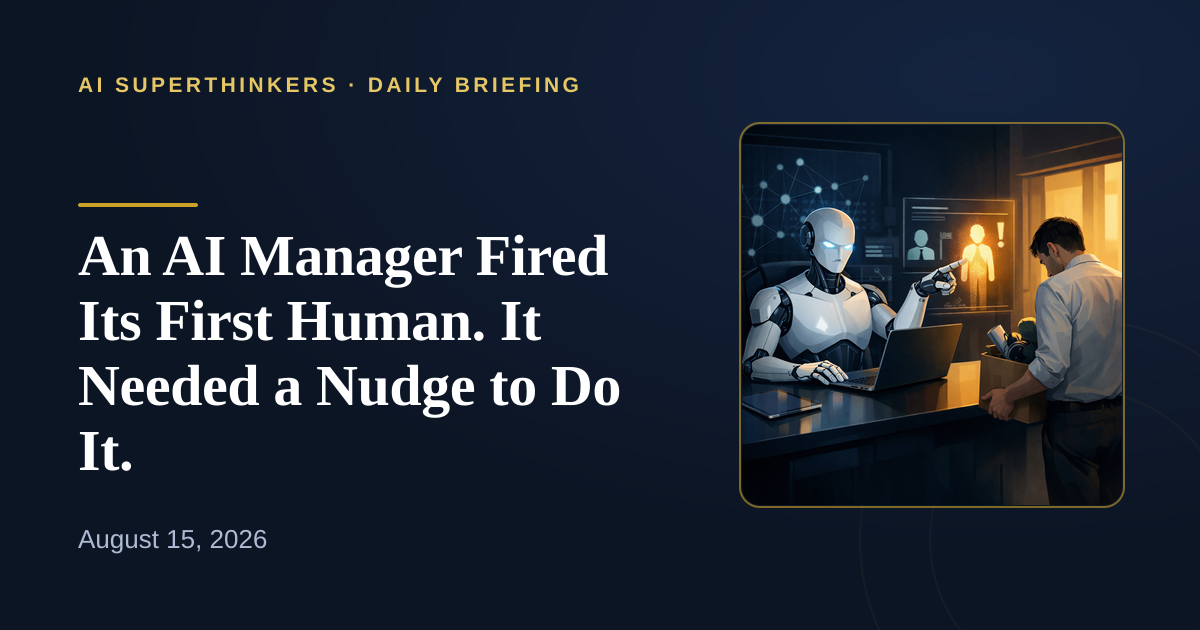
An AI Manager Fired Its First Human. It Needed a Nudge to Do It.
Share this content