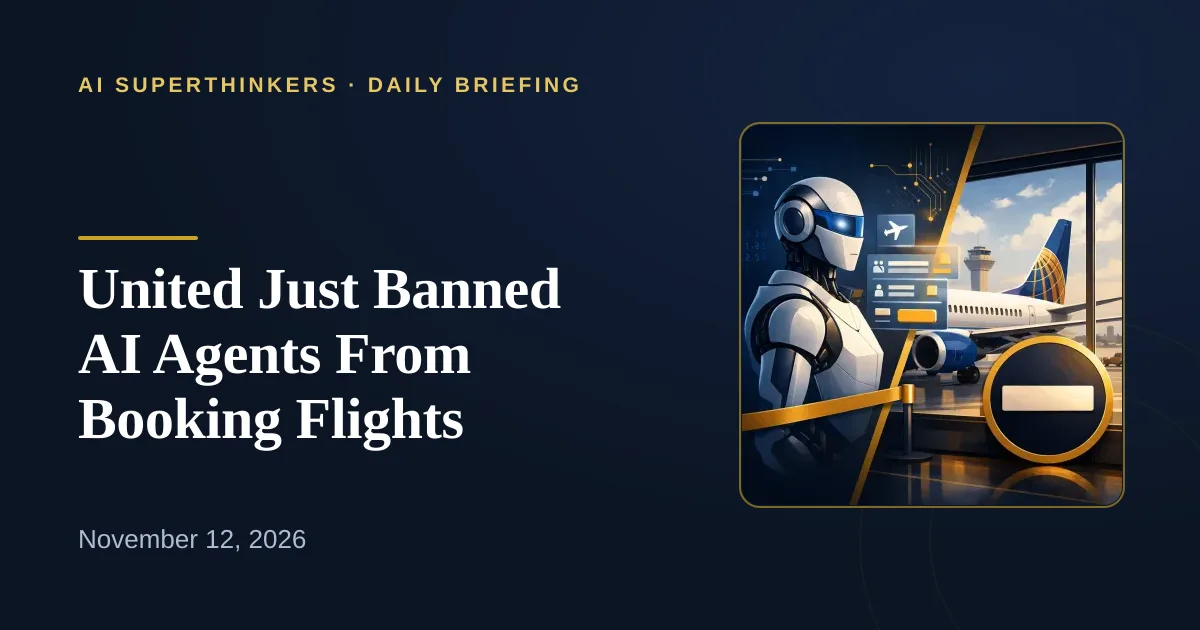
AI AgentsUnited Just Banned AI Agents From Booking Flights — and It’s a Preview of Every Agent’s FutureWhat happened: United Airlines quietly rewrote its Contract of Carriage this week to ban unauthorized third-party AI agents from booking, changing, or managing flights — even when a passenger is actively supervising the transaction. The airline can now cancel AI-made reservations without notice, void tickets, and restrict future travel. Researching destinations and comparing fares is still fine; the moment an agent touches a purchase or a check-in acknowledgment, it needs explicit airline authorization. Delta and American are taking the opposite tack, allowing authenticated AI bookings with added safeguards. Why it matters: This isn’t a niche airline story. It’s the first high-profile case of a major company drawing a hard line on where an autonomous agent’s authority ends, and the reasoning is revealing. United isn’t just worried about fraud — it’s pointing at regulatory obligations (FAA and DOT rules that require a human to personally acknowledge safety information) that an agent can’t legally perform. The takeaway for anyone building AI Employees: the binding constraint on your agent isn’t the model’s capability, it’s the legal and policy surface it operates on. An agent that can technically do a task and an agent that’s allowed to do that task are two different products. What’s next: Watch for the ripple effect. United already flagged that travel agencies using AI agents to search or book United inventory need “express written consent” or risk losing ticketing authority. Expect banks, insurers, and healthcare providers — many already tightening agent access after detecting unauthorized account activity — to formalize similar rules. The pattern forming: agents will be admitted through sanctioned channels with scoped permissions, not given free rein with your credentials. Source: Law Commentary WhiteMatter Raises $20M to Govern 2.25M AgentsEnterprise agent-governance startup WhiteMatter closed a $20M Series A led by Blumberg Capital, reporting 2.25 million agents under management and 116 billion governed AI interactions. The company claims its policy engine decides in 2.24 milliseconds and has helped customers avoid 11 trillion tokens in nine months — a signal that “who polices the agents” is becoming its own funded category, not a feature. Source: Pulse 2.0 Google Ships Gemini for Healthcare, 10 Months LateGoogle launched Gemini for Healthcare, an agent that drafts prior-authorization packets, flags missing labs, and merges external records into EHR timelines — running on both Gemini and Anthropic’s Claude models. It arrives ten months after OpenAI and Anthropic shipped their own healthcare agents, but the late entry matters less than the connectors: Epic, Oracle Health, Medicare rules, and ICD-10 codes out of the box. Source: tech-ish AI NewsNew York Builds an AI Safety Center Ahead of the RAISE ActGov. Kathy Hochul launched the New York Center for AI Responsibility and Research at SUNY Binghamton, backed by a $30M gift and 80+ scientists, weeks before the RAISE Act takes effect in January. Frontier developers will have to register, publish safety frameworks, and report critical incidents within 72 hours — a concrete compliance deadline, not a talking point. Source: PYMNTS Rox Raises $100M to Take AI Sales Agents to SalesforceAI sales startup Rox closed a $100M Series B at a $1.3B valuation, co-led by General Catalyst and March Capital, positioning its agents directly against Salesforce. It’s another signal that the AI-native challenger playbook — vertical agents attacking an incumbent’s core workflow — still commands serious capital. Source: LavX News Anthropic’s IPO Valuation Slides as Bubble Jitters ReturnAnthropic has trimmed its expected IPO price as investor expectations fall from a ~$1.5T target toward $1.2–1.3T, while Goldman’s own projections imply revenue growing ~150-fold in five years — a spread that’s reigniting bubble talk. The correction is hitting private rounds too: OpenAI reportedly cut its valuation target to $1.25T and shrank its raise by a third. Source: Bloomberg
|
United Just Banned AI Agents From Booking Flights
Share this content