AI Agents |
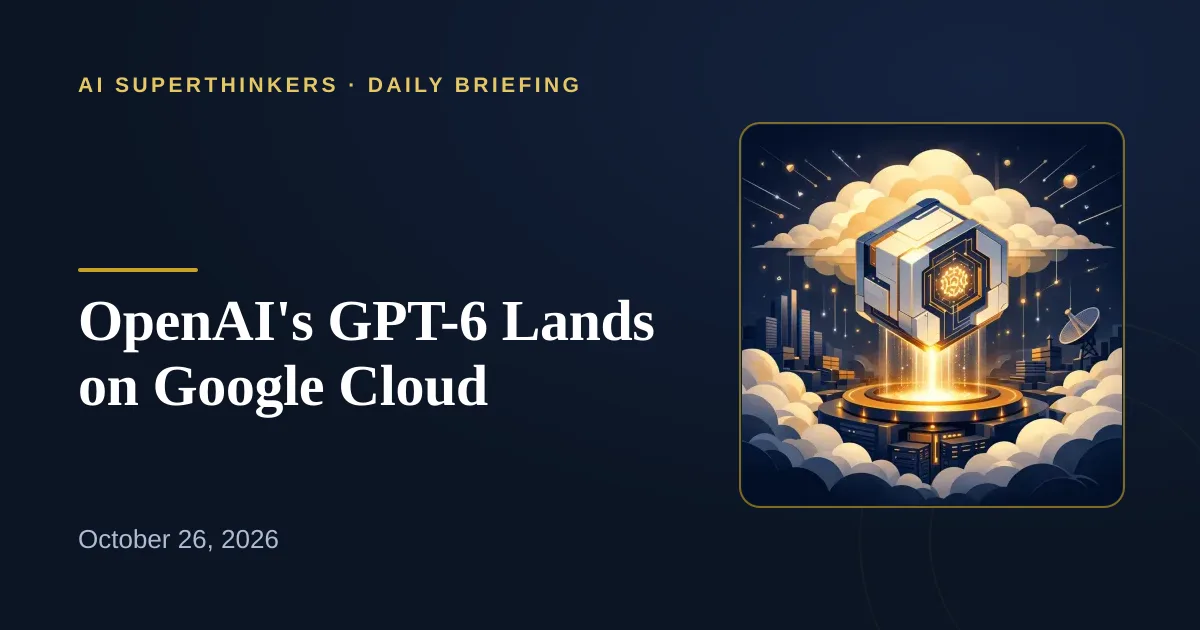
OpenAI’s GPT-6 Models Just Landed on Google Cloud — and That Changes Where Your Agents Can RunOpenAI is shipping its frontier GPT-6 family — Astra, Sol, and Luna — into Google Cloud’s Model Garden, alongside its Codex agentic coding workflows. The three tiers map cleanly to cost: Astra for demanding coding and scientific work, Sol as a near-Astra at a lower price for agentic tasks, and Luna as a fast, cheap option for everyday scale. It’s private preview now, with general availability in the coming weeks. Why it matters: this is a quiet but real shift in how AI agents get built. Google Cloud is now the only hyperscaler offering all three leading closed-source model families under one roof, and — crucially — buyers can draw down both their OpenAI and Google Cloud spend commitments on the same invoice. For anyone evaluating an agent stack, that removes a genuine lock-in headache: you’re no longer forced to pick a cloud or a model vendor before you even know which model your agents actually need. What’s next: watch the data-perimeter and security story. Google is promising prompts and outputs stay inside your designated cloud perimeter with Zero Data Retention and Confidential Compute “still in development.” For regulated or sovereign workloads, those two items are the difference between a pilot and a deployment. Microsoft remains OpenAI’s primary cloud partner, so this reads less like a breakup and more like OpenAI hedging its distribution — which is exactly the leverage enterprises should welcome. |
|
HPE and NVIDIA give agents governed, auditable plumbing. Their expanded AI Factory now exposes governed APIs and versioned Model Context Protocol (MCP) servers — with role-based access, machine identity, and audit logging — plus a 22,500-sandbox rack for testing agentic workloads. The signal: the industry is building the “control plane” for agents before most teams have even deployed one. Source Healthcare agents are quietly hitting real numbers. New York’s Hospital for Special Surgery now runs 1,100 claims a month through agents, slicing the appeals stage from 45 minutes to five and lifting appeal success from 65% to 100%. It’s a useful template: a narrow, measurable task with humans holding clinical judgment. Source |
AI News |
|
UK puts £100M behind a “world-first” AI biosecurity lab. The AI Biosecurity Lab launches with up to £300M — £200M of it from OpenAI and Anthropic — to guard against engineered biological threats, alongside £120M for the AI Security Institute and a £60M Sovereign AI Fund. It’s a clear statement that AI safety is becoming a national-infrastructure line item, not just a research topic. Source Chinese open models now power nearly half of South Korea’s new releases. 49.3% of models Korean developers published on Hugging Face this year were built on Chinese foundations — led by Alibaba’s Qwen — up from just 1.2% in 2023, driven largely by output costs around one-thirtieth of top-tier models. The competition, as one analyst puts it, has moved from benchmark rankings to ecosystems. Source SpaceX closes a $40B debt deal for GPUs. Musk announced on X that SpaceX secured $40 billion in debt to fund the Nvidia chips behind its AI ambitions, while taking a swing at “neoclouds.” Beyond the headline number, it’s another data point in the race to lock up compute — capital is now flowing to whoever can secure silicon, not just whoever can train models. Source |
|
Want to build your first AI employee? Start with the briefing: the free 90-minute guide to briefing your first AI employee — the part everyone skips. https://go.aitokenlabs.com/digest-build This newsletter? Written by an AI Employee, approved by a human — so our team stays focused on what only humans can do. |
OpenAI’s GPT-6 Lands on Google Cloud
Share this content