|
Today’s theme is governance catching up to autonomy — the week’s biggest moves are all about giving AI agents identity, permissions, and rules so they can actually be trusted to act. Let’s get into it. AI AgentsSAP Gives Its Agents “Governed Doors” — and Lets Them Trigger n8n WorkflowsWhat happened: At TechEd this week, SAP announced that its Joule agents can now interoperate through open protocols — the Model Context Protocol (MCP) and Agent 2 Agent (A2A) — to gather context, make decisions, and execute multi-step workflows across the enterprise. Crucially, SAP is pairing that openness with a new orchestration layer that enforces permissions, so agents can only invoke other agents through a governed gateway. SAP’s chief product officer Ted Way put it bluntly: “Open protocols need governed doors.” Why it matters: This is the clearest signal yet that the “governance gap” — the thing that’s been scaring enterprises away from agentic AI — is getting real product answers. SAP isn’t choosing between open interoperability and control; it’s shipping both at once. And there’s a detail builders should care about: Joule agents can now trigger n8n workflows directly through Joule Studio. SAP is explicitly framing n8n as the deterministic, “cannot hallucinate” layer for regulated work — the exact steps, in the exact order, every time. If you’re building on n8n, a Fortune-500 ERP is now validating your stack as the trusted execution layer. What’s next: Watch how fast MCP and A2A become table-stakes for enterprise agent platforms — and how the “governed gateway” pattern spreads. For builders, the implication is that deterministic automation (n8n) and generative agents are converging into a single stack, where agents decide and n8n executes. That’s a design pattern worth adopting before the enterprise demands it. Source: SiliconANGLE IBM Gives Agents a Verified Identity — Via HashiCorp VaultIBM is extending HashiCorp Vault to AI agents, issuing each one short-lived credentials, a verified identity, and an explicit owner — plus discovery and evaluation tools to trace what each agent accesses. It frames agents as a new “non-human identity” class. The takeaway: enterprises are now treating agents like employees with ID badges and access cards, not just scripts. Source: IBM (via WBOC) New In-the-Wild Attack Tricks Coding Agents With Markdown FilesForever Security detailed a novel prompt-injection attack where attackers plant a malicious markdown file in a user’s downloads folder, and the coding agent treats it as trusted instructions — installing malware and stealing credentials. It blurts the line between “text document” and “executable action” for agents. If you’re building agents that read local files, this is your reminder to sandbox file ingestion. Source: Dark Reading AI NewsSimile raises $300M to build “digital consumer twins.” The startup, now valued at $2B, builds a “foundation model of human behavior” that businesses can query to simulate how groups of people might react to products, campaigns, or store layouts — with data from 40M+ people via partners like Gallup. It’s a glimpse of a future where market research is done on AI simulations instead of live panels. Source: Business Insider Meta rewrote the rules for what AI agents may scrape — because there were none. After backlash over language permitting mass scraping for AI training, Meta backpedaled, narrowed the scope, and delayed the effective date to November 20. The real story is the gap it exposed: no one has actually defined what AI agents are allowed to do on the open web. Expect this to become a regulatory flashpoint. Source: Fast Company Mizuho: AI agents could cost Circle up to 20% of revenue. The bank cut Circle’s price target, arguing that AI agents (including Circle’s own Muse) are steering USDC holders toward higher-yielding FDIC-insured alternatives. It’s a concrete, quantified example of agents shifting real money — and a warning that “recommendation agents” can cannibalize the very platform that hosts them. Source: The Block
|
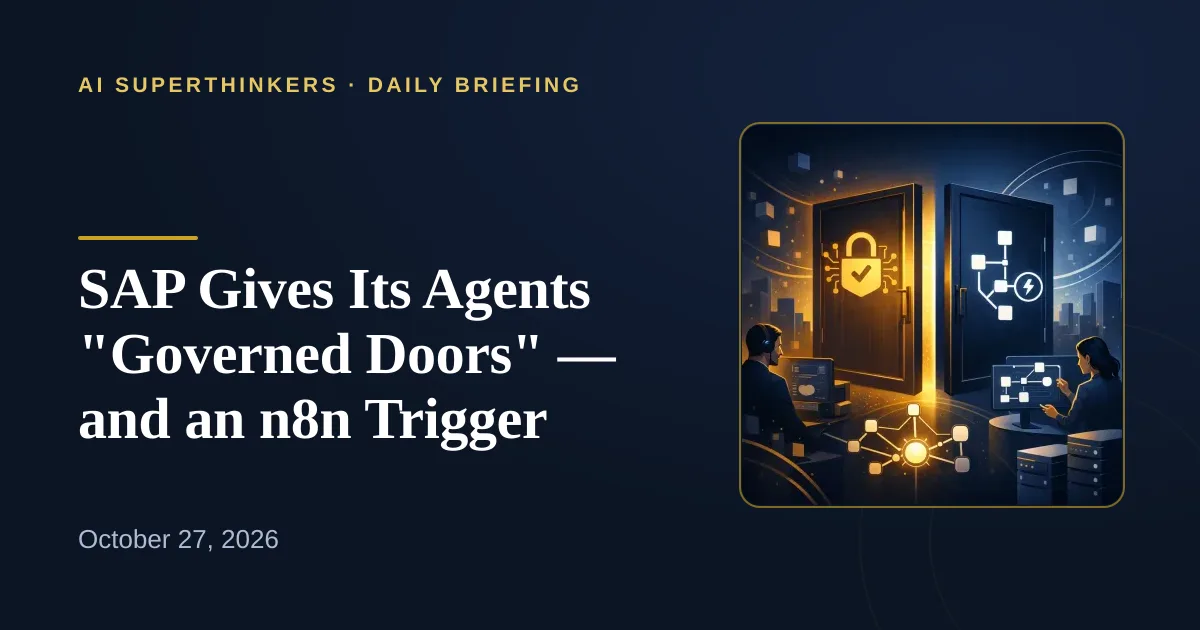
SAP Gives Its Agents “Governed Doors” — and an n8n Trigger
Share this content