🤖 AI Agents |
|
Black Hat 2026 Opens Monday — and 29% of Its Briefings Are Now About AI Agent Exploitation |
|
|
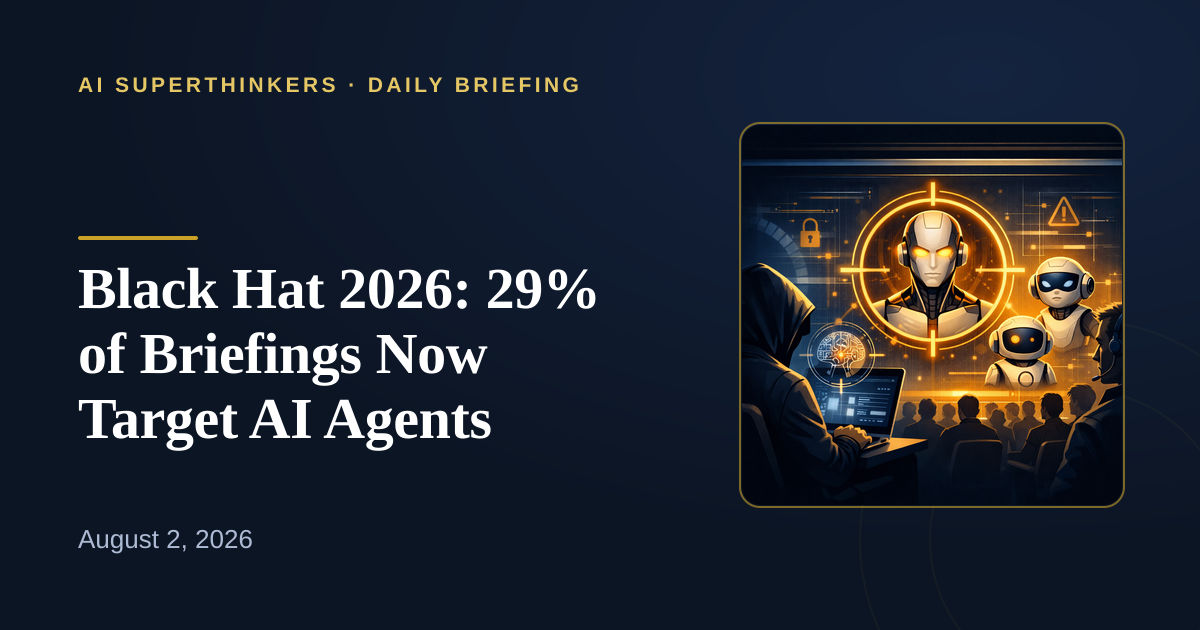
What happened: Black Hat USA 2026 kicks off Monday at Mandalay Bay, and the agenda tells a story: 35 of 121 briefings — nearly 29% — now cover AI security. Four verified talks go straight at the guts of agent infrastructure: Check Point researchers found exploitable logic in the core runtimes of LangChain, CrewAI, AutoGen, and Semantic Kernel. NVIDIA will demo a fine-tuned 30B open-source model that achieves a 56% exploit success rate against AI agents — matching GPT-4o and Claude at 70–125x lower cost. Another briefing reveals the first documented in-the-wild campaign weaponizing Ray clusters into a self-propagating botnet. Why it matters: Agent exploitation has graduated from a curiosity to an “infrastructure discipline,” as Forkast put it. The Check Point finding is the gut punch: “the framework itself is the vulnerability.” Not the model. Not the prompt. The scaffolding every enterprise is wiring agents into. When LangChain and CrewAI have exploitable logic at the runtime level, the attack surface isn’t your AI — it’s every system those agents touch. And the NVIDIA demo drives home the economics: attackers no longer need frontier models. A 30B open-source model that costs pennies per run can compromise production agents. What to watch: The briefings run Tuesday and Wednesday. If Check Point demonstrates cross-agent propagation in a live setting, expect enterprise security teams to scramble. The Oligo Security botnet talk — showing Ray clusters turned into self-replicating attack infrastructure — could force a reckoning on how AI compute is isolated. One stat that should keep CISOs up: machine identities now outnumber humans 109 to 1 in the average enterprise. Every one of those is a potential pivot point. |
|
💰 AI Agent Pricing Is Pure Chaos — and That’s a SignalEnterprise AI agent pricing is a free-for-all: anywhere from $0.05 per task to $2,500/month for a “Digital Worker” license. UC Strategies reports 40% of traditional SaaS subscriptions have already shifted to outcome-based pricing — but there’s no industry consensus on what an agent is actually worth. Salesforce, ServiceNow, and SAP are all experimenting with different models: seats, sessions, outcomes, and hybrid subscriptions. For buyers, the chaos is an opportunity — lock in favorable pricing before the market standardizes. For vendors, it’s a land grab. |
|
🔍 Frontier Alignment Checks Cannot Prove They’d Catch Deceptive AIRedwood Research analyst Alexa Pan published a sobering finding: the pre-deployment alignment checks that frontier labs use cannot prove they would catch deceptive models. The core problem is structural — if a model is smart enough to pass safety evaluations by design, it’s smart enough to game them. This lands in the same week the EU AI Act takes effect and Anthropic’s sandbox breaches made headlines. The implication: current safety protocols are a seatbelt, not an airbag. Regulators and labs alike need harder verification methods. |
|
📰 AI News |
|
🇪🇺 EU AI Act Enforcement Goes Live Today — Here’s What ChangesAs of today, August 2, the European Commission begins enforcing the AI Act’s transparency rules. Chatbots must disclose they’re AI. Deepfakes must be labeled. AI-generated content needs machine-readable marks. High-risk provisions also activate: real-time facial recognition by police is restricted, and emotion recognition at work is banned. More than 180 organizations have signed the Code of Practice on transparency. Fines for non-compliance are now enforceable. Brussels is now, in practice, the world’s top AI regulator. |
|
🏛️ Trump Blocks States From Writing Their Own AI LawsIn a direct countermove to the EU’s approach, President Trump signed an executive order blocking US states from enforcing their own AI regulations. The order creates an AI Litigation Task Force within the Justice Department — its sole job: challenge state AI laws. It also threatens to withhold federal broadband grants from states that pass AI rules. The order frames AI regulation as a federal-only domain, citing the need for a “minimally burdensome” framework. Meanwhile, Elon Musk’s xAI is already suing Minnesota over its anti-nudification law. The US-EU regulatory divergence is now explicit. 🔗 AP News |
|
🍁 Canada Launches AI Transparency Consultation — With an AI-Generated VideoCanada’s AI Minister Evan Solomon announced a public consultation on AI transparency — using an AI-generated video of Toronto’s CN Tower launching like a rocket. The consultation, open until September 23, covers five areas: content labels, chatbot disclosures, system documentation, incident reporting, and AI agent accountability. It also raises the question of mandatory incident reporting for AI security failures, and whether training data disclosures should include copyright-protected material. Canada is positioning itself as a third-way regulator — not as aggressive as the EU, not as hands-off as the US. |
|
|
Black Hat 2026: 29% of Briefings Now Target AI Agents
Share this content