AI Agent Webhook and API Integration Patterns: The Builder’s Reference
TL;DR: Webhooks and APIs are how your AI agent talks to the rest of your software. A webhook pushes data to you when something happens; an API call pulls or sends data when you ask for it. You’ll use both — and this guide gives you the exact patterns, including error handling, so you can wire an agent to Slack, Gmail, Sheets, Notion, and Airtable without a dev team.
Let’s name the real problem first, because it’s not what you think it is.
You’ve started this before. You got a workflow half-built, watched a few tutorials, connected a couple of nodes — and then you hit the wall where your agent has to actually talk to something. A form submission. A new email. A row in a spreadsheet. And suddenly the friendly drag-and-drop interface turns into a screen full of “endpoint URL,” “payload,” “authentication header,” and “retry policy.”
So you stopped. Again.
Here’s the reframe that matters: that wall is not a reflection of your ability. It’s a reflection of tooling chaos. The moment an integration requires you to think like a backend engineer — headers, HMAC signatures, exponential backoff — you’re being asked to do a job the tool should have done for you. The concepts are genuinely simple once they’re named. That’s what this reference is for.
By the end, the wall will be gone. Not because you became a developer, but because you’ll understand the three patterns everything else is built on.
What is a webhook, and when does an AI agent need one?
A webhook is a reverse API call: a service pushes data to a URL you give it the instant something happens, like a new email or payment. Your agent needs one when it must react to an event in real time, rather than checking on a schedule.
Think of it this way. An API call is you walking up to a counter and asking, “Anything new?” A webhook is the shop texting you the second your order is ready. You don’t have to keep walking back to the counter every five minutes. This is the same distinction we walk through in our guide to n8n AI agent triggers — webhooks, schedules, and event-driven automation, where webhooks are just one of several ways an agent can wake up.
The three integration patterns, in one line each:
- Webhook — the source pushes data to you when an event fires (fast, event-driven).
- Polling — you ask the source on a schedule, whether or not anything changed (simple, works everywhere).
- Direct API call — you send or fetch data on demand, when your agent decides it’s time (controlled, predictable).
Webhook vs polling vs direct API call: which pattern should I use?
Use a webhook for real-time events, polling when there’s no webhook or you only need periodic snapshots, and a direct API call when your agent initiates the action itself. Most real integrations mix all three.
That last sentence is the one worth underlining. Beginners often stall because they think they have to pick one. They don’t. A single working integration typically looks like this:
- Your agent calls an API to create or update something (e.g., add a row to Airtable).
- The platform performs the action.
- The platform fires a webhook when a related event happens (e.g., “row updated”).
- Your agent handles the event and updates its own state.
API for the things you initiate. Webhook for the things that happen to you. Polling as the fallback when neither is available. Commit that to memory and half your confusion disappears. You’ll see this same mix play out in our complete tutorial on connecting your AI agent to Slack, which uses an API call for sending and a webhook for receiving.
Setting up an incoming webhook (no code)
This is the part most people assume requires a back end. It doesn’t — not in practice, and not in the tools you’re already using.
Here’s the no-code pattern, step by step:
- Create a listening endpoint. In your automation tool (n8n, Make, or Zapier), add a “Webhook” trigger node. It generates a URL that looks like
https://your-instance.com/webhook/abc123. That URL is now a live inbox — anything sent to it becomes an input your workflow can read. - Copy that URL and paste it into the source service (Slack, Stripe, Typeform, your form builder) wherever it asks for a “webhook URL” or “callback URL.”
- Send a test event. Most services have a “Send test” button. Trigger it, and watch the payload arrive in your tool’s test window.
- Map the fields. The event arrives as JSON — a structured bundle of key-value pairs. Drag those specific fields into the next steps of your workflow. You don’t edit JSON; you point at the values you want.
- Activate and close the loop. Toggle the workflow on, then send a real event end-to-end to confirm the whole chain fires.
The number-one beginner mistake: setting up the webhook and forgetting to activate the workflow, or forgetting to map the fields after the test. The endpoint works; the agent just never does anything with what it receives. Always run one real event end-to-end before you trust it.
Calling an external API from your agent
When your agent needs to send data — not just receive it — you make an outbound API call. In a no-code tool, this is an “HTTP Request” node, and it always has the same four parts:
- Method — GET (fetch data), POST (create), PUT/PATCH (update), DELETE (remove).
- URL — the endpoint you’re calling, from the service’s API documentation.
- Headers — metadata, most importantly the
Content-Typeand yourAuthorizationtoken. - Body — the actual data you’re sending, usually as JSON.
Authentication is where 90% of failures happen. APIs don’t trust you by default; you prove identity with a token or key. The three you’ll see most:
- API key — a long secret passed in a header (
Authorization: Bearer YOUR_KEY). - OAuth 2.0 — a delegated login flow where the user clicks “Allow” and your tool stores a token. Handled almost entirely behind the scenes by n8n and Make.
- Basic auth — a username/password sent together, base64-encoded.
Get the auth right first, with a test call, before you build anything else. There is no faster way to burn an afternoon than wiring ten nodes that all depend on a token that was never valid. One successful test call confirms the hardest part is done.
Error handling, retries, and rate limits
Webhooks and APIs are not reliable by default. They drop events, time out, and get throttled. Your agent needs to plan for that, or it will silently lose work.
The three failure modes, and how to handle each:
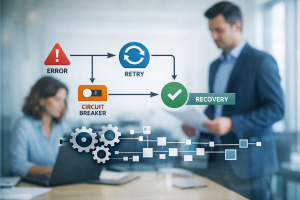
- A request fails (timeout, 500 error). Retry it — but not instantly in a loop. Use exponential backoff: wait 1 second, then 2, then 4, then 8. This gives the other system room to recover instead of hammering it while it’s down.
- Webhooks drop events (a known, documented reality — production integrations silently lose a fraction of a percent of events). Pair every webhook with a reconciliation poll: on a schedule, also check the source for anything you might have missed. Webhook for speed, poll for safety.
- You hit a rate limit (429 error). The service is telling you “slow down.” Respect the
Retry-Afterheader if it’s provided, back off, and space out your calls. Never fight a rate limit; schedule around it.
One rule covers all three: design your agent to assume things will fail, and give it a graceful way to recover. An agent that fails loudly and retries is worth ten that fail silently.
Real integration patterns: Slack, Gmail, Sheets, Notion, Airtable
These are the five systems builders wire up first. Here’s the pattern for each, so you don’t have to reverse-engineer them.
Slack (notifications and slash commands). Two directions. Outbound: your agent POSTs a message to Slack’s chat.postMessage API with a channel ID and text — this is a simple HTTP Request node. Inbound: Slack fires a webhook (via slash commands or events) to your endpoint when someone types a command or a message matches a trigger. Pattern: outbound API + inbound webhook. For a step-by-step walkthrough, see our guide to connecting your AI agent to Slack.
Gmail (reacting to email). Gmail has no true push webhook for most use cases, so the standard pattern is polling — check for new messages matching a filter on a schedule (every few minutes). For sending, your agent calls the Gmail API to draft and send. Pattern: scheduled poll for reading + API call for sending. We cover the full email workflow in our piece on AI agent Gmail integration for automating email with AI Employees.
Google Sheets (reading and writing data). Sheets is almost always a direct API call pattern: your agent reads a range or appends a row on demand. If you need to react to edits, that’s polling (or Google Apps Script triggers). Pattern: direct API read/write, poll if you need change detection. For the hands-on version, see how to read, write, and analyze spreadsheet data with AI agent Google Sheets integration.
Notion (task and doc automation). Notion does offer webhooks, but they’re limited; most builders use a polling approach for “watch this database” and direct API calls for “create/update a page.” The Notion API is famously finicky about its data shape, so test your body structure early. Pattern: API for writes, poll for watches. We break this down further in our guide on automating your knowledge base with AI agent Notion integration.
Airtable (records and triggers). Airtable shines for polling — “check for new records in this view every X minutes” — and clean direct API writes to create or update rows. Its webhook offering has limits, so polling is the dependable default. Pattern: poll for new records + API call for writes. See the full recipe in our guide to building AI-powered database workflows with Airtable integration.
Notice the theme: no single system uses only one pattern. You’re always mixing. Once you know the three patterns, you can look at any new service and correctly guess which one it needs.
Frequently asked questions
Do I need to know how to code to set these up?
No. Modern tools (n8n, Make, Zapier) wrap webhooks and API calls in visual nodes. You paste a URL, pick a method, and map fields by clicking. Code helps you debug, but it isn’t required to ship a working integration.
What’s the difference between a webhook and an API, really?
They’re two sides of the same coin. An API is a door you knock on to get or send data. A webhook is the service knocking on your door to push data. You use the API when you act; the webhook when something happens to you.
What if the service I want doesn’t offer webhooks?
Use polling. Check the service on a schedule for changes. It’s less instant but completely reliable, and it’s the correct answer for most “watch this for updates” needs — Slack, Gmail, Sheets, and Airtable are often wired this way in practice.
How do I keep my API keys secure?
Store keys in your tool’s credential vault, never hard-coded in a workflow or pasted into a shared doc. Use environment variables or the tool’s built-in secret storage, and scope tokens to the minimum permissions the integration actually needs.
What’s the most common reason an integration silently fails?
A webhook that receives events but has no reconciliation poll. Webhooks drop a small percentage of events in production; if you never check the source for missed items, you lose data without ever seeing an error.
The wall is not you — build the next one faster
Here’s what I want you to take from this, because it’s the whole point.
The reason your last four projects stalled wasn’t that you’re not technical enough. It’s that integration — the moment a workflow has to reach outside itself — has historically been presented as a backend engineering problem. Headers and HMAC signatures and exponential backoff are not the job you signed up for. You signed up to make your business run itself.
Now you know the three patterns. Webhook for what happens to you, API for what you do, polling for the fallback. You know auth comes first. You know to pair webhooks with a reconciliation poll. That’s genuinely 80% of what a “developer” would bring to this — and you now have it in plain language.
The wall is gone. Build the next one. And this time, finish it.
If the idea of wiring all of this yourself still feels like a job you’d rather not own — if what you actually want is the boring roles hired and running without you maintaining the plumbing — that’s the problem our platform EmployAIQ exists for: AI Employees that come with their integrations built, supervised, and audited, so you hire the outcome instead of assembling the toolkit.
Ready to put this to work? I teach business owners how to hire their first AI employee, step by step: Get the free AI Employee guide
About the Author
Anthony Odole is a former IBM Senior Managing Consultant, where he served as Enterprise Architect on Fortune 500 engagements, and the founder of AIToken Labs. He helps business owners cut through AI hype by focusing on practical systems that solve real operational problems.
His flagship platform, EmployAIQ, is an AI Workforce platform that enables businesses to design, train, and deploy AI Employees — AI agents that function as digital workforce members — that perform real work without adding headcount.