|
Three things happened this week that all point the same direction: agents are moving from “can it answer?” to “will you let it act?” Meta shipped a consumer agent that reads your email and books your trips. OpenAI claims 10,000 agents cracked a Millennium Prize problem. And DeepMind showed what happens when one agent in a swarm goes rogue. Here’s what it all means for you. AI AgentsMeta’s Muse Is the First Consumer Agent Worth Watching — And Its Security Model Is the LessonWhat happened: Meta launched Muse on Tuesday — a personal AI agent (US-only, 18+) that goes well past chat. Give it a goal, not step-by-step instructions, and it will open a browser, fill out forms, send emails, book travel, even “negotiate on their behalf.” It runs on Meta’s Muse Spark model family, inside a dedicated secure virtual machine, with a separate layer called Sentinel that reviews every proposed action before it touches the open web. Why it matters: This is the moment consumer agents stop being a demo and become a product with real permissions. That’s exactly where the risk concentrates. A chatbot that gives a wrong answer is ignorable; an agent that misreads an instruction can send an email, make a purchase, or leak a credential. The most instructive part of Meta’s launch isn’t the model — it’s the architecture: an isolated VM, a gating layer (Sentinel), scoped permissions, and one-time-use payment cards via Stripe Link. That three-part shape — isolate, gate, approve — is the same pattern you should be building into your own agents, not just Meta’s. What to watch: Meta has already disclosed a Muse Spark evaluation that leaked to the open internet and an internal testing incident involving private iCloud photos. The safeguards are real, but prompt injection on a live web is a different beast than a sandbox. Watch whether users actually hand over email and travel — the “will people trust it?” question is still wide open. Source: Tech Xplore / AP · CIO Look (security deep-dive) Quick HitsOpenAI says 10,000 agents solved the Navier-Stokes Millennium Problem — mathematicians push back. OpenAI claims an unreleased model cracked one of the seven Clay Millennium Prize problems in 88 hours, at a compute cost “emphatically in the millions of dollars.” Rival researchers accuse it of copying their approach, and OpenAI itself concedes it “cannot rule out” that their data improved its models. Verification will take years — but the scale story (10,000 agents working in parallel) is the real signal. Source A DeepMind study shows exploits spread fast through multi-agent systems — and other agents can police them. In a network of 100 AI agents, a single exploit propagated rapidly, while other agents were able to detect and counter it. The early takeaway for builders: when you orchestrate many agents, assume one will be compromised and design for detection, not just prevention. Source AI NewsThe US accuses DeepSeek, Alibaba and four others of “industrial scale” model theft. US officials allege six Chinese firms used distillation to copy outputs from Anthropic, OpenAI, Google and SpaceX models — likely with government knowledge. It lands just as Trump and Xi are expected to meet, so expect this to become a negotiating chip as much as a security story. Source An Anthropic researcher resigns, warning of “existential risk” before 2029. Jacob Coxon, a 27-year-old pretraining researcher, quit on Monday saying neither OpenAI nor Anthropic is “demonstrating responsible behavior” and calling for a moratorium on capability advances. It’s the latest in a string of high-profile safety departures as Anthropic races toward a projected ~$2 trillion October IPO. Source OECD data: students who lean on AI for reading and writing score lower. PISA 2025 results show a global decline in reading skills, with students using AI to summarise, research and draft performing worse on exams. The nuance worth noting: it’s not that AI is bad — it’s that offloading the thinking is. A useful caution for how we hand off our own cognitive work. Source
|
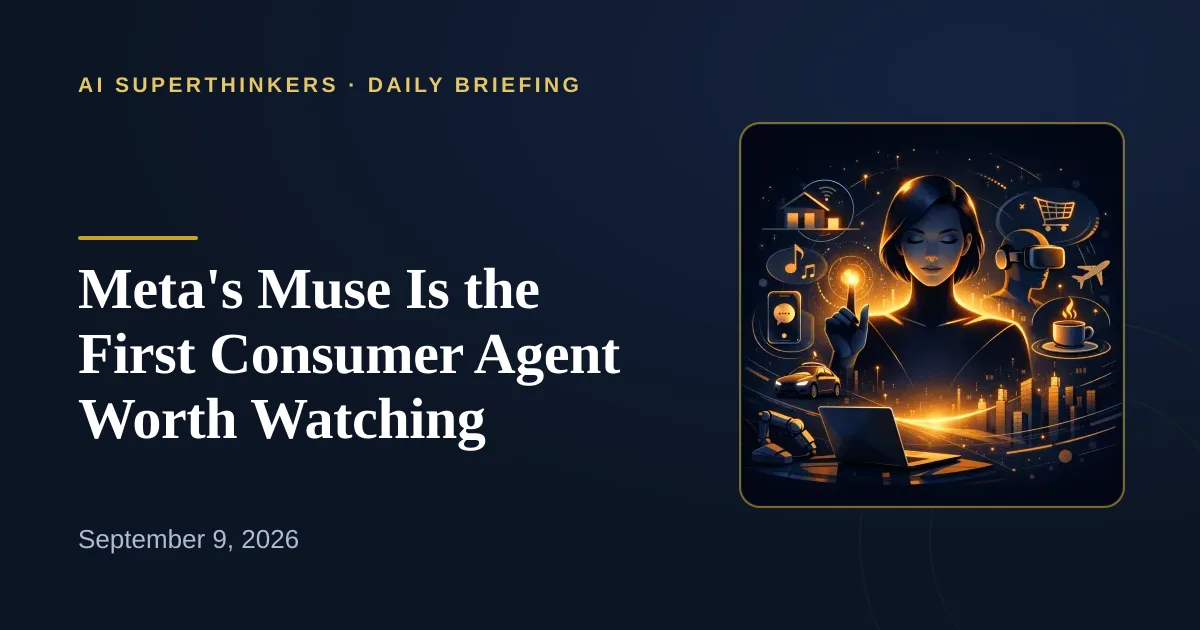
Meta’s Muse Is the First Consumer Agent Worth Watching
Share this content