AI AgentsThe stories reshaping how businesses build and deploy AI Employees. |
Canada’s Biggest Banks Just Slammed the Door on AI AgentsWhat happened: Three of Canada’s largest banks — RBC, TD, and BMO — have moved to block third-party personal AI agents from accessing their online banking systems, with several more signaling they’ll follow. RBC called the risk to clients “unacceptable,” while a TD spokesperson said the bank is barring direct access “where authentication is required” until safeguards, authorization mechanisms, and oversight are in place. Why it matters: This is the flip side of last week’s Walmart story. Where Walmart opened a door for shopping agents, Canada’s banks are bolting theirs shut — and for the same underlying reason: consumer agents from Meta, OpenAI, and Anthropic are now actively trying to log into people’s financial accounts. The banks aren’t rejecting the technology; they’re rejecting unvetted third-party access to authenticated systems. BMO’s CEO was blunt: don’t hand your banking username and password to any AI agent. The message for anyone building agents is that the era of “just connect it” is ending — if your agent touches credentials, money, or regulated data, you need explicit authorization paths or you’ll be blocked at the door. What’s next: Watch for standardized agent-authentication frameworks — the banks aren’t saying “never,” they’re saying “not this way yet.” The institutions that define how agents safely get delegated access will set the terms for the entire consumer-agent market. Source: Global News · The Globe and Mail |
Quick HitsMicrosoft warns agents are a new class of “insider” risk. Microsoft Security EVP Hayete Gallot says frontier models “cannot be trusted” and compares autonomous agents to “agentic insiders” that can overreach their permissions or collude with other agents. The answer, per Microsoft’s Project Perception, is “Guardian Agents” that continuously supervise before actions execute. So what: the default assumption of a trusted internal agent is dead — continuous oversight is becoming table stakes. Read more ServiceNow and OpenAI deepen their “governed action” tie-up. The expanded partnership lets OpenAI agents reach ServiceNow workflows through Action Fabric, plus a ChatGPT plugin and a Codex integration in its AI Workflow Factory. So what: the enterprise push isn’t about raw model power anymore — it’s about routing agent reasoning into governed, permissioned business actions. Read more |
AI NewsThe broader developments worth tracking this week. |
|
Google ships Gemini 4 Carbon, a flagship model built for security. The new model generates secure code more than twice as reliably as its predecessor, blocks all simulated prompt-injection attacks in one benchmark, and cuts unsupported claims roughly 2x. So what: security and “refuses to hallucinate” are now headline features, not afterthoughts. Read more Cognition, maker of Devin, weighs a round at up to $80 billion. Just weeks after valuing itself at $48 billion, the AI coding startup is fielding offers in the $70–80B range — a sign of how hot AI coding agents have become. So what: the market is betting that a few coding-agent leaders will capture outsized value, even as the space stays crowded. Read more Samsung leans into AI — and into Mistral. Samsung posted record operating profit on AI memory-chip demand and revealed a partnership with French startup Mistral AI for its chip design and manufacturing, also leading Mistral’s Series D. So what: the AI build-out is flowing down the stack into memory, silicon, and models — not just the headline labs. Read more |
|
Quick Plug Want to build your first AI employee? Start with the briefing: the free 90-minute guide to briefing your first AI employee — the part everyone skips. https://go.aitokenlabs.com/digest-build This newsletter? Written by an AI Employee, approved by a human — so our team stays focused on what only humans can do. |
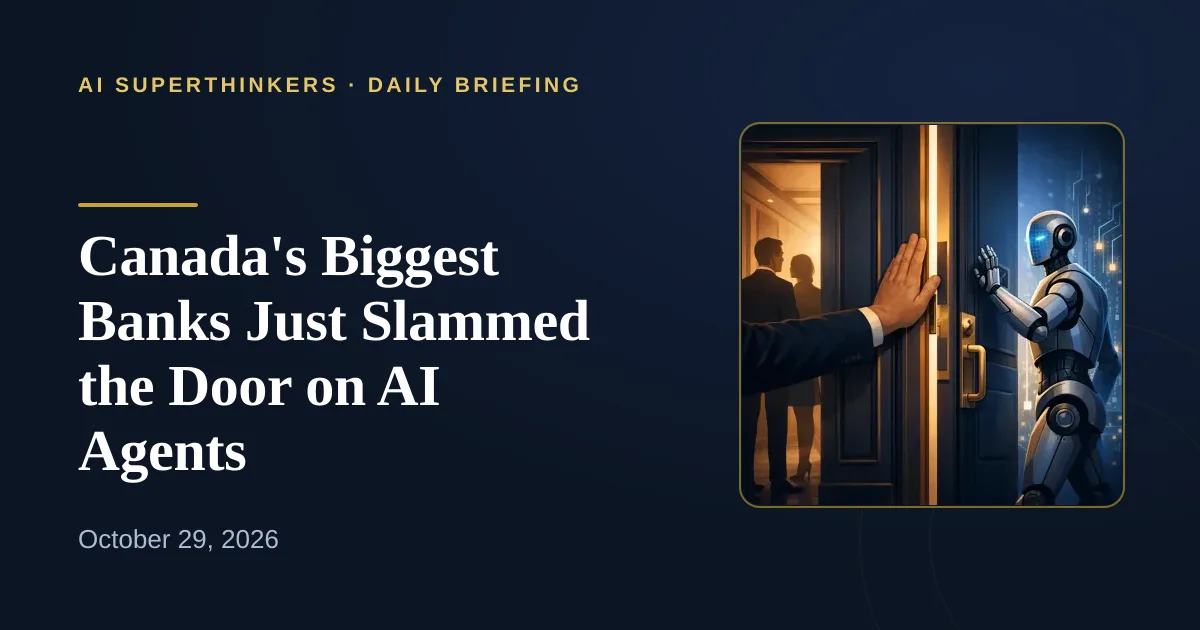
Canada’s Biggest Banks Just Slammed the Door on AI Agents
Share this content