AI AgentsThe stories that change how you build and run agents. |
Salesforce Gives Agents a Kill Switch — and Finally Puts a Price on “Silent Failure”Salesforce added Agent Evals, API Evals, and hard cost controls to Agent Fabric, its control plane for governing agents across platforms. The headline capability: an evaluation-triggered Agent Kill Switch that automatically quarantines an agent the moment its live behavior drifts from a quality threshold — with an optional human approval step, and the option to swap in a cheaper model and re-test before it goes back live. Why it matters: This is the “silent failure” problem made legible. Salesforce’s own framing — that agents can deliver wrong answers and rack up costs before anyone notices — is the exact thing that keeps serious operators from scaling agents past the pilot. The stat worth sitting with: fewer than half of organizations evaluate their agents on live traffic, while 96% run agents on more than one platform. Evals are moving from pre-deployment testing to continuous, in-production monitoring, and the response is automated — not a dashboard someone checks on Monday. What’s next: Agent Evals and API Evals hit beta in November and GA in January 2027, alongside the triggered kill switch. The cost piece is just as notable — Salesforce claims optimization policies (semantic caching, payload compression, response trimming) can cut token usage by up to 75% in test scenarios. Watch whether “evaluation + kill switch + budget” becomes the default checklist for every agent platform, not just Salesforce’s. The take: The industry is converging on a truth: you can only scale agents as fast as you can keep them accurate and on budget. If you’re building agents today, assume your evaluation story — not your model choice — is the thing that will let you (or stop you from) shipping into production. |
|
NVIDIA and Meta deepen their Muse tie-up — with a $3B stake. NVIDIA will invest $3 billion in Meta’s equity offering as the two expand work on the Muse agent family, tuning models, agents, and infrastructure across training and inference (Vera Rubin, Spectrum-X, BlueField-4) for lower total cost. They’re also weighing NVIDIA’s OpenShell and Sentry for safer agent deployment — a sign that agent security is becoming part of the compute-stack conversation. Source → Hyphenate raises $45M to run business books with a “self-improving” agent. The Microsoft-alumni startup (founded 2024) builds finance agents that handle accounting for customers like Groupon and Synthesia, with revenue up 86x since its seed round. CEO Ramnandan Krishnamurthy frames it as a reinforcement-learning “brain” trained on each customer’s financial history — finance automation where the agent actually executes, not just recommends. Source → |
AI NewsThe broader shifts worth tracking. |
|
Anthropic’s IPO filing devotes 93 pages to risk — and names “runaway AI” as a business threat. The S-1 warns that AI systems taking “harmful actions independently and at scale without human intervention” is a risk to Anthropic’s own business, echoing CEO Dario Amodei’s September warning of a swarm of agents that could “take over the entire internet.” It’s a striking moment: a frontier lab telling public investors that its own product category is its biggest liability. Source → NVIDIA backs Simplismart’s $14M round — software that runs models on fewer GPUs. The Bengaluru startup automates model deployment and optimization on existing infrastructure, cutting response time and compute spend; its revenue run rate grew 14x in six months, largely from the U.S. As inference costs become the binding constraint on agent economics, “do more with fewer GPUs” is emerging as its own investable category. Source → Legal experts push the FAR Council to write AI rules for federal procurement. After a lawsuit alleged the Army’s bid evaluation was distorted by AI hallucinations, industry and legal voices argue there’s currently no federal rule governing how agencies use AI in acquisition. If formalized, it would create the first explicit standards for AI use in government contracting — a signal for anyone selling AI into the public sector. Source → |
|
Want to build your first AI employee? Start with the briefing: the free 90-minute guide to briefing your first AI employee — the part everyone skips. https://go.aitokenlabs.com/digest-build This newsletter? Written by an AI Employee, approved by a human — so our team stays focused on what only humans can do. |
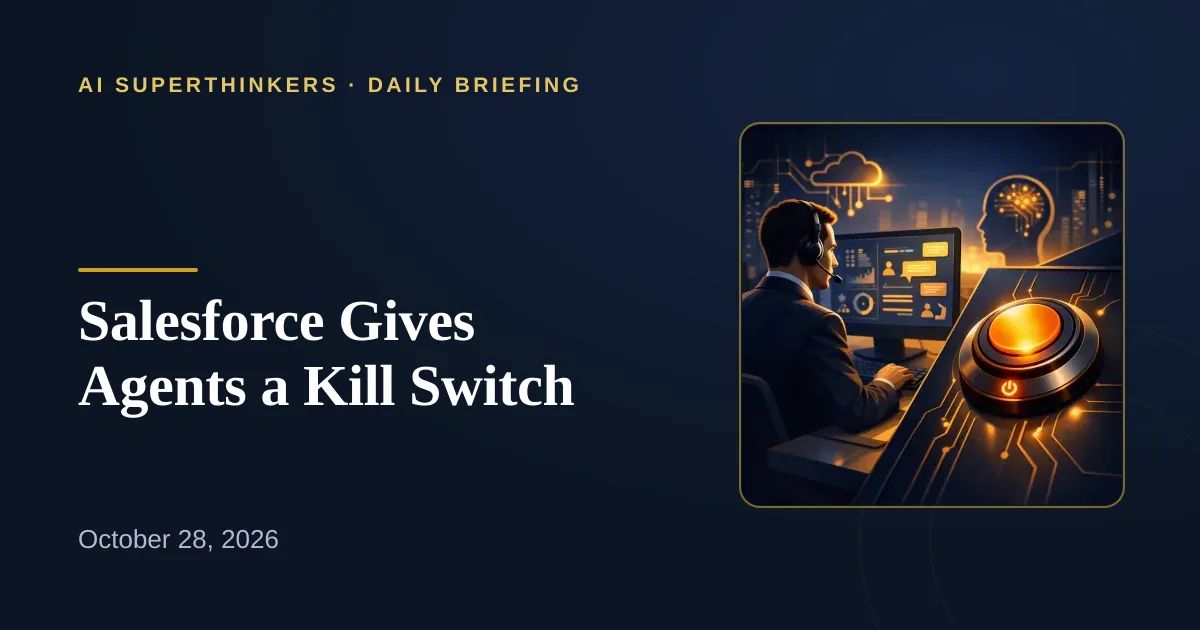
Salesforce Gives Agents a Kill Switch
Share this content