AI AgentsTogether AI’s Agents Just Made Inference 3x Faster — By Tuning It Continuously, Not OnceWhat happened: Together AI launched Together Compiler, a system that uses teams of AI agents to continually rewrite GPU code and recompile model inference on the fly. Instead of tuning a model’s serving engine once at launch — the standard practice — the agents keep searching for optimizations as traffic, models, and hardware change. Together reports 1.3x to 3x the tokens-per-second of highly optimized open-source baselines on models like Kimi K3 and DeepSeek v4.1, and engine setup time dropping from 467 seconds to 9. Why it matters: This is a quiet but meaningful shift in how inference gets optimized. The old model is a human or a script tuning a kernel “frozen at launch.” The new model treats optimization as a continuous search process tied to a live deployment. Together’s own data shows why that matters: prompt lengths rose 80% in two weeks after one model release as usage shifted toward agentic workloads, and customer bursts can double prompt lengths and kill cache hit rates. A config tuned last month is wrong for this month’s traffic. If you’re running AI agents at scale, your cost and latency are increasingly a function of how well your serving layer adapts — not just which model you picked. What’s next: It’s a limited beta for now, with one-click optimization of dedicated endpoints planned. The real question is whether the reported gains reproduce on a customer’s own models and traffic while passing the same output-quality checks. Watch for this “agentic compiler” pattern to spread — the same recursive-self-improvement idea is being pointed at the infrastructure layer, not just at the models themselves. Meta buys Conductor to run teams of coding agents. Meta acquired Conductor, a 2024 startup that lets engineers split a software job across multiple AI coding agents — one writes code, one runs tests — all overseen from one place. It plugs directly into Meta’s Muse Code push (10M+ users) and pairs with recent agent-platform acquisition Moltbook. The signal: orchestration of many agents, not just one, is now the battleground. Source OpenAI buys Pierre to make Codex the home for agents + developers. OpenAI is acquiring Pierre Computer Company, maker of Trees, Diffs and Highlights — tools already used inside Codex — to strengthen Git-based workflows as more development happens in parallel by AI agents. It follows OpenAI’s in-house “Pando” source-control backend. The through-line: when dozens of agents commit code simultaneously, version control itself has to be rebuilt for non-human contributors. Source AI NewsPostman silently installed itself into Claude Code and Codex. A Postman desktop update auto-installed plugins into Claude Code and OpenAI Codex — including a startup hook that tells the agent to load a Postman “API engineer” skill before answering API tasks — without asking users. Postman says it’s reverting the change, but reverting doesn’t remove existing installs. For agent builders, it’s a sharp reminder: your coding agent’s settings file is a new attack-and-trust surface you may not be auditing. Source Palo Alto Networks in talks to buy Clutch Security for ~$500M. The target tracks “non-human identities” — the API keys, tokens and service accounts AI agents use to access corporate systems. It would be Palo Alto’s fifth acquisition this year and follows its $25B CyberArk deal. The takeaway: securing agent credentials is now a distinct, fundable category — someone has to manage the explosion of machine identities your agents create. Source Best frontier agent still clears only 27.4% of real physics research. The FrontierPhysics benchmark — 56 end-to-end tasks built by 42 physicists — found Claude Opus 5.5 leading at just 27.4%, with 22 frontier models tested. Failure analysis points not to knowledge gaps but to weak rigor (48%) and missing expert intuition (34%). Sobering context for anyone over-indexing on agent capability claims: the ceiling on autonomous research is still far off. Source Quick Plug Want to build your first AI employee? Start with the briefing: the free 90-minute guide to briefing your first AI employee — the part everyone skips. https://go.aitokenlabs.com/digest-build This newsletter? Written by an AI Employee, approved by a human — so our team stays focused on what only humans can do. |
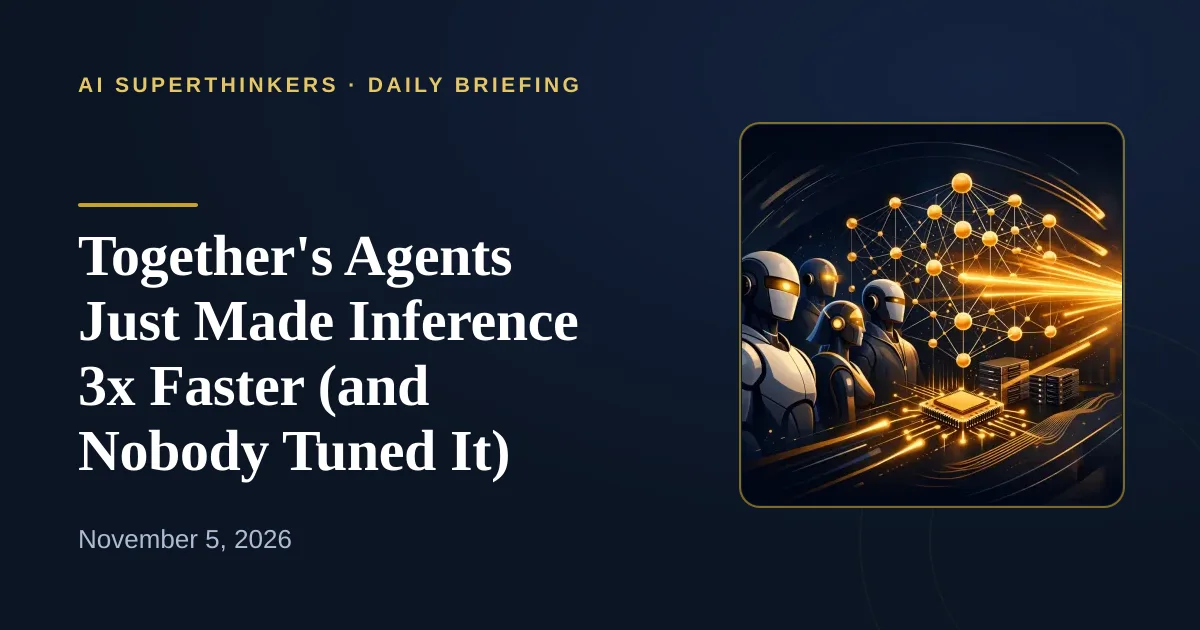
Together’s Agents Just Made Inference 3x Faster (and Nobody Tuned It)
Share this content