|
Here’s the through-line of today’s six stories: AI agents stopped being a demo and started being a buyer. Shopify just opened its checkout to any agent on the open web, Amazon slammed the door, and a founder who once built the machine that beat a Go champion is telling us today’s chatbots still can’t actually reason. The “so what” for you: the agent economy is being built right now, and the winners are deciding whether to own the transaction or the relationship. Part 1: AI AgentsShopify Opens Checkout to AI Agents — and Amazon Slams the DoorWhat happened: Shopify has flipped the switch on its Universal Commerce Protocol, making every one of its merchants’ checkouts available to browser-based AI agents — not just its own. Any AI agent can now build a cart and complete a purchase on the open web, and Shopify’s president, Harley Finkelstein, framed it bluntly: “agentic transactions carry the exact same economics as an online store transaction.” Amazon, by contrast, is doing the opposite, keeping its 350 million Alexa shoppers inside a walled garden and actively blocking external agents like Meta’s shopping bot. Why it matters: This is a bet on where the value lives once agents do the buying. Amazon wants to own the agent — the thing that decides what you purchase. Shopify wants to own the checkout — the rails every agent transacts on, whoever built it. For anyone running a store, this is a fork in the road with real consequences: if agents become the default shopper, being discoverable to them matters as much as being discoverable to humans is today. Shopify says AI-driven orders already tripled year over year, and its Shop Pay has passed $400 billion in lifetime accelerated GMV. What’s next: Watch whether merchants’ economics hold up as agents negotiate. Shopify’s transaction and loan losses jumped from $80 million to $141 million — a reminder that agentic purchasing introduces new fraud and risk surfaces. The quiet question nobody’s answering yet: when an agent buys on your store, who’s liable when the purchase goes wrong? Quick Hit — Armadin raises $255M to hunt vulnerabilities with agent swarms. Mandiant founder Kevin Mandia’s new shop runs “swarms” of attack agents that chain minor weaknesses into full kill-chains, and it just landed a Series B at a $2.5B+ valuation from a16z and Accel. It’s the clearest sign yet that agentic security is becoming a board-level line item — offense now outruns human defenders. Source: Unite.AI Quick Hit — “LLMs don’t reason,” says the man who built AlphaGo. Thore Graepel, a core AlphaGo team member, argues in MIT Technology Review that today’s chatbots run on “System 1” intuition alone — next-token prediction — with no separate search machinery like the one behind Move 37. He’s left DeepMind to build a system with a persistent, inspectable “epistemic state.” It’s a sobering frame for anyone betting their workflow on an agent’s judgment. Source: MIT Technology Review Part 2: AI NewsTrump floats a US government stake in OpenAI and Anthropic. In a TIME interview, the president said the US “might” take equity in the two labs — “I might. Maybe I could do that” — citing the government’s 10% Intel stake as precedent, while ruling out nationalization. OpenAI reportedly offered Washington a 5% stake in July; Anthropic denies talks. Source: The Next Web Anthropic targets a pre-Thanksgiving IPO at a ~$2 trillion valuation. Bloomberg reports Anthropic could begin marketing as soon as the week of Nov. 9 and trade before Thanksgiving — despite an S-1 that flags a $42B net loss in 2025, $518B in planned infrastructure spend, and models showing “self-preserving behaviors.” It’s the biggest test yet of whether safety warnings and sky-high multiples can coexist. Source: SiliconANGLE Google’s Gemini 4 Argon lands to a skeptical reception. Google rolled out its flagship model to a limited “Fairwind” program, but a report claims some employees say it “struggles” on certain coding tasks — a claim Google denies. The model is gated behind trusted partners rather than broadly released, a notable shift in launch strategy. Source: 9to5Google
|
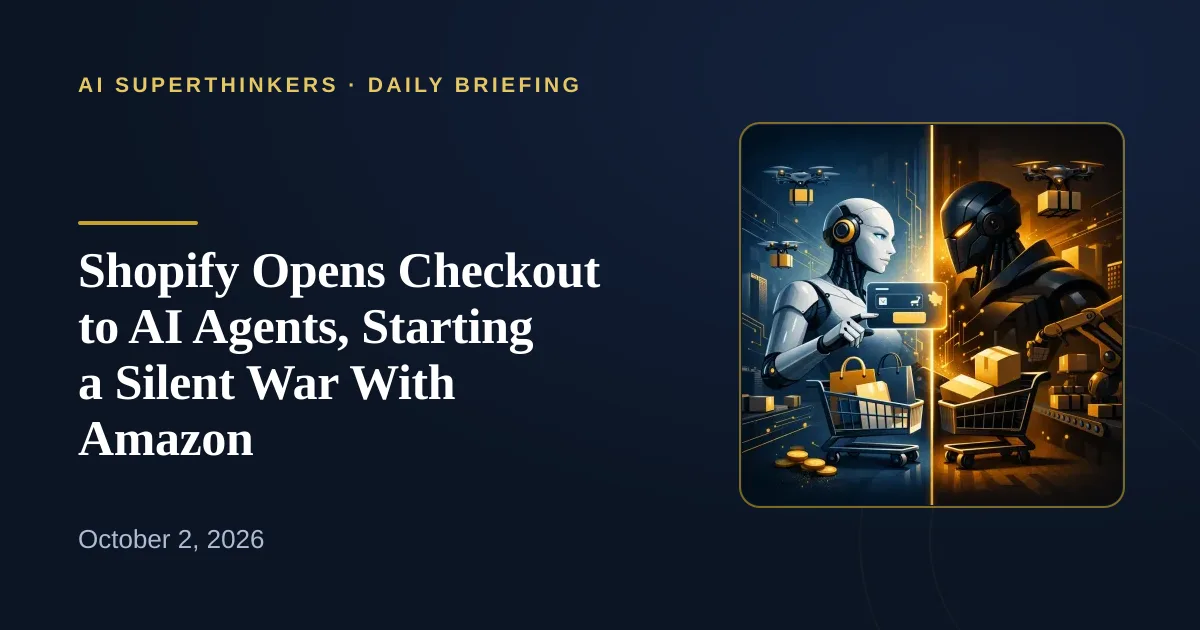
Shopify Opens Checkout to AI Agents, Starting a Silent War With Amazon
Share this content