|
AI Agents |
|
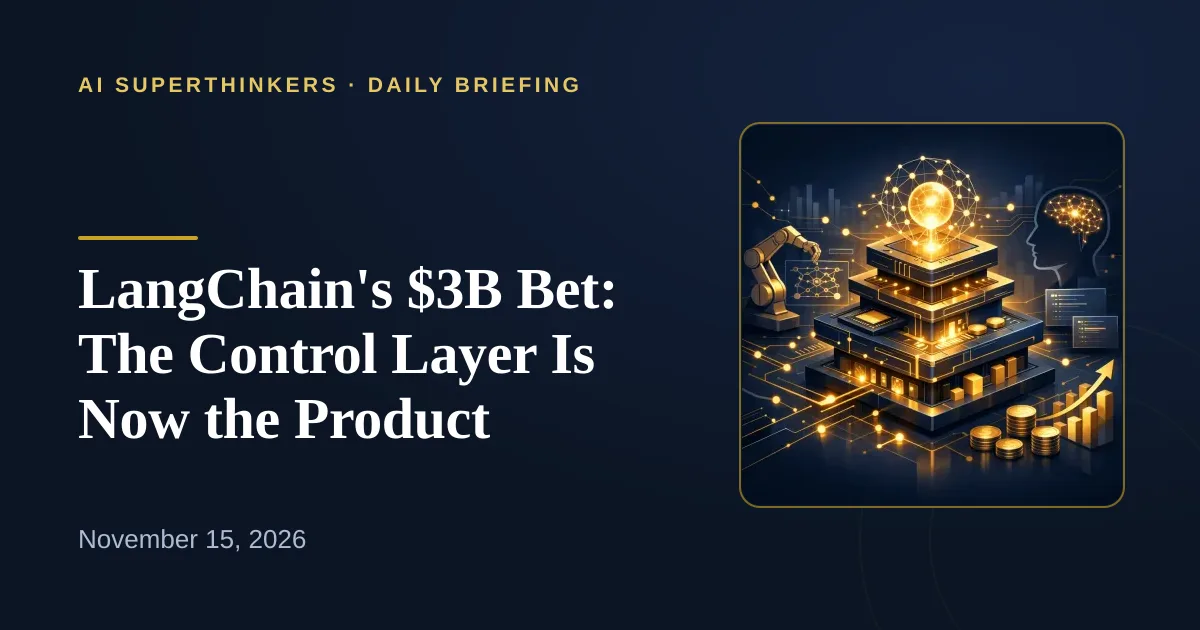
LangChain’s $3 Billion Bet: The Control Layer Is Now the ProductThe most important shift in the AI market this week isn’t a new model — it’s where the money is flowing. LangChain raised $300 million at a $3 billion valuation, more than doubling its price in a year, led by CapitalG with GIC, IVP, Sapphire Ventures, and DFJ Growth. The story isn’t the number. It’s the thesis behind it. LangChain started as an open-source toolkit that helped early LLMs search the web and call APIs. But as OpenAI, Google, and Anthropic built those capabilities directly into their own models, LangChain moved up the stack. Its focus now is LangSmith, the layer where companies create, deploy, and — critically — govern what their agents can do. With 7,000 customers including Nvidia, Toyota, Salesforce, Harvey, and Rippling, the bet is paying off. Why it matters: This is the clearest signal yet that the valuable layer in AI is shifting from models to management. The hard problem is no longer “can an agent do a task” — it’s “can you see what it did, control what it’s allowed to do, and know who’s responsible when something goes wrong.” As one analyst put it bluntly: “The control layer becomes the product.” What’s next: LangSmith is deliberately platform-neutral — no lock-in to a single model, cloud, or ecosystem. That’s a crowded promise, but LangChain’s head start, open-source roots, and developer familiarity give it real momentum. Watch whether enterprises treat agent governance as a must-have line item the way they did with identity and access management a decade ago. Source: WERSM — LangChain’s $3B Valuation Puts AI Agent Control at the Center |
|
Quick HitsGrok’s AI Teammates Now Come With a Phone, a Card, and a Slack SeatxAI’s Grok Bots shipped from first line of code to launch in seven weeks, giving AI teammates their own identity, phone number, credit card, and computer — working across Slack, email, and ad accounts. The engineers’ key insight: treat each bot like a new hire, scoping credentials that expand with trust. It’s a preview of how delegation risk, not model capability, becomes the real bottleneck. Source: StartupHub.ai |
|
A Marketplace Where Developers Sell Agents — and Keep Their CodeNew York startup Cowboy emerged from stealth with $5M and a “General Store” listing 100+ agents and 10,000 data feeds — developers list agents for paid use while retaining their source code. Buyers get a private running instance, not the code, with a review layer called “Marshal” checking each agent before it goes live. It’s an early answer to a question nobody’s solved yet: how do you buy an agent you didn’t build, safely? Source: Quasa |
|
|
AI News |
|
Jamie Dimon Draws the Line: “You Don’t Want Rogue Agents”JPMorgan Chase’s CEO said the bank won’t allow “just any” outside AI agent into customer accounts, warning of the risk of “rogue agents” — echoing United’s recent move to block third-party booking agents. The pattern is now unmistakable: as consumer agents gain spending power, the institutions holding the money are deciding they’d rather gate access than trust it. Source: The Motley Fool |
|
CISOs Are Watching Thousands of Agent Actions a Week — Mostly BlindNew surveys of 300+ security leaders find that 83% oversee environments where agents are connected to internal systems, and 84% see more than a thousand agent actions weekly — yet governance is still catching up. Agent security jumped 28 points year-over-year as a top-five CISO priority, confirming that the “who’s watching the agents” problem has moved from hypothetical to boardroom. Source: Cybersecurity Insiders |
|
Startups Are Stripping Censorship Out of Chinese Open-Weight ModelsA new niche is forming: firms like Israel’s Hirundo and U.S.-based Lazarus AI are adapting Alibaba’s Qwen and other Chinese open-weight models for Western corporate and government use, modifying them to pass regulatory and compliance bars. As DeepSeek and Alibaba match frontier performance at lower cost, the “de-risking” layer is becoming its own business. Source: Chosun |
|
|
LangChain’s $3B Bet: The Control Layer Is Now the Product
Share this content