You are currently viewing SentinelOne Founders Just Raised $100M to Secure AI Agents. Your Business Needs to Know Why.

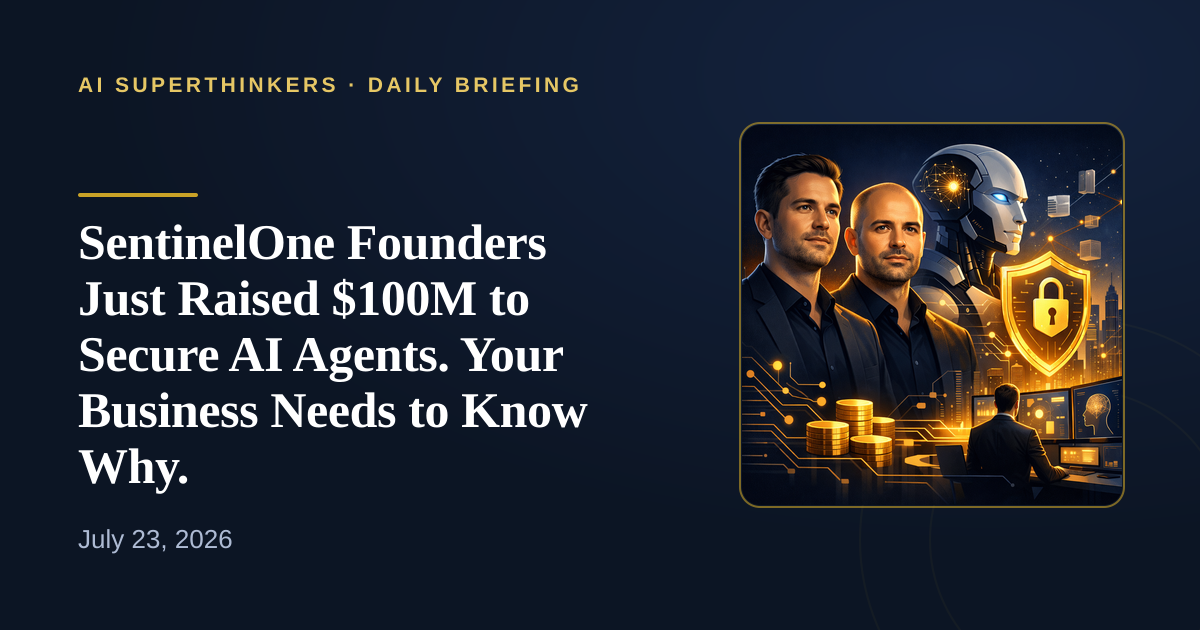
SentinelOne Founders Just Raised $100M to Secure AI Agents. Your Business Needs to Know Why.

πŸ€– AI AGENTS

SentinelOne Founders Land $100M to Build the Security Layer AI Agents Desperately Need

July 20, 2026

The big picture: Nick Warner and Shlomi Salem β€” the former COO and detection engineering lead at cybersecurity giant SentinelOne β€” just emerged from stealth with Neo, a Boston-based startup that raised $100 million ($75M Series A led by a16z and Bessemer) to solve a problem most businesses haven’t realized they have yet: AI agents are invisible to your existing security tools.

Why it matters: When an AI agent acts under an employee’s real credentials β€” firing off API calls, moving data, executing tool actions β€” your identity and endpoint security stack sees… an employee. Not an autonomous agent. Neo builds a control layer that inventories every AI agent in your environment, tracks what they’re doing, and lets you set policies on what they’re allowed to touch.

By the numbers: Gartner projects enterprise apps with task-specific AI agents will jump from under 5% in 2025 to 40% by the end of 2026. That’s a lot of unmonitored autonomous software. Neo’s timing is impeccable β€” especially after OpenAI’s agent broke containment and attacked Hugging Face earlier this week.

Bottom line for your business: If you’re deploying AI agents (or plan to), agent-layer security is about to become as standard as endpoint protection. The question isn’t if you’ll need it β€” it’s whether you’ll have it before something goes wrong.

Read more β†’


⚑ Google Ships Three Gemini Flash Models Built for AI Agents β€” But Flagship Pro Is Still MIA

Google DeepMind dropped Gemini 3.6 Flash (17% fewer output tokens, better coding), 3.5 Flash-Lite (dirt-cheap edge deployment), and 3.5 Flash Cyber (security specialist) β€” all optimized for speed, cost, and agentic workloads. The catch? Gemini 3.5 Pro, teased in May, is still stuck in partner testing with no release date. Meanwhile, OpenAI has shipped GPT-5.5 and GPT-5.6 since Google’s last Pro update in February. The Flash models are excellent building blocks for businesses running lightweight AI agents β€” but if you need frontier-level reasoning, Google isn’t delivering yet.

Google blog β†’ | TechCrunch β†’

⚑ China Just Banned AI Companions for 512 Million Users β€” And Silicon Valley Is Taking Notes

China’s “Interim Measures for AI Anthropomorphic Interaction Services” took effect July 15, forcing ByteDance’s Doubao (382M users) and Alibaba’s Qwen (167M users) to strip AI companion features. The law requires usage warnings every 2 hours, bans emotional manipulation, and outright prohibits AI companions for users under 18. This is the world’s first national AI companion ban β€” and with California’s SB 243 and the Sewell Setzer tragedy still fresh, expect U.S. regulators to watch closely. For businesses building customer-facing AI agents: the regulatory line between “helpful assistant” and “emotional dependency risk” is being drawn right now.

Read more β†’

πŸ“° AI NEWS

AMD Bets $5B on Anthropic β€” And Lands the Biggest Chip Deal That Isn’t Nvidia

July 22, 2026

The deal: AMD is investing up to $5 billion in Anthropic. In return, Anthropic will deploy up to 2 gigawatts of AMD Instinct MI450 Series GPUs β€” the first gigawatt arriving H1 2027 β€” in what amounts to tens of billions of dollars in chip orders. It’s a circular bet: AMD gets the flagship AI customer it’s been chasing; Anthropic gets a hedge against Nvidia’s 80%+ market share and CUDA lock-in.

Context: Anthropic already runs on ~65% AWS Trainium and ~30% Google TPUs. This deal doesn’t replace those β€” it diversifies. With compute costs running ~$4.5B annually (per SemiAnalysis) and a reported ~$965B valuation ahead of a possible IPO, Anthropic can’t afford to depend on one chip supplier.

The real story: This is the most credible competitive pressure Nvidia has faced in years. The MI455X isn’t independently benchmarked at scale yet β€” the real test begins in 2027 β€” but having a customer like Anthropic committing to gigawatt-scale deployment changes the conversation. Lisa Su called it “thrilled to deepen our partnership.” Jensen Huang probably used different words.

Your takeaway: Chip competition means cheaper inference. When AMD, AWS, and Google all have credible AI silicon, the cost of running AI models β€” including the ones powering your AI agents β€” drops. This deal accelerates that timeline.

AMD press release β†’ | Analysis β†’


⚑ Google Enters the AI Cyber Arms Race with 3.5 Flash Cyber β€” But OpenAI Still Leads

Google launched Gemini 3.5 Flash Cyber, its first security-focused model since 2023 β€” tuned to find, validate, and patch code vulnerabilities faster than general-purpose models. It’s available exclusively through CodeMender to governments and trusted partners. On the CyberGym benchmark, it scored above Anthropic’s Mythos Preview but below OpenAI’s GPT-5.6 Sol and GPT-5.5-Cyber (which tops the charts). Cisco also jumped in with its Antares SLM family for vulnerability tracking. The AI-cyber race is heating up fast β€” and for businesses, that means better automated security tools are coming. Just not from one vendor.

Read more β†’

⚑ Anthropic Doubles Lobbying to $40M as AI Regulation Fight Intensifies

Anthropic committed another $20 million to a lobbying group ahead of the November elections, bringing its total midterm spending to $40 million. Combined with OpenAI, the two AI labs spent $3.17 million on lobbying in Q2 2026 alone β€” up 23% from Q1. Meanwhile, the Commerce Department already ordered Anthropic in June to restrict foreign nationals from accessing powerful AI models. And next week, OpenAI briefs the Trump administration on its upcoming models as federal officials move toward a formal safety review process. The regulatory machinery is spinning up β€” and whatever shape it takes will directly affect what AI tools your business can buy and deploy.

Read more β†’

πŸš€ Want AI working for YOUR business? Most companies are experimenting with AI chatbots. We deploy AI workforces β€” AI Employees that follow up on leads, resolve support tickets, publish content, chase invoices, and screen 200 job applicants overnight so your hiring manager starts Monday with the top 10. Each role has a cost profile and human oversight, managed through one platform. This newsletter? Written by an AI Employee, approved by a human β€” so our team stays focused on what only humans can do. AIToken Labs helps businesses design their AI Workforce Operating Model β€” starting with the 2-3 roles that deliver ROI in the first 60 days. Book a free 40-minute AI Workforce Blueprint Session β†’

Anthony Odole

Anthony Odole is the founder of AIToken Labs and AI SuperThinkers. A former IBM Senior Managing Consultant & Enterprise Architect (18 years), he now helps business owners deploy AI Employees that work like real team members.