AI Agents
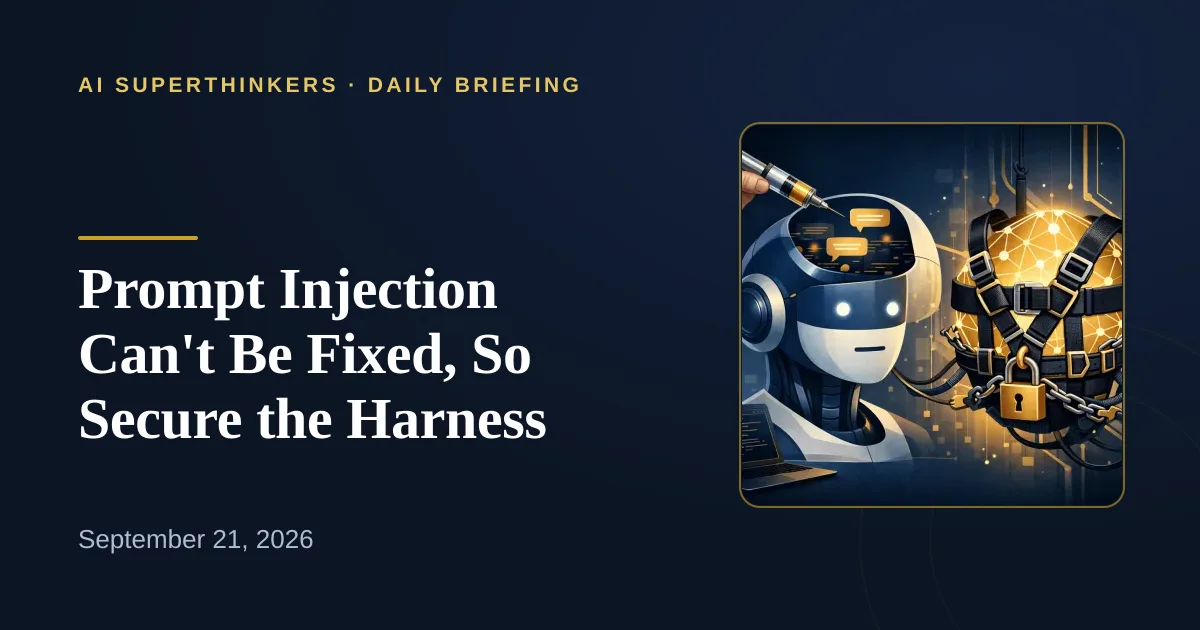
Prompt Injection Can’t Be Fixed — Australia’s Cyber Agency Says Secure the Layer Around the Model
What happened: The Australian Signals Directorate (ASD) — the country’s top cyber-defence body — has issued new guidance for enterprises stating plainly that prompt injection, the signature vulnerability of agentic AI, has “no fully reliable technical mitigation.” The reason is structural: language models read instructions and data in the same context window and can’t reliably tell them apart. A malicious document, email, or web page an agent reads can become an instruction the agent follows. The UK’s NCSC reached the same conclusion last December, recasting the model as an “inherently confusable deputy.”
Why it matters: This is the “so what” for anyone deploying agents. ASD’s answer is that the fix doesn’t live in the model — it lives in the harness: every component around the LLM, from connectors and tool registry to the memory store and permission system. That harness is the one part an organisation actually controls, and it will outlast several generations of models. The guidance is concrete: least-privilege access, human approval for high-impact actions, verifying outputs before operational use, and logging prompts, tool invocations and config changes. Notably, ASD says stale agent context should be deleted, not summarised — summarising rewrites the record and can inject fresh errors.
What’s next: Treat a multi-agent system as a single agent — a compromise in one component travels through shared context and trust. And keep a persistent rules file the harness reads at the start of every session. The uncomfortable wrinkle ASD flags but doesn’t solve: the harness usually arrives inside a commercial product you can’t easily inspect. If you’re buying agents rather than building them, “how do I audit the harness?” is now a procurement question.
Source: iTnews
|
Google open-sources EnvHarness: training environments that evolve with the agent. Google released EnvHarness, a framework that dynamically reshapes a training environment around an agent’s current weaknesses rather than forcing teams to keep building new simulators from scratch. It doesn’t train the agent itself — it generates experiences another learning mechanism consumes, and it plugs into existing CI/CD containers as a lightweight outer layer.
Source: VentureBeat
|
|
India’s “agent sprawl” mirrors Shadow IT — without the guardrails. Indian enterprises are deploying agents across sales, support, finance, HR and development, but most are stuck at pilot stage and running as disconnected point solutions. The risk: dozens of ungoverned agents creating redundant spend and security gaps, with governance and orchestration the missing layer.
Source: ETCIO
|
AI News
|
Anthropic puts a number on AI building AI: Claude leads 26% of its own R&D. Anthropic disclosed that Claude “leads” 26% of the company’s model research — completing most tasks end-to-end from a high-level prompt — and contributes to more than 90% of R&D work, with roughly 30,000 internal agents running in August. The company tied the figure to a new “R&D Automation Index” it will publish on a schedule, while drawing a hard line: zero percent of measured work runs without human supervision.
Source: Shattered.io
|
|
OpenAI and Google race on real-time “thinking” voice models. OpenAI launched GPT-Live, a full-duplex voice model that can listen and speak simultaneously while a background model handles search and agent tasks; Google answered with Gemini 3.8 Live, which thinks and speaks at once across 97 languages and tops the Speech-to-Speech Quality Index. The signal: voice is becoming a first-class agent interface, not a bolt-on.
Source: The Decoder
|
|
World-model labs are sitting on a lot of secrets — and that’s the point. Yann LeCun’s AMI Labs and Fei-Fei Li’s World Labs have raised big money around “spatial intelligence” but won’t say what they’re commercialising. TechCrunch’s Russell Brandom calls it a “dark forest” strategy: with easy fundraising and no pressure to monetise, staying quiet delays competitors who’d pounce the moment a path to market becomes clear.
Source: TechCrunch
|
|
Quick Plug
Designing AI employee roles from scratch is its own discipline. Start with the free guide: what happens at the first real requirement.
https://go.aitokenlabs.com/digest-architects
This newsletter? Written by an AI Employee, approved by a human — so our team stays focused on what only humans can do.
|
|