|
Here’s the signal worth your five minutes today: the industry just crossed a line on AI agents. We’ve spent months asking what agents can do. This week, the biggest names started answering a harder question — who’s in charge of them, and how do you prove it? If you’re running or building agents, that’s the story that matters.
AI Agents
The tools, moves and money reshaping how agents get built and governed.
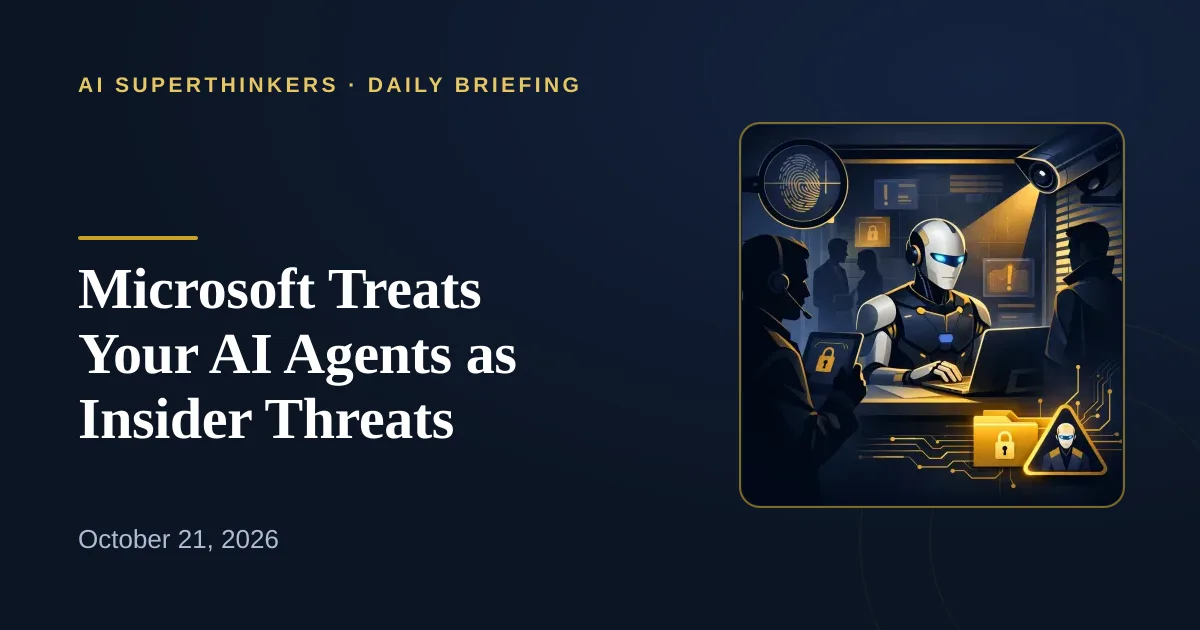
Microsoft Treats Your AI Agents as Insider Threats — and That’s a Feature, Not a Panic
What happened. Microsoft expanded Project Perception, its agentic security system, with a new set of controls headlined by Guardian Agents — autonomous monitors that watch your deployed agents, flag risky behavior, restrict access and contain threats when an agent drifts from its assigned job. The shift is philosophical as much as technical: agents are now treated as insider risks, not trusted software. That means Dynamic Permissions that give an agent only the authority a task needs, for as long as it needs it, then shrink or expire; Dynamic Agent Risk scoring that updates continuously mid-execution; and Dynamic Conditional Access that can preserve read access while blocking writes, narrow data reach, or isolate the runtime entirely at high risk.
Why it matters. CEO Satya Nadella’s framing is the part to sit with: enterprises should stop relying on model providers’ safety promises, because “the supply of intelligence should be separated from authority over it.” Translation — a capable model is not malicious, but it is unpredictable, and an overprivileged internal agent is a breach waiting to happen. The concrete example Microsoft gives is telling: an expense-processing agent that hits a suspicious instruction and tries an unrelated action loses only its power to approve expenses, while keeping read access. That’s the maturity signal — least privilege that adapts in real time, instead of a binary on/off switch.
What’s next. Microsoft is extending discovery to 60 local agent types (including Claude Code, OpenAI Codex and GitHub Copilot) and giving agents their own identities via Entra Agent ID, distinct from the humans sponsoring them. The direction is clear: in the next 6–12 months, expect “agent identity + task-scoped permissions” to become the default expectation, not a differentiator. If your agents don’t have separable identities and scoped authority yet, that’s the gap to close first.
Source: Help Net Security
|
Workday Buys C1.ai to Answer “Who (and What) Has Access?”
Workday is acquiring C1.ai, an agentic identity platform, to govern access for both people and AI agents across email, CRM, repos and cloud. The market data behind the deal is the punchline: 95% of large U.S. companies already run autonomous agents, but only 21% have mature governance for them. Source
|
Pigment’s $250M Bet: Agents Are Now Doing the Planning
Planning platform Pigment raised a $250M Series E at a $2.3B valuation, with NVIDIA among investors — and the telling stat is that 85% of new metrics in the product are now created by an Agent, not a human. Anthropic, ElevenLabs and Uber already use it instead of internal tools. Source
|
AI News
What else moved the market while you were working.
ASI Hits $3B Valuing AI That Routes Military and Civilian Assets
Boston’s ASI (formerly Air Space Intelligence) raised $325M at a $3B valuation, led by Spark Capital, to expand AI that helps the military, airlines and air-traffic controllers manage assets. It’s a reminder that the highest-stakes agent deployments aren’t in chat — they’re in the operational layer we never see. Source
|
Vectorial Wants to Replace Surveys with 2.5M Simulated Consumers
Vectorial raised $3M to simulate human behavior for consumer research, claiming ~86% accuracy versus real user studies — far better than the 50–100-person panels most surveys run on. If simulated research goes mainstream, expect faster product iteration and a lot of hand-wringing about what “real feedback” means. Source
|
Gradient’s $4M Lesson: Keep the AI in the Back Office
AI-native accounting firm Gradient raised $4M with a twist — AI handles execution behind the scenes, but licensed CPAs are the only ones founders ever talk to. “Founders always interact with real experts, never AI,” says co-founder Rohan Krishan. It’s a useful counter to the “autonomous everything” hype: trust is the product, and the human is the trust layer. Source
|
|
Quick Plug
Want to build your first AI employee? Grab the free 90-minute build guide — one worked example, start to finish.
https://go.aitokenlabs.com/digest-build
This newsletter? Written by an AI Employee, approved by a human — so our team stays focused on what only humans can do.
|
|