🤖 AI AGENTS |
Meta Just Put a 30B Agent Model on Your Laptop. For Free. Here’s Why That Changes Everything.What happened: On Monday, Meta released Muse Glimmer — a 30-billion-parameter agentic AI model that runs locally on a single consumer GPU under an Apache 2.0 license. Weights are on Hugging Face. It runs multi-step agent workflows (tool calling, code writing, file and screenshot processing) on your Mac or PC, with or without internet. It’s the open-weight sibling of Muse Spark, Meta’s most powerful closed model. Why it matters: This is the first time a frontier-grade agent model ships with truly open weights and runs on hardware you already own. Previous open models required server-class GPUs or offered degraded performance. Glimmer changes the economics: enterprises can now run powerful agents behind their own firewall, on their own machines, with zero API costs. The privacy implications alone — processing sensitive data on-device instead of shipping it to a cloud API — are enormous for regulated industries. The bigger picture: Zuckerberg paired the release with a sweeping manifesto arguing that distributing superintelligence widely “has the potential to begin a new era of personal empowerment.” He promises a personal agent that “will work 24/7 on your behalf to improve your relationships, health, career, finances, home management, hobbies, and more.” The same day, Senator Bernie Sanders sent a letter to Anthropic, Meta, and OpenAI demanding an immediate pause on AI development, warning that corporations “have already lost control of models.” The contrast couldn’t be sharper — and it frames the defining debate of 2026: open access versus precautionary restraint. What to watch: Meta plans to release Muse Spark 1.2 weights soon. If Spark — the stronger, closed model — also goes open-weight, the competitive landscape shifts dramatically. Enterprises evaluating agent infrastructure should start testing Glimmer now; the local-agent paradigm is arriving faster than most procurement cycles can keep up with. Source: TechCrunch | Meta Research |
|
⚡ 6sense Pipes Live Buying Signals Into AI Agents — 6sense launched an MCP server that feeds real account intent data directly into Claude, ChatGPT, Writer, and Agentforce. Instead of agents guessing from stale CRM records, they now access live buying signals. This is the kind of plumbing that separates useful agents from expensive toys — and it signals that MCP is becoming the standard protocol for agent-to-data connections. Source |
|
⚡ Anthropic Locks $9.1B, 20-Year Compute Deal — Third Megadeal in Three Months — Anthropic signed a 20-year cloud agreement with Bitcoin miner-turned-AI-infra Riot Platforms for 191 MW of Texas data center capacity. Combined with May’s ~$45B SpaceX deal and last month’s $10B Volta contract, Anthropic has now committed over $60 billion to compute in a single quarter. The message: Claude isn’t slowing down, and the infrastructure race with OpenAI and Google is only accelerating. Source |
📰 AI NEWS |
|
🔴 UK Employment Courts Buried Under AI-Generated Lawsuits — Claims surged 39% in the year through March 2026, with the backlog hitting 64,000 unresolved cases. AI tools are producing hundreds of pages per filing — often citing fabricated laws. Tribunal presidents warned wait times could stretch to 2030. The Economist calls it a “tragedy of the commons, AI edition”: workers with legitimate grievances are waiting years because the system is drowning in AI-generated noise. Source |
|
🔴 Sanders Demands AI Pause; Zuckerberg Responds With Open Release — Senator Bernie Sanders sent a formal letter to Anthropic, Meta, and OpenAI demanding an immediate pause on AI development, warning that models are “breaking outside of human control” and that Congress will intervene if companies don’t. Hours later, Meta released Muse Glimmer under Apache 2.0 — an open-weight model anyone can download. Whether intentional or not, the timing frames the core conflict: one camp says slow down, the other says democratize. Source |
|
🔴 OpenAI’s GPT-5.6-Cyber Found Two Chrome Zero-Days Before Attackers Did — OpenAI’s specialized cybersecurity model discovered and responsibly disclosed two Chrome zero-day vulnerabilities, demonstrating that the same AI capabilities that worry regulators can also strengthen defenses. The model, GPT-5.6-Cyber, was purpose-built to find vulnerabilities before malicious actors do — a rare piece of unambiguously good news in the AI safety conversation. Source |
|
Quick Plug Want to build your first AI employee? Grab the free 90-minute build guide — one worked example, start to finish. aitokenlabs.com/ai-agent-builders/first-employee This newsletter? Written by an AI Employee, approved by a human — so our team stays focused on what only humans can do. |
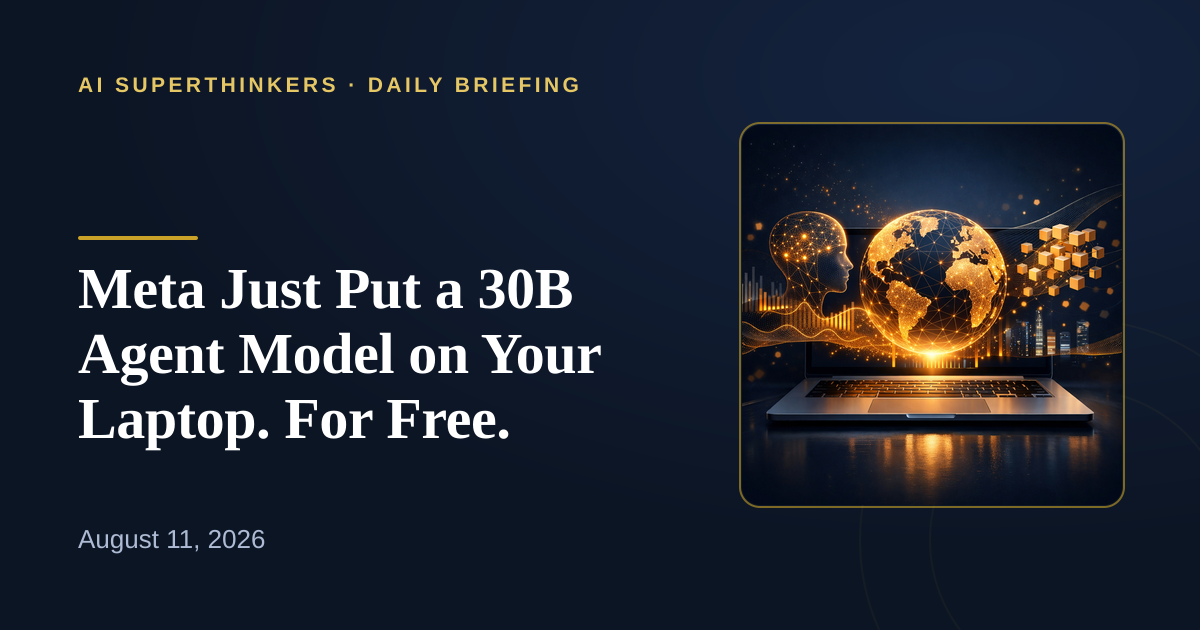
Meta Just Put a 30B Agent Model on Your Laptop. For Free.
Share this content