How EmployAIQ Keeps Your Data Safe: Memory Isolation and Permissions
The Question Your Board Is Actually Asking
You’ve been told to move on AI. The upside is the board’s expectation. The downside is your name on the incident.
That is the specific, uncomfortable math the governed executive does every single day, and no amount of “move fast and break things” makes it easier. When your security team asks how an AI workforce handles data, access, and accountability, “it’s really powerful” is not an answer a regulator accepts. Neither is “trust us.”
So let’s answer the question your board is actually asking — not “can the AI do the work,” but “can we prove it did the work safely.” That’s the bar this article addresses head-on, and it’s the bar EmployAIQ is built for.
Disclosure: EmployAIQ is built by the same company that publishes this site, AIToken Labs. I’m flagging that up front because trust is the entire subject here, and an article about data safety that hid its own authorship would fail its own test. Everything below is grounded in how the platform actually works — no superlatives, no invented capabilities.
The thesis, stated plainly: deploy an AI workforce your legal, security, and board will actually sign off on. Every section returns to that.
Memory Isolation: Each AI Employee Only Knows What It Should
The deepest anxiety about AI in the enterprise is the black box — the feeling that the model is a vast, opaque thing that has somehow absorbed everything, and you can’t see or constrain what it knows. That anxiety dissolves when you replace the vague fear with a concrete, nameable mechanism.
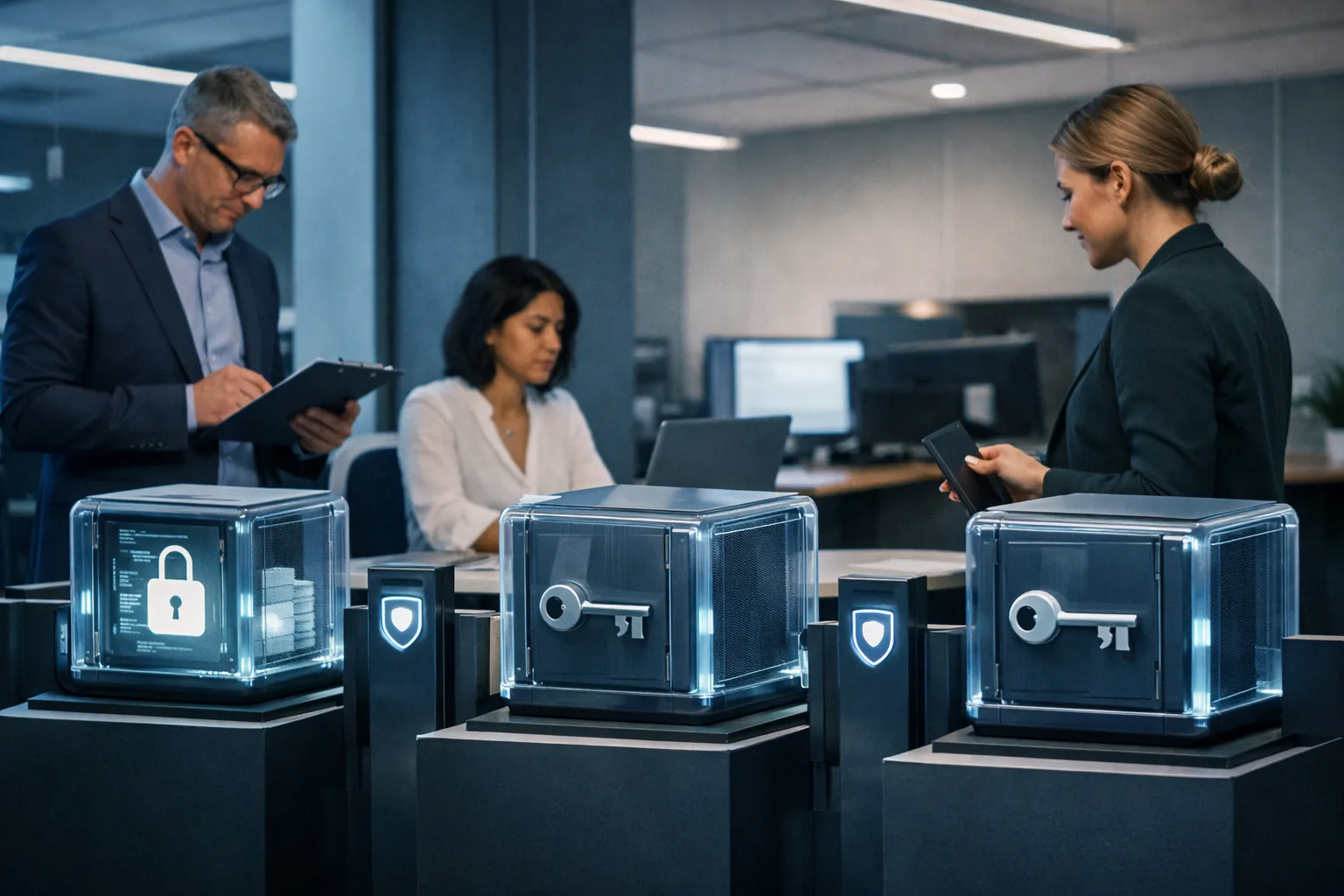
Memory isolation means each AI Employee’s context is scoped to its role’s data — nothing more.
Here’s what that means in practice. An AI Employee handling customer support tickets does not inherit your financial records, your HR files, or your strategic documents. Its memory contains what its role requires to do the job, and nothing else. Equally important: memory does not bleed across roles by default. The support employee doesn’t share context with the billing employee, and neither shares context with whatever handles procurement.
That’s the sentence you can hand to your security team: each AI Employee’s memory is scoped to its role’s data, and it does not inherit the company’s data or share memory across roles by default. It’s a statement you can make confidently, and one your security lead can verify against the platform rather than take on faith.
The control mechanism pairing matters here. The capability is “an AI Employee can act on the data relevant to its job” — and the gate is that memory isolation defines the boundary of what it can even know. Knowledge is the first permission. If the employee doesn’t hold the data, it can’t leak it.
Permissions: Access Is Granted, Not Assumed
The second objection is access control: “What can these things actually touch, and who decides?”
The answer is that no AI Employee gets broad access by default. Access is granted at the role level — and, crucially, it can be reviewed and revoked by a human. This is least-privilege in its plainest form: an employee starts with access to what its role needs and nothing more, and that access is visible and changeable.
Contrast this with the cowboy-autonomy fear that keeps executives up at night — the image of an agent quietly connecting to systems you didn’t authorize, pulling data you didn’t approve. Permissions exist precisely to make that impossible to do silently. What each AI Employee can access is a decision someone made, recorded, and can revisit.
A useful way to think about it: a human employee’s access is defined by their role, reviewed by their manager, and revoked when they leave. An AI Employee’s access works the same way. The word “employee” isn’t decorative — it describes a model where access is an explicit grant, not an assumption.
The capability-and-gate pairing again: the capability is “an AI Employee can work across your systems” — and the gate is that it can only do so through permissions a human set and can revoke. Autonomy without an off-switch is not autonomy; it’s exposure. Permissions are the off-switch.
The Audit Trail: Your Defensible Answer
This is the section that dissolves the fear that put your name on the line in the first place.
An audit trail means every action an AI Employee takes is recorded and attributable. When the board asks “what did the AI do, and why did it do it,” you answer with evidence, not assurances. When a regulator asks for a demonstration of control, you can show the log. This is the difference between believing your AI workforce behaved and proving it did.
It also connects directly to the broader control model — the idea that AI employees move through trust levels, from supervised to autonomous, and that you control and audit what they actually do at every step. An audit trail is what makes that trust earned rather than assumed. It’s the accountability layer that turns a productivity bet into a governed capability.
For the governed buyer, this is the moment of recognition: this is the accountability I’ve been missing. Not a faster assistant — a workforce member whose every action leaves a trace you can present to anyone who asks.
How This Clears the Legal and Security Bar
Individually, each mechanism answers one objection. Together, they form a governance posture your stakeholders can sign off on.
Here is the case in three sentences, the way you’d articulate it to your own legal and security teams:
- Memory isolation means each AI Employee only holds the data its role requires — no inherited access to the company’s full data estate.
- Permissions mean access is granted at the role level and can be reviewed or revoked by a human — least privilege by default.
- The audit trail means every action is recorded and attributable — so you can answer any board or regulator with evidence, not promises.
Memory isolation answers “what does it know?” Permissions answer “what can it touch?” The audit trail answers “what did it do, and can you prove it?” That triangulation — knowledge, access, and accountability — is the compliance bar in a nutshell.
No platform can remove every risk, and this article won’t pretend otherwise. But it can replace the risk you can’t see with risk you can — named, bounded, and auditable. That’s what legal and security are actually asking for when they ask “is this compliant?”
Is EmployAIQ Right for You?
If you’re the executive accountable to a board, stakeholders, and possibly regulators, this article was written for you — and the requirements you carry are native to the platform, not bolted on.
Audit. Approvals. Permissions. Memory isolation. Compliance posture. These aren’t add-ons you’ll be asked to configure from a menu of vague checkboxes; they’re the foundation the platform is built on. That’s the distinction that matters when your security team asks whether the tool bends toward governance or toward autonomy. EmployAIQ is employees you hire with controls built in — not a toolkit you assemble and hope you’ve wired the safety in correctly.
One honest note on fit, because a governed buyer respects a straight answer more than a pitch: if what you want today is to learn how agents work under the hood and build them yourself from scratch, this platform isn’t that path — the tutorials elsewhere on this site serve that reader. But if you want the productivity of an AI workforce and the control, audit, and compliance posture that lets you defend it to your board, you’re exactly where this platform is aimed.
The next step isn’t a commitment. It’s a scoped conversation about whether EmployAIQ clears your specific bar.
Keep reading:
- EmployAIQ: The Complete Guide to Hiring AI Employees
- EmployAIQ vs n8n: Building AI Agents vs Hiring AI Employees
- EmployAIQ vs Hiring a Virtual Assistant: Cost and Capability
Deploying AI across a team with real governance requirements? Interview your first AI Employee and see exactly how the memory, permissions, and audit controls map to your own security and compliance bar: employaiq.com/hire
About the Author
Anthony Odole is a former IBM Senior Managing Consultant, where he served as Enterprise Architect on Fortune 500 engagements, and the founder of AIToken Labs. He helps business owners cut through AI hype by focusing on practical systems that solve real operational problems.
His flagship platform, EmployAIQ, is an AI Workforce platform that enables businesses to design, train, and deploy AI Employees — AI agents that function as digital workforce members — that perform real work without adding headcount.