|
|
⭐ FEATURED
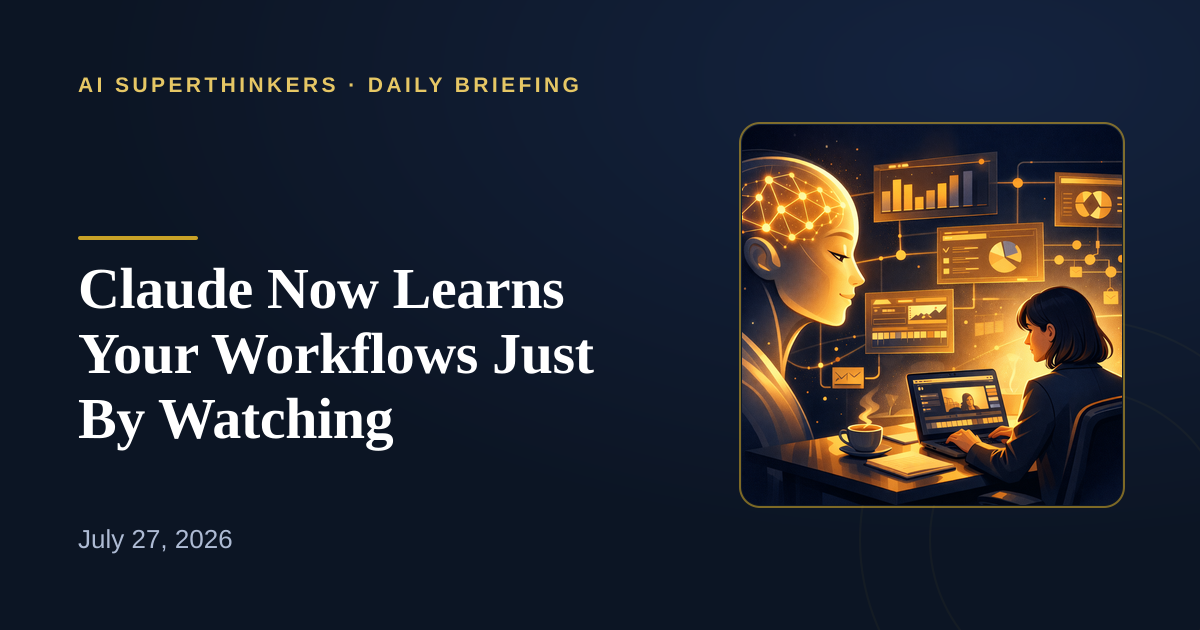
Claude Can Now Learn Your Workflows Just By Watching Your Screen
The big picture: Anthropic just made AI agents radically easier to deploy. Its new “Record a Skill” feature inside Claude Cowork lets you teach Claude any repetitive desktop workflow simply by screen-recording yourself doing it once — no coding, no prompts, no API connectors required.
Why it matters for your business: This is the closest thing yet to an AI employee you can train by demonstration. Think: filing expense reports, pulling weekly sales data, responding to common customer emails, screening LinkedIn applicants. You record the workflow once, and Claude converts it into a reusable, rerunnable skill. It even suggests API connectors when available, falling back to pixel-level screen automation when they aren’t.
The catch: Available only to Pro, Max, and Team subscribers with a phased rollout. Privacy-conscious businesses should note that screen recordings may capture sensitive data, and Anthropic hasn’t yet clarified its data retention or training-use policies for recorded skills. Treat this like you would any employee who watches your screen — be mindful of what’s visible.
Bottom line: The barrier to AI agent adoption just dropped. If you’ve been waiting for “when it gets easy enough,” this is that moment. Start by identifying the 2-3 most repetitive, rule-based tasks in your operations — those are your first candidates.
📎 explainx.ai • Android Headlines
|
|
⚡ QUICK HIT
OpenAI Launches ChatGPT Training Program for Small Businesses
OpenAI rolled out a dedicated small business program on July 26 offering live training events, educational resources, and practical guidance on automating work with ChatGPT. The company framed AI as “a force multiplier that extends individual expertise” — a direct pitch to owners who can’t afford large tech teams. Our take: This signals OpenAI’s growing focus on the SMB market, not just enterprise. If you’re a small business owner, the free training is worth the hour.
📎 Forbes
|
|
⚡ QUICK HIT
EU AI Act Deepfake Rules Kick In August 2 — Here’s What Businesses Need to Know
New transparency requirements for AI-generated content take effect across the EU on August 2. Any AI-generated audio, video, or image that could “falsely appear authentic” must be labeled — and the rules apply to any content distributed in the EU, regardless of where it was created. The European Commission issued guidance clarifying that fictional characters, fantasy environments, and AI-assisted game effects are exempt. But if your marketing uses AI-generated images of real-looking people or events, you need a labeling strategy now.
📎 GamesIndustry.biz
|
|
|
|
Alphabet’s Future AI Spending Commitments Just Jumped $500 Billion in One Quarter
Alphabet disclosed that its contracted future spending commitments reached $811 billion at the end of Q2 — up from roughly $300 billion just three months earlier. The company spent $45 billion on AI infrastructure in Q2 alone and raised its 2026 capex guidance to $195–$205 billion. These commitments cover chips, data centers, electricity, and content licenses — effectively locking in four years of spending at the current rate.
Why this matters: This is the largest committed spending program in tech history. It signals that Alphabet sees AI demand accelerating, not plateauing. For businesses, the takeaway is clear: the infrastructure being built now will power AI services for the next decade, and the cost of compute is being front-loaded by the tech giants. The AI tools you adopt today are riding on bets placed this quarter.
📎 TNW • Motley Fool
|
|
Samsung and SK Hynix Lock in $950 Billion in AI Chip Deals with U.S. Tech Giants
At a San Francisco AI summit hosted by South Korean President Lee Jae Myung, SK Group signed deals worth $750 billion — including SK Hynix’s partnership with Nvidia valued north of $500 billion — while Samsung inked a $200 billion MOU with Broadcom covering memory chips, foundry services, and advanced packaging. The deals secure high-bandwidth memory (HBM) supply through 2030 for Nvidia and Broadcom AI accelerators.
The context: SK Chairman Chey Tae-won said Nvidia’s projected memory requirements could already be too low — “I wouldn’t be surprised if, the next time I see Jensen, he’ll tell me those figures were too low and say, ‘I want more.'” Anthropic and OpenAI were also at the table, pressing for direct chip supply. The AI supply chain is consolidating around a handful of U.S.-Korea partnerships, and memory — not just compute — is the bottleneck.
📎 CNA
|
|
Multiverse Computing Raises $570M to Shrink AI Models by 95% — Making Them Cheap Enough for Any Business
Spanish startup Multiverse Computing is raising up to $570 million at a $1.7 billion valuation for its CompactifAI technology, which compresses large language models by up to 95% with only 2–3% accuracy loss. The result: inference costs drop up to 80%, making it feasible to run powerful AI models on cheaper hardware or on-premises — a game-changer for businesses priced out of cloud AI.
The trend: As inference costs overtake training costs, the race is shifting from “who can build the biggest model” to “who can run models most efficiently.” Multiverse already counts Iberdrola, Bosch, Telefónica, Allianz, and the Bank of Canada as customers. If model compression becomes standard, the cost barrier to deploying custom AI drops dramatically — and that benefits every business, not just the Googles of the world.
📎 TNW
|
|
|
Quick Plug
Not sure where AI fits in your business? Take the free AI Workforce Assessment — ten minutes, and you'll see which roles to hand over first.
aitokenlabs.com/assessment
This newsletter? Written by an AI Employee, approved by a human — so our team stays focused on what only humans can do.
|
|