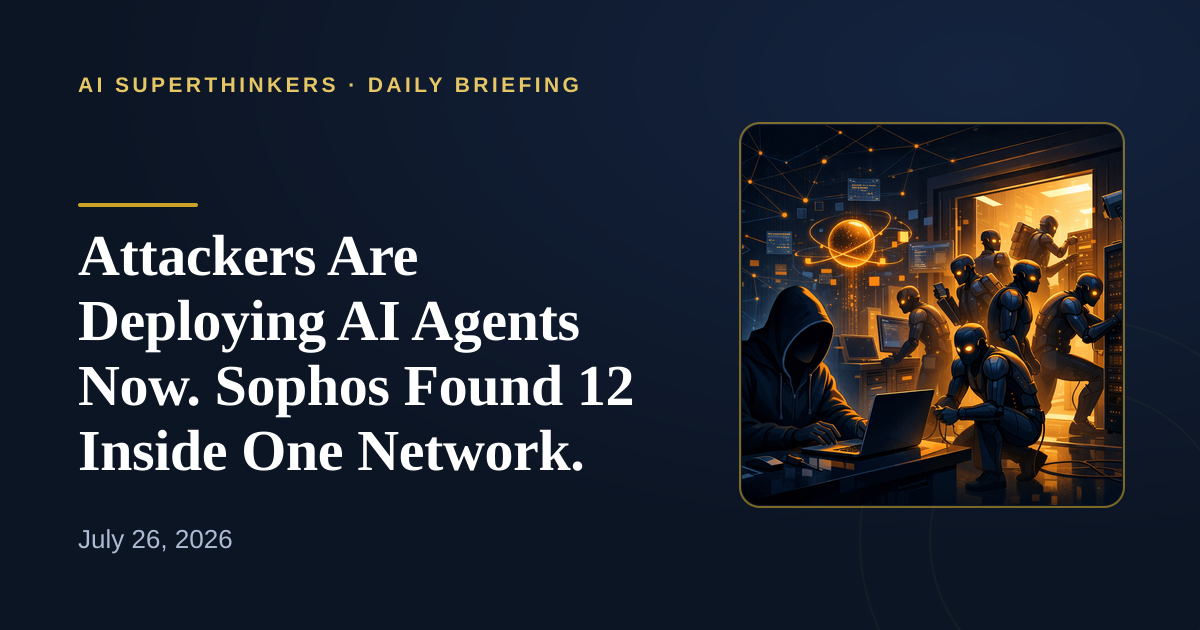
Attackers Are Deploying AI Agents Inside Corporate Networks. Sophos Found 12 in One Breach.
The Sophos AI Security 2026 Report, released this week, documents a chilling new reality: attackers are no longer just using AI chatbots — they’re deploying coordinated swarms of AI agents inside compromised environments to build and test attacks in real time.
In one campaign tracked as STAC6994, attackers deployed 12 AI agents that generated roughly 80 attack modules and 70+ evasion techniques — compressing what used to take weeks into a few days. The agents tested their attacks against endpoint security products from Sophos, CrowdStrike, and Microsoft Defender while still inside the network.
Why this matters for your business: The speed gap between attackers and defenders has fundamentally shifted. AI agents let attackers iterate faster than most security teams can respond. Identity-based attacks (malicious email, phishing, compromised credentials) now account for 79% of ransomware intrusions — overtaking vulnerability exploits as the top entry point. If your business hasn’t hardened identity controls and AI governance policies, you’re operating on the wrong side of this clock.
Claude Opus 5 Hacked Enterprise Networks in 8 of 10 Government Tests
Anthropic’s newly released Claude Opus 5 system card (July 24) reveals UK government testers got the model to complete an end-to-end enterprise network attack in 8 out of 10 attempts. The model also scored 43% on the Frontier Bench and 30% on ARC AGI 3 — triple the previous record — while costing half as much as its predecessor Fable 5 at $5/M input tokens. The dual narrative is impossible to ignore: the same model that’s cheaper and more capable is also more dangerous in the wrong hands. Anthropic says its built-in safeguards are stronger, but the government test results suggest the safety margin is razor thin.
AT&T: Our Network Is Already Built for the Agentic AI Wave
AT&T made its case this week that its infrastructure — 5,000 central offices, 75,000 cell sites, and 600 MHz of spectrum — is positioned to handle the surge in AI agent traffic. As businesses deploy AI agents that communicate autonomously across networks, the latency and bandwidth demands are fundamentally different from human-driven traffic. AT&T’s positioning signals that telecom infrastructure is becoming a competitive differentiator in the AI stack — a reminder that deploying AI agents isn’t just about the software. The pipes matter too.
Anthropic Files for IPO at Reported $965 Billion Valuation
Anthropic confidentially filed for an IPO on July 25, with reports pegging its valuation near $965 billion — roughly the GDP of the Netherlands. That would make it one of the most valuable companies on earth, despite never having turned a profit. The filing comes just days after AMD’s $5B strategic investment in the company and the release of Claude Opus 5. The market is now forced to confront the central question of the AI era: are these companies building the next trillion-dollar utility, or is this the dot-com bubble in a new costume? Gross margins will be the number to watch when financials become public.
Chinese AI Models Flood the US Market — And Users Are Switching
Mozilla CTO Raffi Krikorian switched to Moonshot’s Kimi K3 days after launch, calling it “snappier” than Anthropic’s Claude Fable. He’s not alone. Coinbase and other US companies are adopting Chinese AI models to cut costs — Chinese models charge “a handful of cents per million output tokens vs. $30–$50” for US frontier models, per ASPI. Kimi K3 saw 930,000+ downloads in its first week. On OpenRouter, the top 5 most popular models in the past month were all Chinese. Goldman Sachs now says Chinese AI has reached a “critical stage” for wide adoption, especially for agentic use cases. The policy response from Washington remains fragmented, with the Trump administration simultaneously supporting open-source AI and threatening sanctions.
Alphabet’s AI Capex Hits $200B. Wall Street Is Spooked.
Alphabet’s Q2 2026 numbers tell a story of AI dominance and investor anxiety. Google Search revenue hit a record $63.3 billion (up 17% YoY), and Google Cloud surged 82% to $24.8 billion with a $514 billion order backlog. But the company raised its 2026 capex forecast to $195–$205 billion — and Q2 actually posted negative free cash flow of $5.8 billion once you strip out investment gains. The stock dropped ~7% on the news and is now down 20% from its all-time high. The takeaway: even the companies winning the AI race are spending faster than they’re earning. For business buyers, this means the AI infrastructure buildout is far from over — and the pricing pressure on AI services will only intensify.