When you run an AI agent in production, your primary model will fail at some point. A provider outage, a rate-limit spike, a silent quality regression — any of these takes your workflow down unless you planned for it. The naive fix is to point every failure at the most expensive frontier model “just to be safe.” That’s how a resilience strategy quietly becomes a five-figure monthly bill.
TL;DR: Build fallback as an explicit escalation ladder — cheapest adequate model first, step up only on failure — with hard cost caps and per-tier failure semantics. Resilience is a routing decision, not a spending decision.
What is multi-model fallback in an AI agent?
Multi-model fallback is a routing policy that defines an ordered list of alternative models, with explicit conditions for when the agent steps from one to the next and what happens when it does. It’s distinct from general model routing, which optimizes for the cheapest capable model on every call. Fallback is the safety net underneath that routing: it answers “what happens when the chosen model can’t do the job right now?”
The failure triggers matter more than the list itself. Most builders only handle hard failures — timeouts, 429s, 5xx errors. The expensive mistakes come from the soft failures you never wired in: a model that returns a response but a verifier scores it below threshold, or a provider that’s technically up but serving degraded latency.
Why do most fallback setups silently overspend?
Because the fallback target is usually the most expensive model in your stack. When you configure “if GPT fails, call Claude,” you’ve hard-coded a premium-price escalation for every failure, including transient ones that would have cleared in 300 milliseconds.
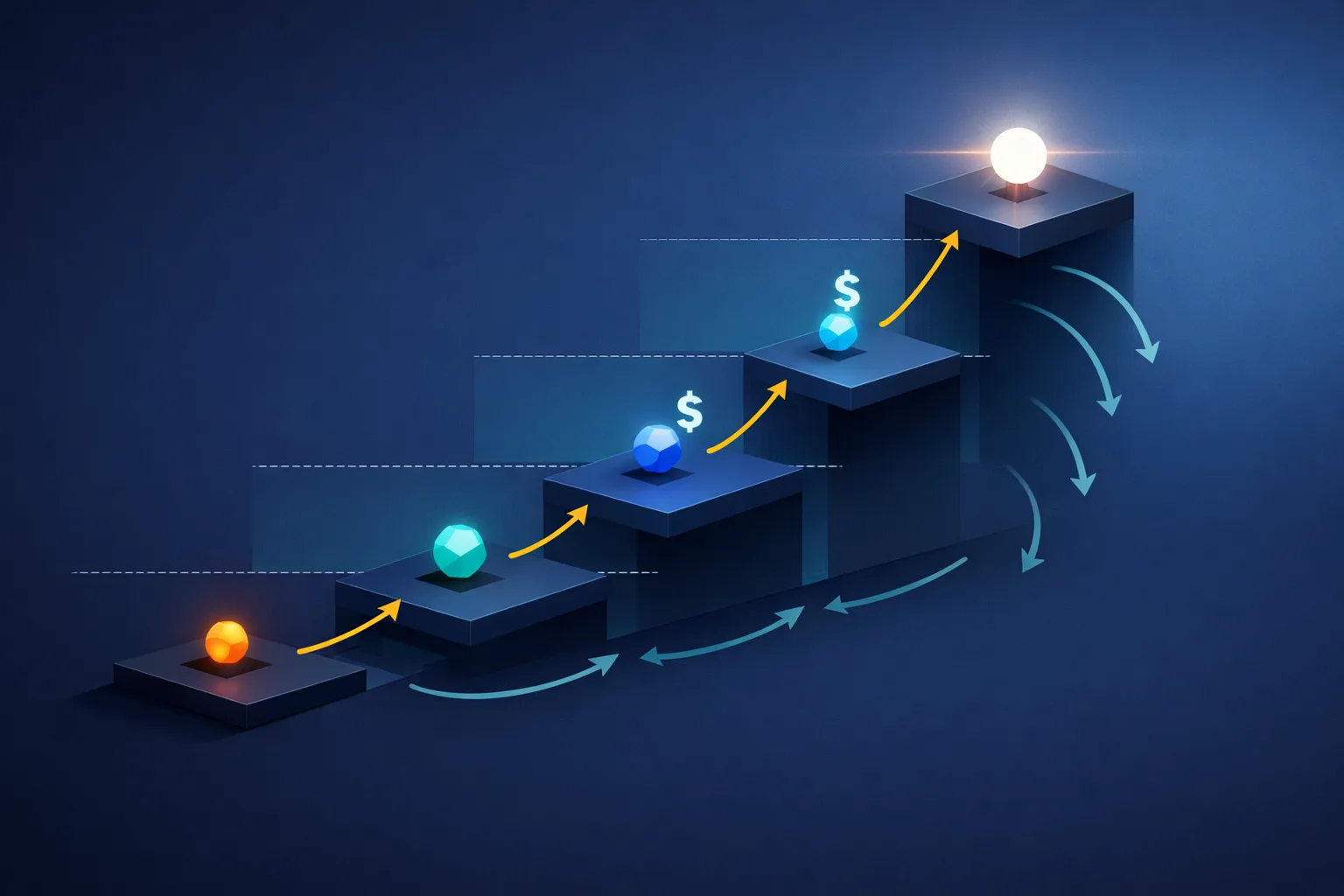
The alternative is to treat escalation as a ladder, not a parachute. A well-designed ladder steps up one rung at a time through models that are progressively more capable — and more expensive — only as far as the task actually requires. Most production traffic that fails a cheap model is correctly served by the next cheap model, not the frontier tier.
That’s the core insight, and the one that separates a cost-controlled system from a runaway one.
How do you build an escalation ladder that controls cost?
Here’s the structure, in order:
- Define your rungs by capability, not brand. Rank models by what they can actually do for your task — measured against your eval suite — not by vendor reputation. Rung 1 is the cheapest model that passes your evals for the common case.
- Set explicit escalation triggers. Hard failures (timeout, rate limit, 5xx) escalate immediately. Soft failures (quality score below threshold, latency above your p95 budget) escalate only after a retry or a verifier check.
- Cap escalation depth. Decide the maximum rung any single request may climb. If a request reaches the top and still fails, it fails — it does not get routed to an even more expensive emergency model.
- Enforce a per-request cost ceiling. A request that has already burned its budget on escalation should return a graceful degradation response, not keep climbing.
- Keep a warm “undo” snapshot. Your last-known-good model version stays available as the rollback target if a new model regresses mid-deployment.
The point of every rung is that escalation is bounded. Unbounded escalation isn’t resilience; it’s an open tab.
What should your fallback tiers cost versus each other?
The cost structure should look roughly like this:
| Tier | Typical model class | Share of traffic | Cost multiplier |
|---|---|---|---|
| Primary | Small/fast model (e.g., a lightweight or mid-tier model) | 85–95% | 1× (baseline) |
| Fallback 1 | Same-class alternative provider | 5–10% | ~1× |
| Fallback 2 | Next capability tier up | 1–3% | 3–10× |
| Emergency | Frontier / reasoning model | <1% | 10–50× |
The column that actually controls your bill is “share of traffic,” not the multipliers. If 95% of calls stay on the primary tier, a 50× emergency model that serves 0.2% of traffic is a rounding error. If your fallback target is the frontier tier and a provider outage pushes 40% of traffic onto it for an afternoon, that’s a real invoice event.
The fix is a same-class fallback as rung one: a different provider serving an equivalent model at a comparable price. Cross-vendor redundancy gives you outage protection without the capability tax.
How does fallback relate to broader model routing?
Fallback is one layer inside a routing strategy. Routing chooses the cheapest adequate model per task before execution; fallback handles what happens when that choice fails during execution. They share the same foundation — an eval suite, a verifier, and per-feature cost attribution — but they answer different questions.
If you’re still designing the routing layer underneath, our guide on AI Agent Hybrid Model Routing for Cost Savings walks through smart model selection from the ground up. The fallback ladder you build here sits directly on top of it.
Three adjacent levers compound the savings. When your escalation ladder keeps re-sending long conversation history to each new model, you’re paying to re-tokenize the same context on every rung — context window compression cuts that cost before fallback even triggers. If your fallback path touches retrieval, embedding cost optimization stops your vector spend from quietly scaling with every retry. And once your ladder is live, the escalation caps you set belong inside a broader cost governance framework that keeps the whole AI employee fleet from drifting past budget.
How do you implement this without rebuilding the plumbing?
Raw-code fallback means writing retry wrappers, provider SDKs, and verifier hooks by hand — real engineering, every time you swap a model. No-code tools hide the routing logic entirely, which is exactly what you don’t want when you need to read and tune the escalation semantics.
The middle path is what matters: a workflow layer where the ladder is visible and editable, not buried in code or black-boxed. In n8n, you build the ladder as an explicit error-handling branch off the AI Agent node — each rung is a node you can inspect, reorder, and attach a cost cap to. The failure semantics stay yours; the retry and provider plumbing is already handled.
That’s the real answer to “is this another no-code toy?” — you get the primitives (routing logic, failure semantics, cost levers) as first-class, readable objects, not a hidden switch.
FAQ
When should fallback escalate on soft failures?
Escalate on soft failures only when you have a verifier or quality score to detect them. Without one, soft-failure detection is guesswork, and you’ll escalate (and pay) for responses that were actually fine. Hard failures — timeouts and errors — always justify escalation.
Should my emergency tier be a different provider?
Yes. Cross-vendor redundancy is the whole point of the emergency tier. Two models from the same provider share the same outage. Keep your top rung on a genuinely independent provider.
How do I stop a runaway loop from draining my budget?
Enforce a per-request escalation cap and a per-tenant token quota at the gateway. A single request that climbs every rung and still fails must terminate — it cannot loop back to rung one. Cost attribution per feature also tells you which route is driving spend before the invoice arrives.
Does fallback add latency?
Yes, and you should budget for it. Each escalation adds a round trip. Set a latency budget per rung and treat exceeding it as a soft-failure trigger. For most user-facing agents, two rungs is the practical ceiling before the user notices.
Want to design AI employee roles from scratch rather than deploy templates? The AI Agent Architects runs as a small five-week cohort, and the waitlist hears every enrolment date first: Join the AI Agent Architects waitlist
About the Author
Anthony Odole is a former IBM Senior Managing Consultant, where he served as Enterprise Architect on Fortune 500 engagements, and the founder of AIToken Labs. He helps business owners cut through AI hype by focusing on practical systems that solve real operational problems.
His flagship platform, EmployAIQ, is an AI Workforce platform that enables businesses to design, train, and deploy AI Employees — AI agents that function as digital workforce members — that perform real work without adding headcount.