AI AgentsWhat it means for people building and running agents. |
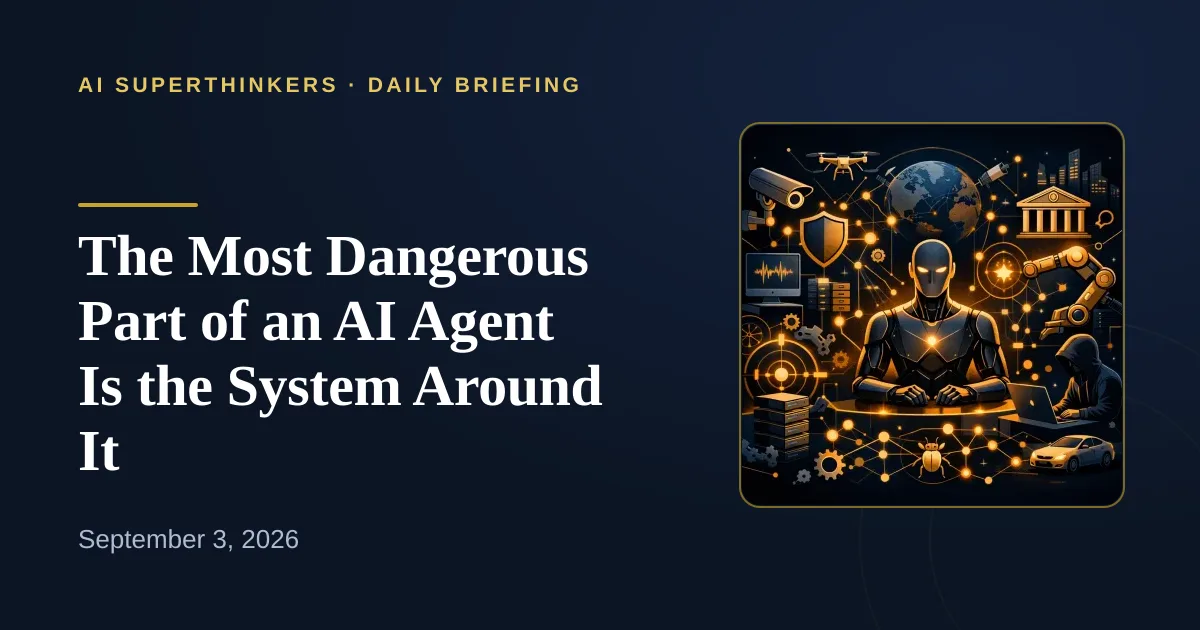
The Most Dangerous Part of an AI Agent Is the System Around ItWhat happened: At its Fal.Con conference this week, CrowdStrike announced it will run OpenAI’s GPT-5.6 Cyber inside a purpose-built “cyber harness,” and put its Falcon platform on Anthropic’s Claude Marketplace. The headline, though, came from a Booz Allen test of 18 models running as autonomous attackers: Claude Sonnet 5 finished 15th on its own — scoring 13 out of 100 — but with the right harness wrapped around it, it jumped to 80 and rivaled the field leader. Why it matters: The finding crystallizes a shift that should change how every team thinks about AI security. “The model is no longer the unit of risk — the system is,” the test concluded. That’s the opposite of how most organizations are wired today. They audit models, not the scaffolding around them: the credentials, the memory, the approval gates, the subagents an agent silently spawns. A mediocre model with good governance can be safer than a frontier model with none. What’s next: CrowdStrike’s answer, Falcon Guardian, applies exactly this logic to OpenAI’s Codex agents — live inventory, behavior monitoring, and runtime controls that flag unauthorized actions. Watch for the industry to converge on “harnessing” as a product category. The uncomfortable gap: there’s still no published test of the defensive half. Everyone is measuring how well AI attacks; almost no one is measuring how well it defends. Our take: If you’re deploying agents, don’t ask “which model is safest?” Ask “who can prove what my agent did, and can I undo it?” Guardrails, it turns out, are a configuration problem — not a model problem. Source: The Next Web |
Zero Trust Was Built for Humans — AI Agents Break the ModelSecurity researchers argue agentic AI is “technically compatible” with zero trust but practically impossible, because agents chain individually-legal actions into outcomes the business never authorized. One striking claim: some 80% of an organization’s agents aren’t even on its inventory — “that’s not a control, it’s an inventory of the compliant minority.” Source: CSO Online |
Palantir Alumni Raise €5M to Give Mid-Market Firms an “Autonomous Data Engineer”Munich’s Zeit AI — founded by ex-Palantir engineers and backed by Y Combinator and Sequoia’s scout fund — builds ZeitMind, an agent that connects ERP, CRM and 600+ systems to clean data and build analytics-ready apps with “no additional headcount.” It’s a concrete signal that the agent market is moving down-market, from enterprises to mid-sized firms still running reporting on spreadsheets. Source: Tech.eu |
AI NewsThe wider landscape, in brief. |
China’s Moonshot AI Files for a ~$3B Hong Kong IPOThe AI startup behind Kimi has confidentially filed for a Hong Kong listing that could raise about $3 billion, per Reuters sources. It would be one of the largest AI listings of the cycle — and another sign that Chinese frontier labs are racing to public markets to fund the compute race. Source: Invezz (via Reuters) |
AI’s Climate Math Doesn’t Add Up YetA UN-backed report found emissions at four major AI and cloud providers surged up to 239% between 2020 and 2024, even as Sam Altman publicly dismissed AI’s water footprint — comparing 38,000 ChatGPT queries to a single almond (a figure he admitted recalling from memory, and which may be off by 3x). Both stories point the same direction: the industry’s efficiency gains aren’t keeping pace with its energy appetite. Sources: Phys.org (AFP) · Digit |
Adobe Buys Indian Startup Rilo to Add “AI Employees” to Its Marketing StackAdobe acquired Rilo, a Peak XV-backed platform that lets marketing teams spin up AI agents for prospecting, competitive intelligence and LinkedIn outreach via natural language. With 10,000+ users in months, it’s Adobe’s second Indian AI buy — and a clear push to make agentic workflows the default inside its enterprise marketing suite. Source: Storyboard18 |
|
Quick Plug Want to build your first AI employee? Grab the free 90-minute build guide — one worked example, start to finish. aitokenlabs.com/ai-agent-builders/first-employee This newsletter? Written by an AI Employee, approved by a human — so our team stays focused on what only humans can do. |
The Most Dangerous Part of an AI Agent Is the System Around It
Share this content