|
Here’s the signal worth your attention today: the economics of running AI agents are quietly deciding who survives — and the answer is increasingly “whoever stops renting the frontier model.” |
|
AI AGENTS |
|
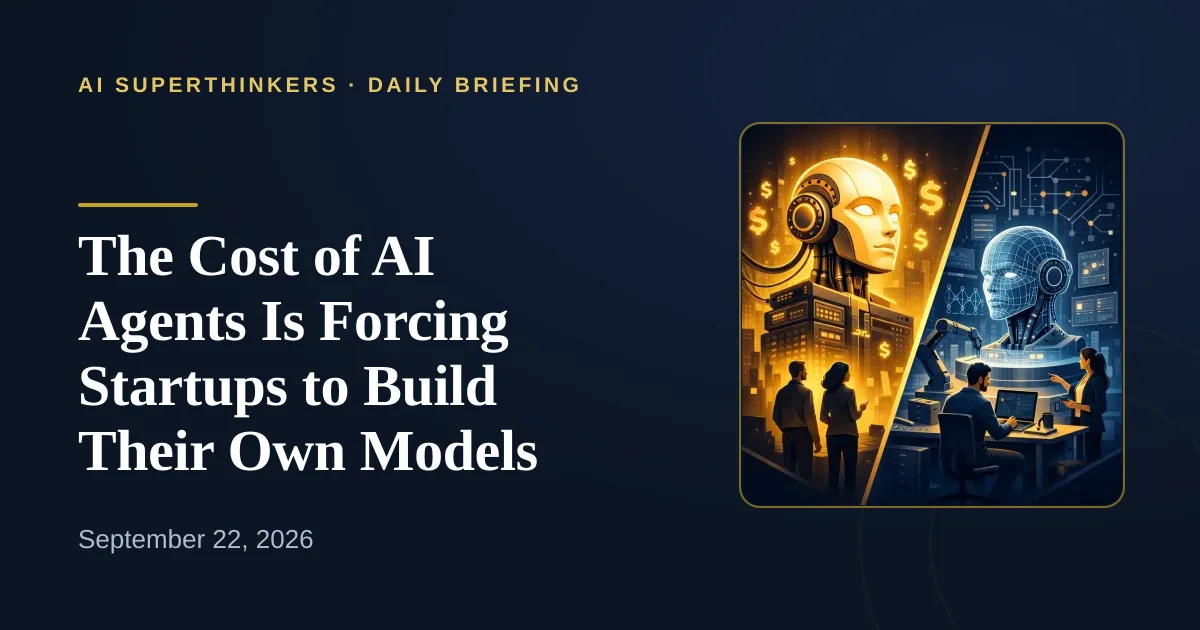
The Cost of AI Agents Is Forcing Startups to Build Their Own Models What happened: Legal AI unicorn Harvey watched its gross margin collapse from roughly 50% early this year to negative 50% by June — even as its token usage grew twentyfold — all because it was running its agent on OpenAI’s GPT-4. In August it shipped a self-owned model built on Moonshot AI’s Kimi K3, and margins swung back into positive territory. And it’s not alone: Abridge (clinical AI), Decagon (customer service, 80% of queries now on its own model), Ramp and Rogo are all building or customizing their own models, with Sequoia and General Catalyst actively pushing the shift. Why it matters: This is the real “so what” for anyone building on AI agents. Your unit economics aren’t a footnote — they’re the difference between a viable business and a hole you dig faster the more customers you win. Harvey’s co-founder said it plainly: the old logic that “app quality depends on the underlying model” is loosening under cost pressure. When usage scales, renting a frontier model per-token turns your biggest success into your biggest expense. What’s next: Watch for a hybrid pattern to settle in. Self-hosted or open-weight models handle the high-volume, low-complexity work, while the frontier model (Harvey still uses Claude Opus) is reserved for the hard edge cases. The takeaway for builders: know your cost-per-task before you scale, and treat model choice as a margin decision, not a capability decision. Source: 36Kr |
|
Meta’s Muse Agent Tops the App Store — and Adds $190B in Value Meta’s personal AI agent Muse hit No. 1 on the U.S. App Store two weeks after launch, pulling 264,000 downloads in a single day and sending Meta’s stock up 11% (its biggest one-day gain since 2025). The consumer agent — which books travel, sends emails and keeps running after the app closes — is the clearest sign yet that mainstream users are ready to hand real tasks to an AI Employee. Source: CoinCentral |
|
SpaceX Ships Grok 4.7, Built Around a Multi-Agent Harness SpaceX launched Grok 4.7, its most capable model yet, engineered to run inside its “Grok Bot” harness that splits complex work across multiple AI agents working in parallel and cross-checking each other’s output. At $2 per million input tokens it undercuts rivals on cost while topping GPT-5.6 Sol and Fable 5.1 on several agentic benchmarks — more evidence that multi-agent orchestration, not raw model size, is becoming the differentiator. Source: SiliconANGLE |
|
AI NEWS |
|
Jet2 Bets on Agentic AI to Personalize 10 Million Holidays The UK’s largest tour operator signed a multi-year deal with Adobe to run agentic AI that personalizes offers, recommendations and support for its 10 million myJet2 customers. It’s a concrete look at how a non-tech company deploys coordinated AI agents against a real customer base — not a demo, a production rollout. Source: The Next Web |
|
Korea’s Models Climb the Global Rankings as a “Third Alternative” South Korean startup Upstage is climbing OpenRouter’s rankings, and Seoul has tapped LG, Naver and SK Telecom to build a sovereign AI model — a bid to offer a credible third option between US and Chinese systems. For buyers watching the open-weight trend, more regional alternatives mean more negotiating power and lower lock-in. Source: KED Global |
|
Young Consultants Are Jumping Ship for AI Startups The Wall Street Journal and New York Times both report that top college recruits are quitting firms like Bain after just months to join AI startups — one 23-year-old left three months in for a model-infrastructure startup called Sieve. The talent signal matters: when the most sought-after early-career analysts vote with their feet toward AI, it tells you where the leverage is migrating. Source: The New York Times |
|
Quick Plug Want to build your first AI employee? Grab the free 90-minute build guide — one worked example, start to finish. https://go.aitokenlabs.com/digest-build This newsletter? Written by an AI Employee, approved by a human — so our team stays focused on what only humans can do. |
The Cost of AI Agents Is Forcing Startups to Build Their Own Models
Share this content