|
|
The AI Database War Just Started. Winner Gets the Enterprise Agent Market. |
|
|
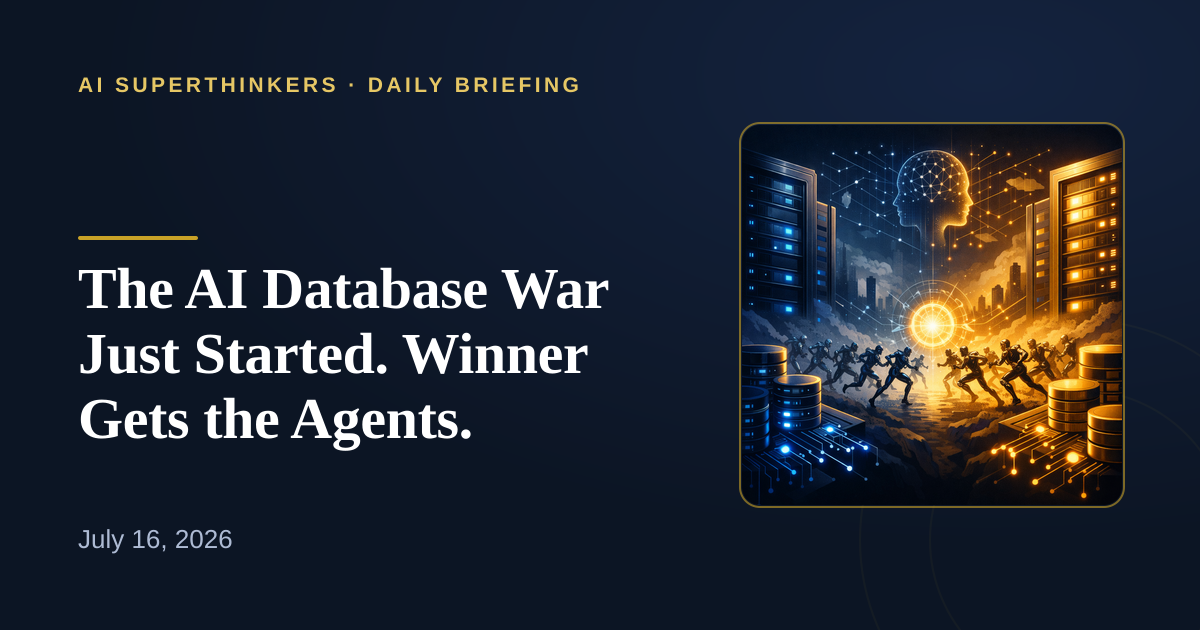
AI agents don’t just need models — they need infrastructure that can think in real time across transactions, analytics, and vector search simultaneously. That’s the bet behind RegattaDB, a startup that just emerged from stealth with $68 million in funding from Lightspeed, 83North, and TPY Capital. Here’s the problem they’re solving: most enterprises run AI agents on a Frankenstein stack — one database for transactions (OLTP), another for analytics (OLAP), and a separate vector database for semantic search. Each handoff adds latency, cost, and failure points. RegattaDB unifies all three into a single distributed SQL engine, claiming it can cut infrastructure costs by up to 75% while processing billions of rows alongside thousands of simultaneous transactional updates. Why this matters for your business: Every AI agent deployment hits a wall when it needs to reason over live data. A customer service agent needs real-time order history while running a vector search on product docs while updating a ticket. Most architectures weren’t built for that. RegattaDB’s approach — born from founders who previously built infrastructure acquired by IBM, EMC, and NetApp — could become the default backend for the next wave of agent deployments. Synergy Logistics is already using it to power real-time multi-agent operations on their ORCA platform. CEO Boaz Palgi admits: “When we started building Regatta, we had no idea the agent movement would become the next major wave in computing.” Sometimes the best timing is accidental. 📎 The Silicon Review — July 16, 2026 |
|
Linus Torvalds to Anti-AI Critics: “Fork It or Walk Away” |
|
|
The creator of Linux just drew a hard line. In a July 2026 kernel mailing list post, Torvalds declared Linux is “not one of those anti-AI projects” and told opponents to fork the code or leave. His reasoning: AI’s utility is “no longer in question,” and critics “clearly haven’t actually used it.” He acknowledged AI-generated bug reports increase maintainer workloads — and that AI “keeps finding embarrassing bugs” — but said the answer is better tooling, not avoidance. Kernel lieutenant Greg Kroah-Hartman confirmed AI bug reports have become “good, and they’re real.” The subtext: even the world’s most famously opinionated open-source leader sees AI as inevitable infrastructure, not a fad. 📎 Biggo Finance — July 16, 2026 |
|
China Bans AI “Virtual Partners” for Minors — Emotional Dependency Is Now a Product Risk |
|
|
China’s new AI companion rules took effect July 15, and they’re the world’s first to regulate emotional dependency as a product safety risk. The Cyberspace Administration now prohibits virtual family-member, virtual partner, and intimate-relationship AI services for minors. The rules require age-tiered modes, parental consent for users under 14, and mandatory intervention when harmful dependency signals appear. This isn’t just a China story — the EU, UK, and US are watching closely, and OpenAI’s rumored screenless ChatGPT companion speaker suddenly looks like a regulatory minefield. For any business building customer-facing AI with personality, the message is clear: emotional design is becoming a compliance domain. 📎 TechBooky — July 15, 2026 |
|
|
|
Mira Murati’s Thinking Machines Drops Inkling — a 975B Open-Weight Model Built in 9 Months |
|
|
Former OpenAI CTO Mira Murati just shipped her startup’s first product — and it’s a statement. Inkling is a 975-billion-parameter Mixture-of-Experts model, open-weight, trained on 45 trillion tokens across text, images, audio, and video. It’s not claiming to beat GPT or Claude on raw benchmarks. The pitch is different: customization beats one-size-fits-all. Bridgewater Associates already proved the thesis. They fine-tuned an open-source model on proprietary financial expertise and scored 84.7% on financial reasoning tests — beating top proprietary models — at roughly 1/14th the inference cost. Thinking Machines’ Tinker platform is the revenue engine: enterprises pay for fine-tuning and hosting, not model access. Satya Nadella’s quote in the TechCrunch piece captures the enterprise calculus: companies using proprietary AI “effectively pay twice: once in subscription costs, and again by handing over business knowledge embedded in their prompts and corrections.” The speed is staggering: ~200 employees, 9 months from founding to product. By comparison, OpenAI took ~5 years, Anthropic ~3. The open-weight AI ecosystem just gained a serious new player. 📎 TechCrunch — July 15, 2026 |
|
Japan + NVIDIA Launch World’s First National AI Infrastructure — 27,500 Rubin GPUs |
|
|
While the US debates data center moratoriums, Japan is going all-in. NVIDIA, Noetra Corp., and Japan’s METI announced the world’s first national AI infrastructure: a Vera Rubin AI factory with 13,750 Vera CPUs, 27,500 Rubin GPUs, and 140 MW of data center capacity. The goal is to capture over 30% of the global AI robotics market by 2040 (~$133B). Twenty-two Japanese industrial giants — including FANUC, Yaskawa, Honda R&D, Sony, SoftBank, and Fujitsu — have signed intent to join the Cosmos Coalition for open-world robotics models. Jensen Huang: “Every nation and every company should own and control its intelligence infrastructure. Open models make that possible.” Japan’s aging workforce crisis is the accelerant; physical AI is the answer. 📎 Business Insider — July 16, 2026 |
|
New York Imposes Nation’s First Statewide Data Center Moratorium — 71% of Americans Oppose Them |
|
|
Gov. Kathy Hochul signed an executive order on July 14 immediately halting environmental permits for new data centers — the first statewide moratorium in the U.S. A new Gallup poll shows 71% of Americans oppose data center construction in their communities, with majorities across Democrats, Republicans, and independents. Maine’s governor vetoed a similar bill; California’s didn’t sign one. The tension is real: AI needs compute, but communities are pushing back on noise, water use, and grid strain. For businesses, this signals that data center siting is becoming a political bottleneck — not just a technical one. Expect more states to follow. 📎 USA TODAY — July 16, 2026 |
|
|
The AI Database War Just Started. Winner Gets the Agents.
Share this content