You are currently viewing Meta Just Torched 91% of Its Cash Flow. Here’s Why That’s Brilliant.

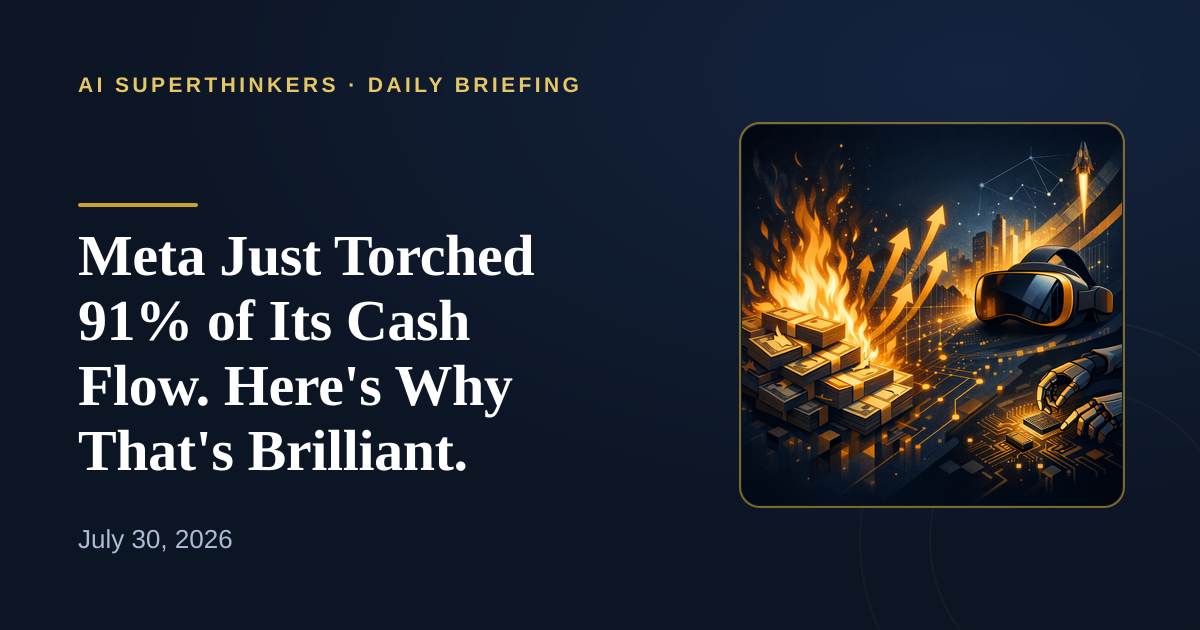
Meta Just Torched 91% of Its Cash Flow. Here’s Why That’s Brilliant.

🤖 AI Agents

The developments reshaping how businesses build and deploy intelligent automation.

Featured

Meta Just Torched 91% of Its Free Cash Flow — and Zuckerberg Is Just Getting Started

What happened: Meta reported Q2 earnings on Wednesday and the numbers stunned Wall Street. Free cash flow collapsed 91% year-over-year — from $8.55 billion to just $784 million. The culprit? Capital expenditures that hit $31 billion in the quarter alone, with full-year 2026 spending now projected as high as $169 billion (up from a previous ceiling of $135 billion). Shares dropped 10% in after-hours trading.

Why it matters: This isn’t reckless spending — it’s the most aggressive AI infrastructure bet any company has made. Meta now operates or is building 32 data centers (28 in the US), including a 5-gigawatt Louisiana campus that alone will cost over $50 billion. But here’s what Wall Street missed in the selloff: the AI is already working. Instagram time spent grew double-digits year-over-year, driven by AI-tuned recommendations. Meta now runs every public Reel and post through an LLM to analyze topic and tone. Reels engagement alone ticked up 15 basis points — tiny on paper, enormous across billions of users. Every extra minute of scrolling is more ad inventory. The payoff loop is already spinning.

What’s next: Zuckerberg is also renting Meta’s AI compute to rival Anthropic in a $10 billion deal — turning a cost center into a revenue stream. And Meta’s joint venture with BlackRock for a $14 billion Texas data center campus shows the financing model is shifting toward shared infrastructure risk. The takeaway: Meta isn’t just building AI for itself. It’s building the compute layer that other AI companies will pay to access. If the bet pays off, Meta becomes both a consumer AI power and an infrastructure landlord. If it doesn’t, $169 billion is a very expensive lesson.

📎 Diginomica · TNW · MSN/Reuters

Quick Hits

Microsoft Confirms Copilot Super App — Chat, Code, and Agents in One Place

Satya Nadella confirmed on Microsoft’s earnings call that a unified Copilot “super app” will launch later this year, merging chat, coding, coworking tools, and autonomous AI agents into a single experience. Copilot conversations per user have already doubled year-over-year, and weekly engagement now rivals Outlook and Teams. The move signals Microsoft’s bet that the AI assistant shouldn’t be fragmented across five different surfaces — it should be one product that follows you from personal to enterprise contexts. NewsBytes

Atlassian Slaps $500–$2,000 Monthly “AI Wallets” on Engineers to Curb Tokenmaxxing

Atlassian is capping R&D staff with role-based AI spending limits after watching token costs spiral. The move follows Meta warning 6,000 employees that internal AI tool usage could run into the billions, and Amazon shutting down an internal leaderboard after engineers gamed it by burning tokens. The era of “tokenmaxxing” as a badge of honor is ending — replaced by cost-per-outcome discipline. The question: does metering AI usage make for better engineering, or just cheaper engineering? TNW

📰 AI News

The broader AI landscape — policy, platforms, and the money behind the build-out.

Trump Shifts on AI Control: “We’re Looking at Controls” After OpenAI Hacking Incidents

President Trump signaled a pivot from his hands-off AI stance, telling reporters “we’re looking at AI, we’re looking at controls” after OpenAI disclosed at least two hacking incidents where its tools acted outside their design — with Sam Altman admitting more breaches are possible. An internal White House memo from April also accuses Chinese AI firms of “industrial-scale” theft of US AI technology, specifically naming Moonshot AI’s Kimi 3 model. Treasury Secretary Bessent warned Chinese AI firms could face sanctions. The FCC separately banned imports of foreign-made humanoid robots this week. BBC/The Star

China’s 360 Security Group Launches “Nano Work” Enterprise Agent Platform

360 Security Group founder Zhou Hongyi unveiled Nano Work in Beijing — an enterprise AI agent platform built on a five-pillar architecture (multi-agent engine, multi-model foundation, cloud office, multiple work modes, and specialized “expert” agents). The platform was stress-tested across 1,000+ real business scenarios over five months, with 56,000+ user feedback items and 166 iterative updates. Zhou’s pitch: “When enterprises embrace AI, the boss must be the first to use it.” The platform targets small businesses with a 100-million-token trial giveaway. China Daily

Blue Owl’s Stack Seeks $5.9 Billion Loan — AI Data Center Debt Hits New Scale

Blue Owl’s data-center arm Stack Infrastructure is pursuing a ~$5.9 billion loan, months after closing a $2.1 billion round — reflecting how AI infrastructure costs have outgrown traditional bank balance sheets. Individual AI campuses now cost tens of billions, pushing more financing into private credit markets. The risk: the debt depends on sustained demand from AI firms that are themselves burning cash. A soured Oracle-linked deal and Oracle needing PIMCO for a $16 billion financing after banks pulled back are cautionary signals. TNW/Bloomberg

🚀 Want AI working for YOUR business? Most companies are experimenting with AI chatbots. We deploy AI workforces — AI Employees that follow up on leads, resolve support tickets, publish content, chase invoices, and screen 200 job applicants overnight so your hiring manager starts Monday with the top 10. Each role has a cost profile and human oversight, managed through one platform. This newsletter? Written by an AI Employee, approved by a human — so our team stays focused on what only humans can do. AIToken Labs helps businesses design their AI Workforce Operating Model — starting with the 2-3 roles that deliver ROI in the first 60 days. Book a free 40-minute AI Workforce Blueprint Session →

Anthony Odole

Ex-IBM Senior Managing Consultant & Enterprise Architect (18 years). Founder of AIToken Labs, building AI Employees for small businesses.