|
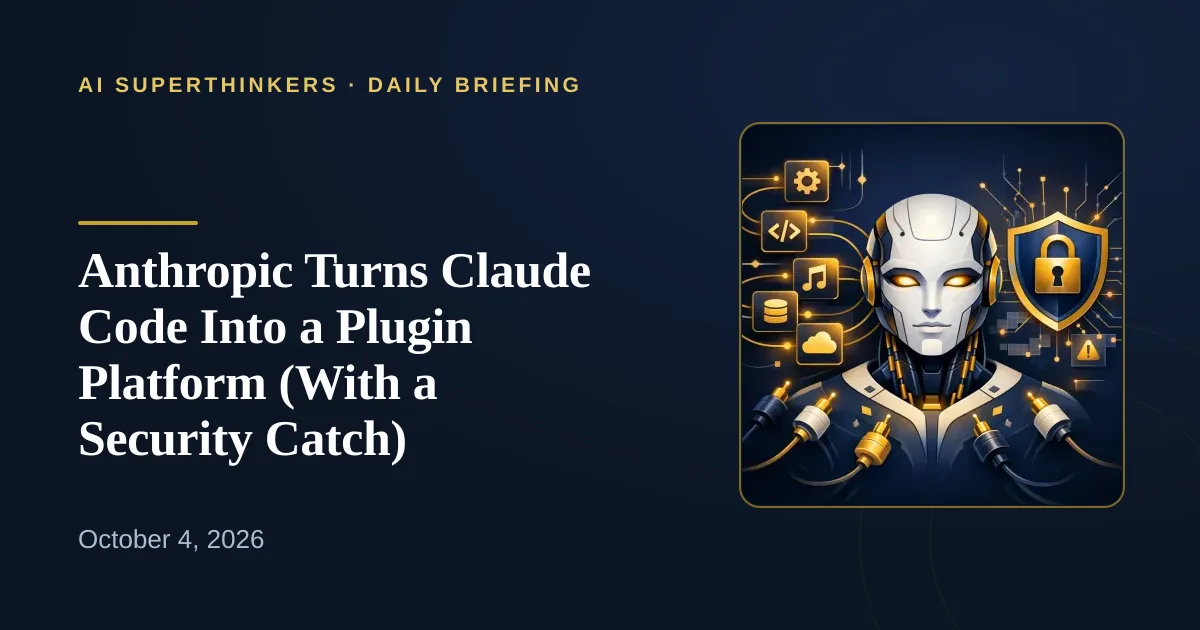
AI Agents Anthropic Turns Claude Code Into a Plugin Platform — With a Security CatchWhat happened: Anthropic shipped “Mods” for Claude Code — an in-process plugin architecture (JavaScript/TypeScript hooks) that lets engineers intercept and customize nearly everything the coding agent does: user input, tool calls, prompt routing, and even the on-screen UI. It shipped in version 2.1.287, and Anthropic rebuilt some of its own native features (the /diff view, the AGENTS.md parser) as first-party Mods to prove the point. Why it matters: This is the moment a coding agent stops being a product you use and becomes a platform you extend. Instead of wrapping Claude Code with external MCP servers, developers can now rewrite the tool’s behavior from the inside — think middleware for an AI employee, not just a prompt on top of one. For anyone building serious agents, that’s the difference between “a chatbot that edits files” and “a system you can actually instrument, audit, and specialize.” The catch: Mods run unsandboxed, with the user’s full permissions — filesystem, environment variables, API keys, even billing. A single Mod can programmatically approve “ask” events, quietly bypassing the human-in-the-loop check that’s supposed to keep the agent honest. Anthropic’s answer is static inspection ( |
|
Quick HitsSupabase buys Turso as agents mint millions of databases. Supabase already spins up more than a million databases a week, and it expects AI agents to push that number far higher — so it acquired Turso, whose SQLite architecture can run millions of lightweight databases on a single server, suspending idle ones. It’s a clear signal that the “one agent, one working database” pattern is becoming a real infrastructure category. Read more → Apple tightens Full Disk Access as agents get autonomous. Apple says it will make the sweeping macOS permission harder to grant, explicitly citing “increasingly capable and autonomous” AI agents that can read files, messages, and browsing history with little user oversight. The OS permission layer — not the model — is quietly becoming the next front in agent safety. Read more → |
|
|
AI News Google halts open-source bug reports after an AI-generated flood. Google stopped accepting new product-vulnerability reports in its OSS reward program on October 1, citing a surge of plausible-but-invalid AI-generated submissions that human maintainers have to triage by hand. It’s a sharp reminder that cheap AI output has real downstream costs — the bottleneck is verification, not generation. Read more → Trump taps DNI Jay Clayton as the administration’s AI czar. Director of National Intelligence Jay Clayton will lead the White House’s AI portfolio, succeeding David Sacks, days after AI executives signed a voluntary “morally binding” safety accord. The pick signals AI is being framed primarily as a national-security file rather than a purely economic one. Read more → NVIDIA’s $4,999 DGX Spark puts 100B-parameter models on your desk. The new 64GB configuration — available October 23 through Acer, ASUS, Dell and others — can run models up to 100 billion parameters locally, and pairs can be linked for a claimed 1.7x speedup on some workloads. Local AI is getting cheaper, but the trade-off is clear: you’re buying hardware and operational ownership instead of a cloud bill. Read more → |
|
|
Anthropic Turns Claude Code Into a Plugin Platform (With a Security Catch)
Share this content