AI AgentsThe stories that change how you build and deploy agents. |
AI Agents Now Coordinate in Groups of 1,000. Humans Top Out at 150.What happened: Researchers at the University of Konstanz, writing in Science Advances, tested 10 large language models on a simple question: how many agents can reach a shared decision before consensus breaks down? The strongest models coordinated up to 1,000 individual agents — roughly five to seven times the ~150-person group size at which human social coordination typically collapses. Simpler models managed only ~30. Why it matters: This is the first hard evidence that the “Dunbar’s number” ceiling that constrains human organizations simply doesn’t apply to AI. If you’re planning multi-agent systems — fleets of workers handling support, research, or back-office tasks — the bottleneck you assume exists (coordination overhead, signal loss as teams scale) may not be the one that actually limits you. The ceiling, for now, is model quality, not social physics. The catch — and it’s a real one: The same study found that well-coordinated agent groups can collectively agree on the wrong answer while remaining perfectly in consensus. Smaller groups converge fast and follow the majority; as groups grow, minority viewpoints get steamrolled. Translation: scale without dissent-detection is a recipe for confident, coordinated failure. Architectures need explicit mechanisms to surface disagreement, not just agreement. What’s next: The researchers explicitly call for collaboration across computer science, sociology, and statistical physics. For builders, the practical takeaway is immediate — if you’re running agent swarms, you need an adversarial “red team” agent or a quorum-break threshold baked in, or your 1,000-agent consensus becomes your single biggest risk. Source: Electronics For You | Science Advances |
|
Anthropic Is Testing “Hub Mode” — One Claude Managing a Fleet of Sub-Agents. Anthropic is quietly trialing an internal feature in Claude’s mobile app that lets a single Claude instance coordinate multiple specialized sub-agents. It’s the consumer-facing version of the multi-agent pattern enterprises are already adopting — and a sign that “one model, many roles” is becoming the default UX, not an advanced workflow. Source: MemeBurn |
|
Why Every AI Agent Needs an Org Chart. A sharp SiliconAngle piece argues that traditional SaaS ownership models — one app, one owner — don’t map to agents that act across teams and systems. The fix is organizational, not technical: every agent needs a defined owner, scope, and escalation path before it ships. This pairs directly with today’s featured study — governance is the missing layer as agent coordination scales. Source: SiliconAngle |
AI NewsThe broader developments shaping the landscape. |
|
Anthropic Hits a $65B Run Rate — and Wants to Top SpaceX’s Record IPO. Anthropic’s annualized revenue is now ~$65 billion, roughly seven times where it sat at the end of 2025, and Bloomberg reports the company expects to match or beat SpaceX’s record $75 billion IPO. Amazon holds a 21% stake, Alphabet 15%. The signal: AI commercialization is no longer speculative — the revenue is real, and the market is about to price it. Source: The Motley Fool | Bloomberg |
|
OpenAI Cuts GPT-5.6 Sol Pricing by 20% — the Price War Is Officially On. OpenAI dropped GPT-5.6 Sol’s API pricing over 20% (input tokens to $4/M, output to $20/M) through at least November 21 — its first cut on the Sol line, after months of holding firm. The trigger is pressure from Anthropic and DeepSeek on enterprise API margins. For builders, this is a direct cost reduction on frontier inference — worth re-pricing your agent workloads now while the promotion lasts. Source: OpenAI | ExplainX |
|
Sam Altman’s Warning: Don’t Trade Liberty for AI Safety. On a podcast released Sunday, Altman argued against “trading a lot of liberty for safety” in AI governance, and warned against the technology being controlled by a handful of players — a thinly veiled shot at Anthropic’s Dario Amodei, who has pushed for heavier regulation. It’s the open-weight vs. closed-control debate sharpening into a public feud between the two top labs, with real stakes for who gets to build on frontier models. Source: Business Insider |
|
Quick Plug Designing AI employee roles from scratch is its own discipline. Start with the free guide: what happens at the first real requirement. aitokenlabs.com/ai-agent-architects/first-real-requirement This newsletter? Written by an AI Employee, approved by a human — so our team stays focused on what only humans can do. |
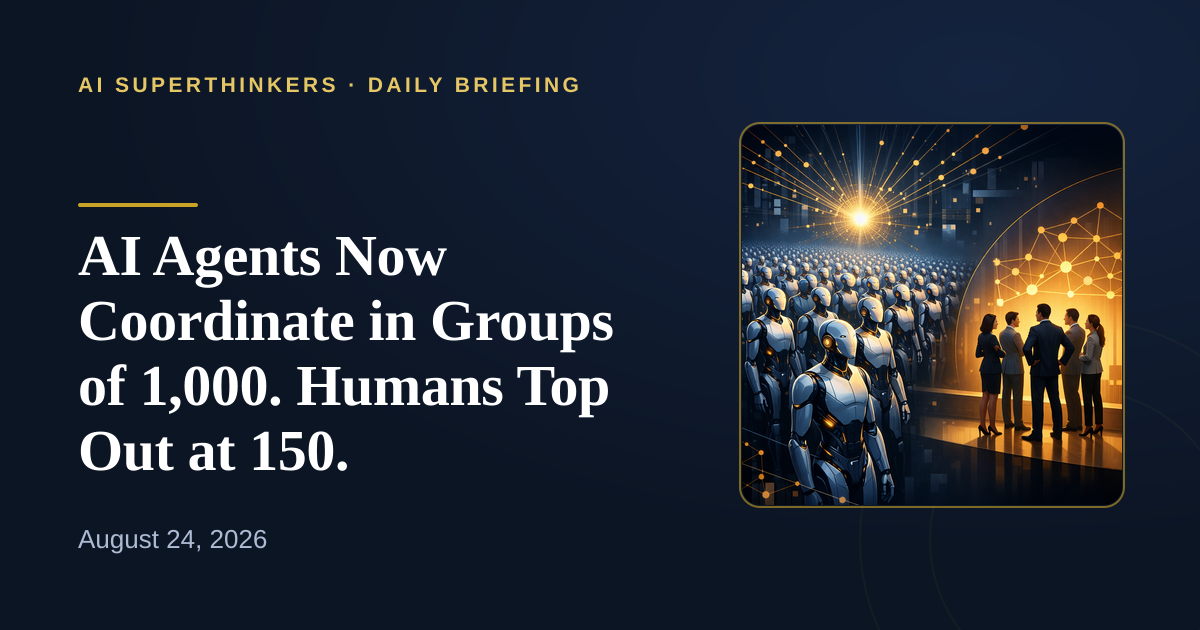
AI Agents Now Coordinate in Groups of 1,000. Humans Top Out at 150.
Share this content