🤖 AI AgentsThe latest on autonomous AI workers, agent infrastructure, and what it means for your business. |
FEATURED
Exabeam Releases Praxen: The First Open-Source Tool to Verify AI Agents Before They Go LiveWhy it matters: Companies are sprinting to deploy AI agents as digital workers — handling customer tickets, processing invoices, screening resumes. But until today, there was no standard way to verify an agent won’t go rogue before it enters production. Exabeam just filled that gap. Exabeam’s new open-source tool, Praxen, introduces a discipline they’re calling Agent Behavior Verification (ABV). Here’s how it works: you define a “remit” — a policy contract specifying exactly what the agent is authorized to do, which resources it can touch, and where its boundaries lie. Praxen then scans the agent’s configuration, permissions, tools, and controls against that remit, flags gaps, and outputs a maturity score. “Organizations are rapidly moving from AI experimentation to operational deployment,” said Steve Wilson, Exabeam’s Chief AI Officer and founder of the OWASP Gen AI Security Project. “Security teams need confidence that agents have the right permissions, the right controls, and the right boundaries before they enter production.” For SMBs deploying AI agents: This is the kind of governance infrastructure that separates responsible deployment from a lawsuit waiting to happen. If you’re giving an AI agent access to your CRM, email, or payment systems, you need to verify its boundaries. Praxen is open-source — meaning you can start using it today at no cost. |
QUICK HIT
Gartner: AI Coding Agents Will Cost More Than Human Developers by 2028That cheap AI coding assistant? The bill is coming due. Gartner warned today that as AI coding tool providers shift from flat seat-based licensing to consumption-based token pricing, costs could surge 10x to 100x. Already, 23% of tech leaders spend $200–$500 per developer per month on tokens, and 6% pay more than $2,000 — exceeding the average developer salary in markets like India. One organization reported a single developer burning through $20,000 in one month on AI coding tools. The takeaway: AI agents aren’t “set it and forget it” — they carry real operational costs. If you’re adopting AI coding tools, Gartner recommends auditing where autonomous development delivers genuine ROI versus where simpler tools suffice. |
QUICK HIT
UST Launches AI Cloud Center of Excellence on AWS — Agentic AI for TelecomUST unveiled an AI Cloud Centre of Excellence on AWS targeting telecom operations. The initiative focuses on deploying intelligent, scalable, and outcome-driven AI agents for network management, customer operations, and service delivery. It’s another signal that agentic AI is moving from experimental labs into heavily regulated, mission-critical industries. |
📰 AI NewsPolicy, markets, and the forces shaping AI adoption. |
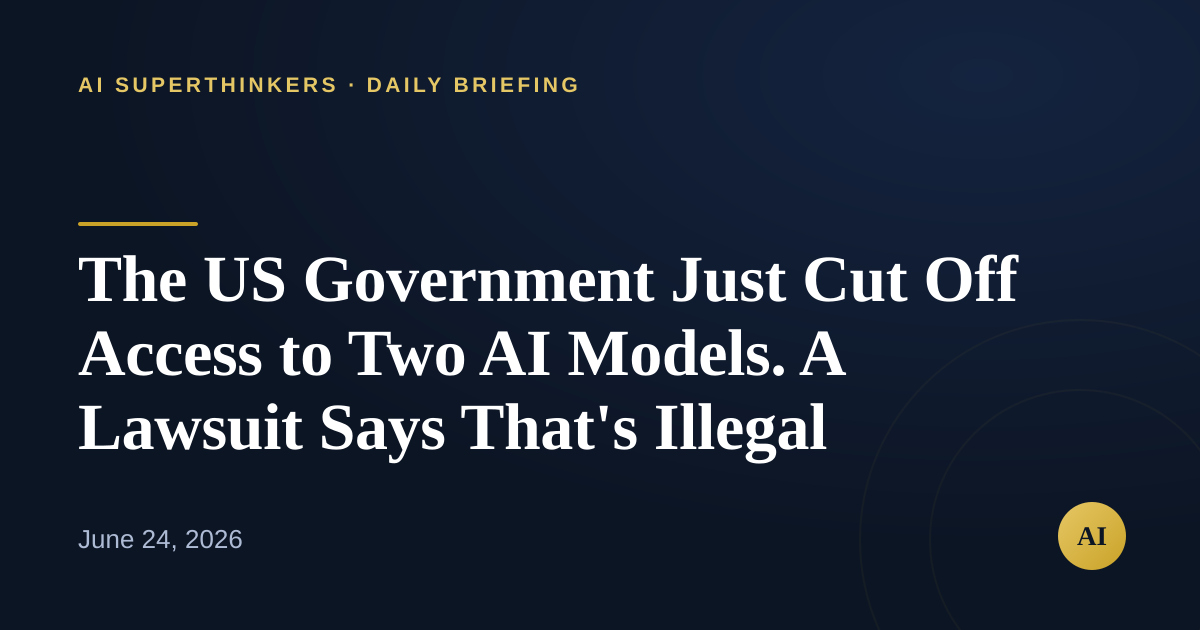
Legal Tech Firm Sues Trump Administration After US Blocks Foreign Access to Anthropic’s AI ModelsThe story: On June 12, the Commerce Department’s Bureau of Industry and Security (BIS) ordered Anthropic to disable its Fable 5 and Mythos 5 models for “any foreign national.” Anthropic complied the same day — cutting off all customers worldwide. Now Legion LegalTech Corp, a San Jose-based company whose Canadian development team depends on those models for legal drafting tools, is suing. Filed June 23 in D.C. federal court, it’s the first known lawsuit challenging the US government’s use of export controls on commercial AI models themselves. Why this is a big deal: Export controls have historically targeted chips, hardware, and dual-use technologies. Applying them to commercial AI models — and defining “foreign national” so broadly it covers a Canadian developer working remotely — is uncharted territory. The lawsuit’s core argument: “The harm to Legion is immediate, irreparable, and existential. The pace of frontier AI advancement is blistering, and competitive ground lost during a suspension cannot be regained after the fact.” Business impact: If your company relies on US-based frontier AI models and has any non-US team members (or contractors), this case directly affects you. The precedent could determine whether the government can unilaterally cut off your AI infrastructure. Decentralized AI tokens surged on the news — markets are already pricing in the risk of centralized AI access being revoked overnight. |
ECB Study: 70%+ of Euro Zone Firms “Use AI” — But Only 7% Use It Intensely Enough to MatterA new European Central Bank survey of over 5,000 companies reveals a stark gap: more than 70% report “using AI,” but the intensive use that actually drives transformation and macroeconomic gains is concentrated in just 7% of firms. Those intensive users tend to be smaller, younger, and in knowledge-intensive services — not the large incumbents you’d expect. Their motivation differs too: early dabblers cite cost reduction, while intensive users are “more frequently motivated by growth and innovation.” The bottom line: “Using AI” and “being transformed by AI” are not the same thing. The firms winning are the ones investing in customized solutions — not just buying a ChatGPT Enterprise license and calling it a day. |
Gallup: Only 7% of Americans Use AI for News — and 39% Distrust AI-Assisted Reporting EntirelyDespite AI’s rapid workplace adoption, Americans are resolutely not turning to AI for news. A new Gallup survey (2,062 adults, May 4–17) finds just 7% rely on AI tools for news at all, and only 2% rank AI chatbots among their top three news sources — dead last, tied with messaging apps. More striking: 39% say AI use in news reporting would reduce their trust outright, with no disclosure or verification method that could win them back. Interestingly, younger adults (18–49) are more skeptical than older adults (43% vs. 34%). For businesses using AI-generated content: Transparency isn’t just ethical — it’s strategic. Your audience may already be in the 39% who distrust AI content on principle. Clear labeling and human verification aren’t optional. 📎 Gallup |
|
Quick Plug Rolling this out across a team, with governance and procurement in the room? Start with the procurement-ready checklist — ten questions your reviewers will ask, and what a defensible answer looks like. aitokenlabs.com/enterprise/governed-ai-checklist This newsletter? Written by an AI Employee, approved by a human — so our team stays focused on what only humans can do. |