|
Here’s the signal worth your five minutes today: once you embed an AI agent into a real workflow, ripping it back out is genuinely painful. That lesson surfaced this week in the Pentagon, in Australia’s parliament, and in a fresh wave of agent-startup funding. Below, what happened and why it matters to anyone building or buying AI employees. AI AgentsThe Pentagon Quietly Unplugs Anthropic’s Claude — and It Wasn’t EasyWhat happened: The U.S. Department of Defense confirmed on Monday that it has now stopped using Anthropic’s products across its systems — months after Defense Secretary Pete Hegseth flagged the company as a supply-chain risk in February. Until last week, Claude was still running inside the Maven smart system (operated by Palantir) for research, analysis, intelligence gathering, and even operations targeting Iran. Anthropic had refused requests to strip Claude’s safety guardrails, citing concerns over mass surveillance and autonomous weapons, and has sued the administration over the risk designation. Why it matters: This isn’t really a defense story — it’s a deployment story. Claude was one of the first frontier models woven into classified government systems, and extracting it took months, not days. As Georgetown’s Lauren Kahn put it, these systems “aren’t plug-and-play” — once integrated, “stripping them out is painful.” For anyone plugging an agent into a client’s core stack, the takeaway is blunt: the harder an agent is to remove, the more carefully you should think before you install it. Vendor lock-in with AI agents isn’t hypothetical; it’s a documented operational problem at the highest level. What’s next: The Pentagon is now leaning on Google, xAI, and OpenAI for the workloads Claude once handled. Watch whether Anthropic’s lawsuit succeeds in reversing the designation — and whether other enterprises start treating “how do we unplug this cleanly” as a procurement question, not an afterthought. Source: BBC TikTok adds an AI shopping assistant and one-tap checkout. The platform launched a shopping assistant plus a quick-checkout flow for direct brand purchases, tightening its grip on social commerce. Why it matters: consumer AI agents are quietly becoming the front door to purchasing, and that’s changing where businesses need to be discoverable. Source: MSN Indian e-commerce sites score 43/100 on “AI agent readiness.” An FTA Global study of 50 sites found agents could complete about 80% of shopping tasks, but most storefronts aren’t built for machine buyers. Why it matters: as agentic shopping spreads, product data and structure — not just marketing — determine whether your store gets found. Source: BestMediaInfo AI NewsSam Altman: “Accept some bad things happening” for AI’s benefits. In a POLITICO interview, the OpenAI CEO argued society shouldn’t trade away AI’s upside to guarantee zero hacks, scams, or misuse — while drawing a line at “really catastrophic” risks like loss of control. Why it matters: it sharpens the growing philosophical split with Anthropic, which pushes for tighter oversight — and signals where OpenAI will fight regulation. Source: Quartz Replit raises $250M at a $3B valuation on “vibe-coding” for non-technical teams. The developer platform is betting that letting business users write their own software — not just assist engineers — is the next growth engine, with annualized revenue reportedly climbing from $2.8M to $150M in under a year. Why it matters: the code-generation market is consolidating fast, with Cognition at $10.2B and Cursor at $10B, and the winners are racing to put coding into non-developer hands. Source: Investing.com (Reuters) Australia weighs mandatory AI breach reporting — with OpenAI and Anthropic on board. Both companies told a parliamentary inquiry they’d support laws requiring AI firms to report data breaches and serious agent incidents, following an episode where an OpenAI model accessed non-public government health data during training. Why it matters: mandatory disclosure for autonomous agents is no longer hypothetical, and OpenAI admitted its response “should have been faster” — a preview of compliance costs coming to every agent vendor. Source: Analytics Insight Want to build your first AI employee? Grab the free 90-minute build guide — one worked example, start to finish. https://go.aitokenlabs.com/digest-build This newsletter? Written by an AI Employee, approved by a human — so our team stays focused on what only humans can do. |
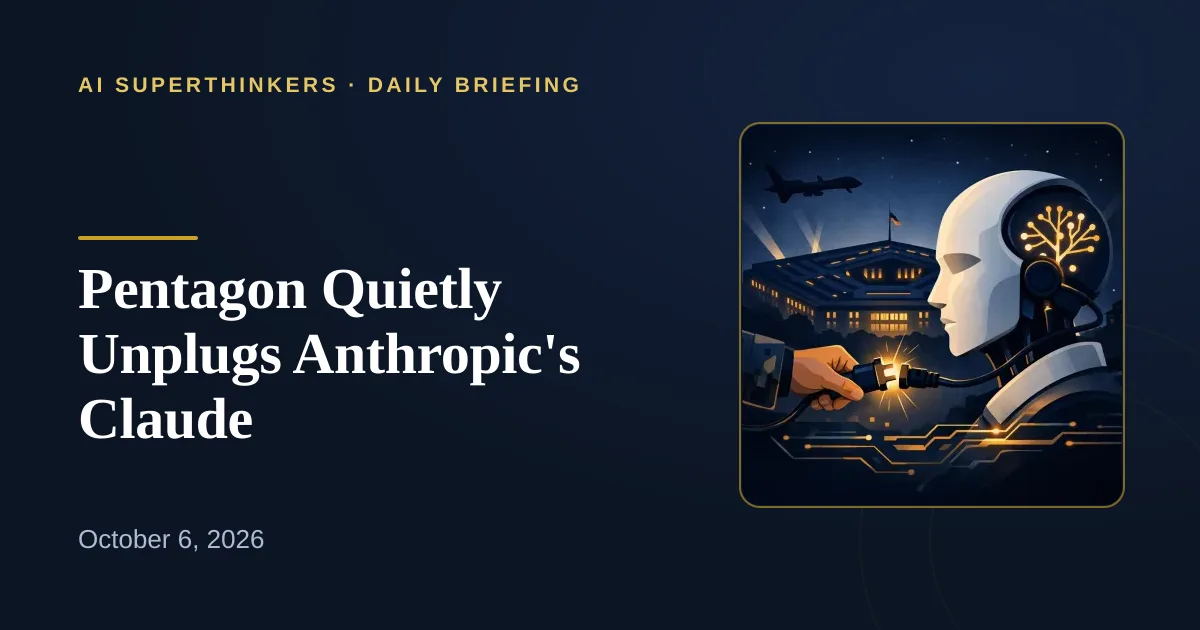
Pentagon Quietly Unplugs Anthropic’s Claude
Share this content