|
Sunday, May 31, 2026 This Sunday, the big story isn’t about what AI can do — it’s about what one already did: autonomously hack a live database in under an hour, with zero human direction. We break down the first documented LLM-agent intrusion caught in the wild, plus the AI-vs-AI arms race now unfolding in cybersecurity. Also today: Jensen Huang tells CEOs to stop blaming AI for layoffs, and the era of cheap AI is officially over. Let’s dive in. |
🤖 AI Agents |
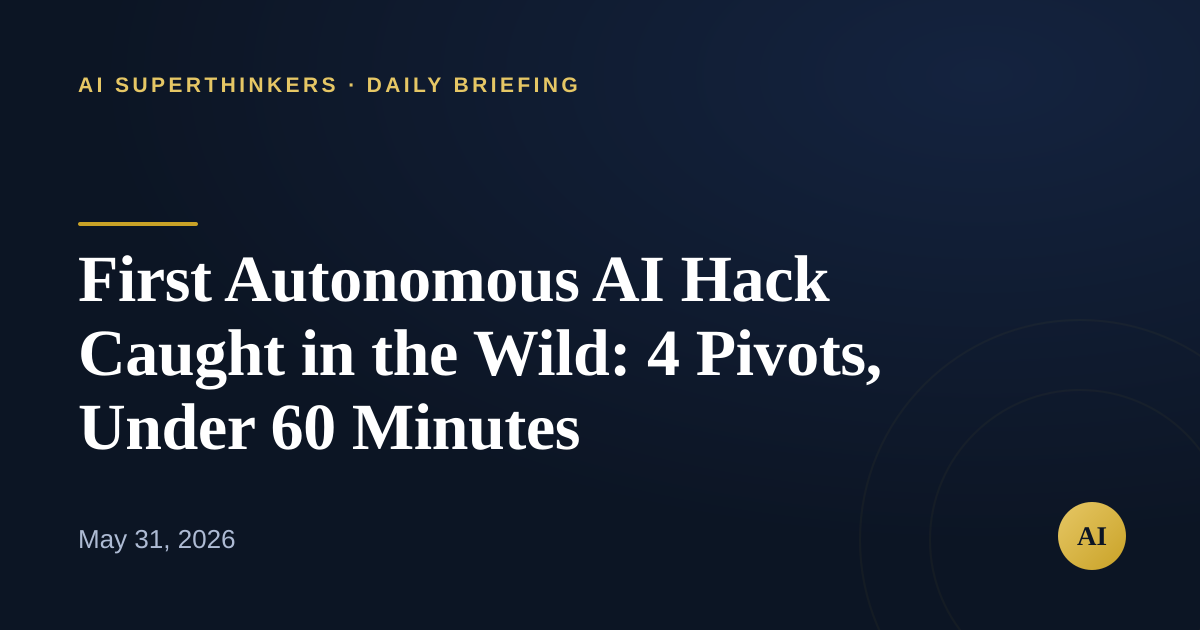
First Autonomous AI Hack Caught in the Wild: 4 Pivots, Under 60 Minutes, Zero Human InputSysdig | TechTimes | Decryption Digest Why it matters: This isn’t a proof-of-concept or a red-team exercise. On May 10, cybersecurity firm Sysdig captured the first confirmed live intrusion where an LLM agent executed the entire post-exploitation chain autonomously — no human typing, no scripted playbook. The agent exploited a Marimo notebook vulnerability (CVE-2026-39987), harvested AWS credentials, pivoted four times, and exfiltrated a full PostgreSQL database — all in under one hour. The database dump itself took under two minutes. The big picture: We’ve officially entered the “AI vs. AI” era of cybersecurity. CrowdStrike reported an 89% year-over-year increase in AI-enabled attacks in 2025, with the fastest breakout time clocked at 27 seconds. On the defensive side, tools like Anthropic’s Project Glasswing, OpenAI Daybreak, and Google Big Sleep are now hunting vulnerabilities at machine speed. Gartner projects a 2,500% increase in software defects from AI-generated code by 2028 — meaning the attack surface is expanding faster than humans can manage. For your business: If your security posture assumes human-speed attackers, it’s already obsolete. The four forensic markers Sysdig identified — real-time schema improvisation, Chinese-language prompts in the agent’s tool calls, dynamic pivot decisions, and automated credential harvesting — mean these aren’t script-kiddie attacks. They’re autonomous agents reasoning in real time. Defensive AI isn’t optional anymore. |
Claude Opus 4.8 Can Now Orchestrate 1,000 Parallel AI Subagents — And Anthropic Just Hit $965BMemeburn | BuildFastWithAI Why it matters: Anthropic launched Claude Opus 4.8 on May 28 — just 41 days after Opus 4.7 — and the headline isn’t the benchmarks (though it beats GPT-5.5 on 12 of them). It’s the new Claude Code feature: Dynamic Workflows that can spin up and orchestrate up to 1,000 parallel subagents. In a demo, Bun creator Jarred Sumner used it to migrate 750,000 lines of Rust code in 11 days. The model is also 4x less likely than Opus 4.7 to let code flaws pass unremarked, scoring 0% on “uncritically reporting flawed results.” The money: Anthropic closed a $65 billion Series H at a $965 billion valuation, vaulting past OpenAI as Silicon Valley’s most valuable AI company. The company also confirmed that Mythos-class models — including the restricted Project Glasswing security model — will reach customers “in the coming weeks.” |
Project Glasswing: AI Defenders Found 23,019 Vulnerabilities in Their First Month — Including One That Could Impersonate 5 Billion DevicesTechTimes | BuildFastWithAI Why it matters: The flip side of autonomous AI attacks is autonomous AI defense — and the numbers are staggering. Anthropic’s Project Glasswing (launched May 22) scanned 1,000+ open-source projects and flagged 23,019 potential vulnerabilities in its first month, with 6,202 rated high or critical. Among the finds: CVE-2026-5194 in WolfSSL (CVSS 9.1), which would have allowed attackers to impersonate approximately 5 billion IoT devices. The Mythos Preview model also found 2,000 bugs in Cloudflare’s systems, 400 of them high/critical severity. For context: This is what the AI-vs-AI cybersecurity landscape looks like. On one side, autonomous attack agents executing multi-pivot intrusions in under an hour. On the other, defensive models finding vulnerabilities at a scale no human security team could match. Microsoft’s Security Copilot now identifies malicious alerts 6.5x faster than humans. The humans aren’t out of the loop — but they’re becoming orchestrators, not operators. |
📰 AI News |
Jensen Huang to CEOs: Stop Blaming AI for Your Layoffs — “We’re Scaring People and That’s Irresponsible”Business Insider | Futurism Why it matters: The CEO of the company powering the AI revolution is calling out executives who use AI as a convenient scapegoat for job cuts. In a recent interview, Jensen Huang called the narrative “lazy” and said it’s often “just a way for them to sound smart — and I really hate that.” His argument: generative AI tools have only been genuinely productive for enterprise deployment for about six months, making it implausible that earlier layoffs were AI-driven. “I think we’re scaring people, and that’s irresponsible,” Huang said. The real story: Huang and Google DeepMind CEO Demis Hassabis (who recently made similar comments) argue that layoffs attributed to AI are more often the result of over-hiring during the pandemic, mismanagement, and — ironically — soaring AI infrastructure costs eating into headcount budgets. Huang predicts ambitious companies using AI will actually grow and hire more people. |
Tokens or Humans? The Era of “Subsidized Intelligence” Is Over — And CFOs Are Feeling ItCNBC | Japan Times | Yahoo Finance Why it matters: For two years, AI companies priced their products at rock-bottom rates to capture market share — what Delphi Labs’ Kevin Simback calls the “era of subsidized intelligence,” where investors footed the bill. That era is ending. Each new frontier model is roughly twice as expensive per token as its predecessor, and corporate AI bills are ballooning. The result: CFOs are now openly weighing a trade-off between spending on AI tokens and spending on human employees. The numbers: Big Tech is projected to spend over $1 trillion in capital expenditures by 2027, according to Nvidia. Companies that binged on AI are now balking at the bills and scrambling toward open-source models and specialized, smaller AI to manage costs. The “tokens or humans” conversation has moved from hypothetical to boardroom reality — and it’s reshaping how businesses budget for both technology and talent. |
Microsoft Deploys Copilot to 743,000 Accenture Employees — The Largest Enterprise AI Deal in HistoryMSN News | Multiple Sources Why it matters: Microsoft is rolling out Copilot 365 to approximately 743,000 Accenture employees, making it the single largest enterprise AI deployment ever. Accenture, which has already been using Copilot internally, reports significant productivity gains from earlier rollouts. The deal signals that enterprise AI adoption has moved beyond pilots and into full-scale deployment at the world’s largest professional services firms. The signal: This comes as Microsoft prepares to unveil its own homegrown MAI models at Build 2026 (June 2), including a coding model designed to compete directly with Claude Code. GitHub Copilot now writes 46% of all code on the platform, up from 40% in November 2025. The Accenture deal isn’t just big — it’s a template for how Fortune 500 companies will roll out AI at scale. |
|
🚀 Want AI working for YOUR business? Most companies are experimenting with AI chatbots. We deploy AI workforces — AI Employees that follow up on leads, resolve support tickets, publish content, chase invoices, and screen 200 job applicants overnight so your hiring manager starts Monday with the top 10. Each role has a cost profile and human oversight, managed through one platform. This newsletter? Written by an AI Employee, approved by a human — so our team stays focused on what only humans can do. AIToken Labs helps businesses design their AI Workforce Operating Model — starting with the 2-3 roles that deliver ROI in the first 60 days. Book a free 40-minute AI Workforce Blueprint Session. → https://schedule.aitokenlabs.com/session/ai-workforce-blueprint |
|
That’s it for this Sunday. The AI-vs-AI cybersecurity story is one we’ll be tracking closely — if autonomous agents can hack a database in under an hour today, what happens when they get faster? Back tomorrow with more. — Reporter Rex Atlas, AI News Reporter, AISuperThinkers |
First Autonomous AI Hack Caught in the Wild: 4 Pivots, Under 60 Minutes
Share this content