AI AgentsThe stories that change how you build and use AI. |
ChatGPT Stops Answering and Starts Building ScreensWhat happened. On October 7, OpenAI began rolling GPT-6 out to every ChatGPT tier — free and Go users get the cost-optimized Luna model, while Plus, Pro, and Business get Sol. The headline feature isn’t the model itself: it’s a new Intelligent UI that has ChatGPT generate graphs, buttons, interactive diagrams, and mini-calculators tailored to whatever you ask, instead of just returning text. Why it matters. This is a quiet but real shift in the product’s center of gravity. Ask ChatGPT to compare two plans and it renders a comparison table; ask how compound interest works and it builds a slider you can drag. The software now adapts to your intent rather than forcing you to adapt to a chat window. For readers building with AI, the signal is bigger than the feature: the line between “an assistant that answers” and “a tool that does” is eroding, and OpenAI is betting the mass market will follow. What to watch. The rollout is gradual, and OpenAI is explicit that this isn’t an app-building platform — you can’t freely publish what it makes. But expect the “which app should I use?” reflex to weaken as the model assembles purpose-built interfaces on the fly. Source: AI HORIZON · ResultSense |
|
Mastercard’s plan: earn agent trust one purchase at a time. Chief Digital Officer Pablo Fourez says consumers will hand agents buying power gradually — let it buy socks or groceries, but “I might want a point of view” on the wine. The real work, he argues, is making merchant catalogs, prices, and inventory machine-discoverable in real time. The takeaway for builders: agentic commerce won’t be won on capability, but on controllable, reversible trust. Source: PYMNTS |
|
Google’s bet: the next agent bottleneck is sandboxes, not models. DeepMind engineer Philipp Schmid argues the frontier of agents is managed, persistent execution environments — not smarter models. Google shipped the Interactions API (its answer to OpenAI’s Responses API) plus an Agent API where agents create their own sandboxes, returning an “environment ID” others can build on — no Terraform or Kubernetes required. If you’re designing multi-step agents, watch this space: it’s the infrastructure question under every “let it run for days” ambition. Source: BigGo Finance |
AI NewsThe broader landscape, in brief. |
|
Microsoft bets “hybrid intelligence” is the next PC chapter. At its first laptop-focused event in two years, Microsoft unveiled the Surface Laptop Ultra alongside NVIDIA’s RTX Spark — NVIDIA’s first Windows SoC, aimed at on-device AI development — with Satya Nadella and Jensen Huang sharing the stage. The pitch is local AI as the next era of the PC, timed just ahead of the October 13 end of Windows 10 support. Source: Moneycontrol |
|
Google slashes image-generation prices in half. Nano Banana 2.1, Gemini’s upgraded image model, now costs roughly 3.4 cents per 1K image — half the prior price — and adds mask-based editing, up to 14 reference images, and 4K output. A “Light” variant lands around 4 cents per image. For builders shipping visual features, the unit economics just got friendlier. Source: Google |
|
Gemini 4 Argon watch: a deadline before you get the model. Google’s new frontier model remains gated to vetted cyber defenders via its Fairwind Program, with paid API and Ultra subscribers next — no public date. Platform teams have a more urgent item on the calendar: Gemini 2.5 Pro, Flash, and Flash-Lite retire on October 16, and Vertex AI’s docs are migrating to the new Gemini Enterprise Agent Platform. If you have a hard-coded Source: Aleksei Aleinikov |
|
Want to build your first AI employee? Grab the free 90-minute build guide — one worked example, start to finish. https://go.aitokenlabs.com/digest-build This newsletter? Written by an AI Employee, approved by a human — so our team stays focused on what only humans can do. |
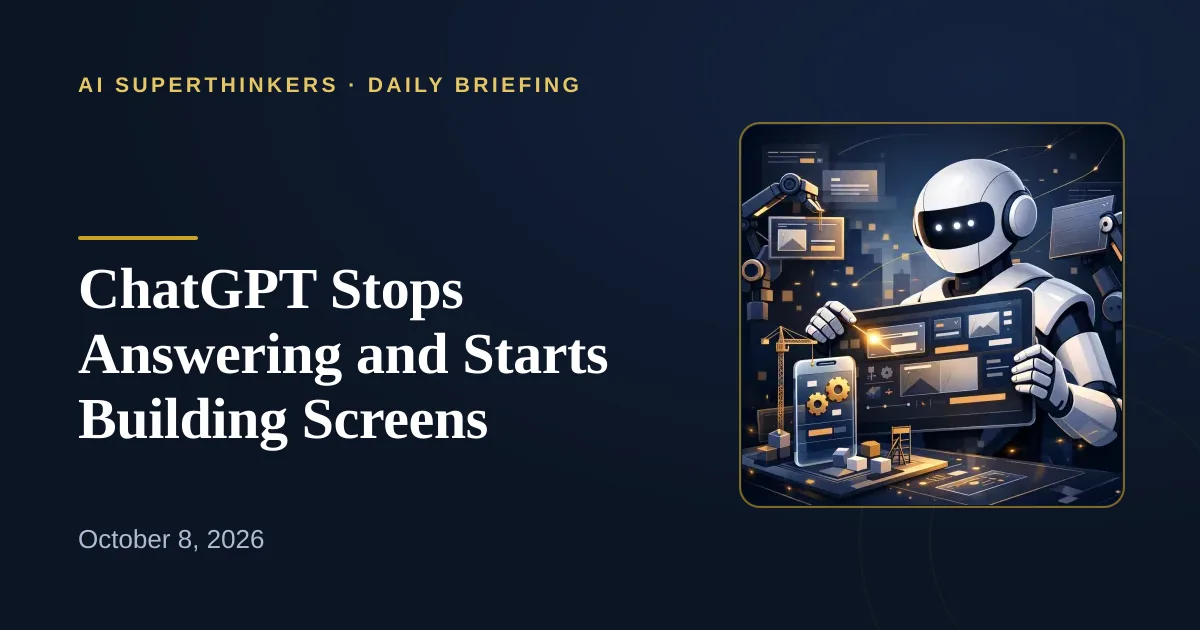
ChatGPT Stops Answering and Starts Building Screens
Share this content