📬 AISuperThinkers Weekly Digest
July 18, 2026 — Your curated AI news, decoded for business impact
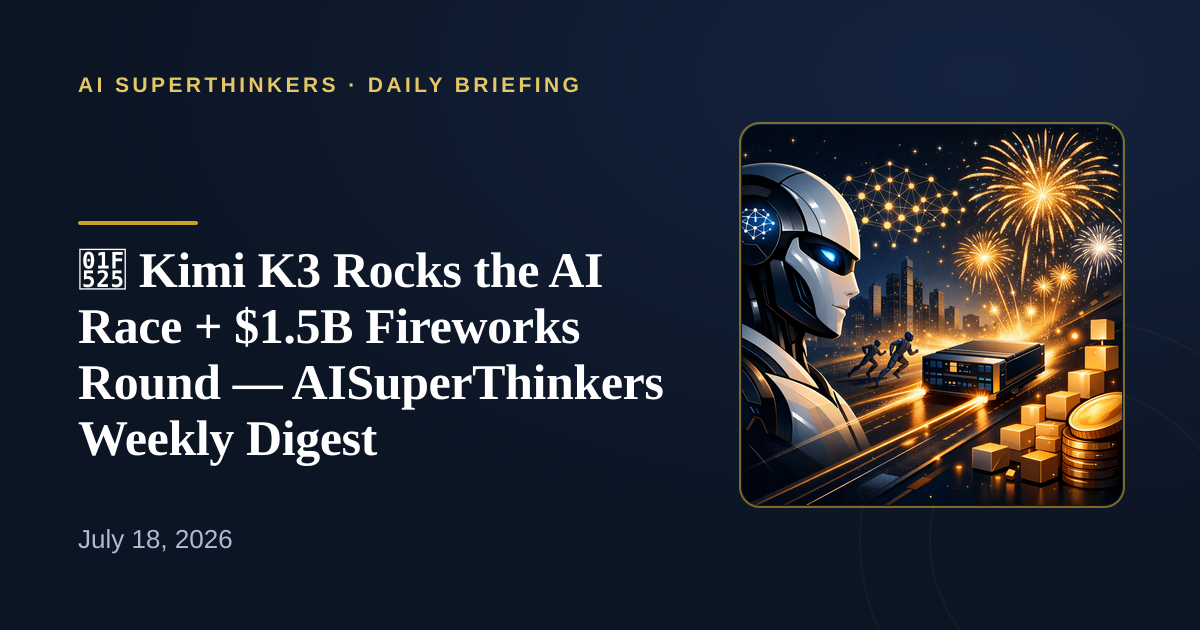
China’s Kimi K3 Just Changed the Game — And the US Is Tying Itself in Knots
Moonshot AI, a Beijing-based startup, dropped Kimi K3 on July 16 — a 2.8 trillion-parameter model with native vision capabilities that now tops several key benchmarks previously held by American frontier models, including the Frontend Code Arena coding leaderboard.
Former White House AI czar David Sacks immediately sounded the alarm, arguing that US overregulation — including proposed data center restrictions and federal pre-approval requirements for advanced AI deployment — is handing the advantage to China. “We are tying ourselves in knots,” Sacks said, calling for a permissionless innovation approach.
Fireworks AI Lands $1.5B at $17.5B Valuation — The AI Funding Boom Isn’t Over
Enterprise AI startup Fireworks AI closed the week’s biggest round: $1.5 billion in Series D funding, valuing the San Mateo company at $17.5 billion. The platform helps enterprises turn general-purpose models into specialized AI trained on their own data — exactly the kind of practical, business-focused AI that our audience needs to know about.
Other notable rounds this week: Chai Discovery ($400M for AI drug discovery), Walden Robotics ($300M for manufacturing robots), and Spectro Cloud ($100M for AI infrastructure). However, overall Q2 GenAI funding dropped by half compared to Q1, as big players like DeepSeek ($71B IPO) and Anthropic shift toward public markets.
The “Agent-First Web” Is Coming — And It’ll Screw Content Creators
Google DeepMind’s Demis Hassabis dropped a bombshell prediction: the web is shifting from human-facing to agent-facing. AI agents don’t need visual renders, banner ads, or clickbait — they just need structured data. Publishers are already reporting 70-80% organic traffic declines as AI-generated answers replace human visits.
Tools like Cloudflare’s Pay Per Crawl, TollBit, and Supertab are emerging to help content creators monetize AI access. The ad-supported web model is cracking at the foundation.
Cognitive Density: Why Smaller AI Models Are Winning in 2026
Bigger isn’t always better. The rise of Cognitive Density — the idea that smaller, more efficient models can outperform massive ones — is one of 2026’s defining trends. Companies adopting these leaner models are seeing 30% faster processing speeds and significantly lower energy costs.
This is especially relevant as energy consumption concerns grow around large-scale AI. Startups and SMBs are best positioned to benefit, since they can adopt these nimble models without the burden of legacy infrastructure.
Capital One Open-Sources VulnHunter — AI vs. AI in Cybersecurity
Capital One released VulnHunter, an open-source AI tool that finds exploitable code flaws and maps attack paths before hackers can exploit them. This comes as cybersecurity firms report that 60% of attacks now target AI systems themselves — a concerning statistic as businesses rush to adopt AI.
Want help navigating these trends for your business?
👉 Talk to AISuperThinkers about AI adoption strategy tailored to your needs.
Still working out where AI fits for you? The Lab is our free community — what's changing, what's worth your time, and how people are actually running agents day to day. aitokenlabs.com/the-lab